
Car Phone Holder Wholesale: The Position Is the Rule
 ·
Updated October 16, 2026
·
10 min read
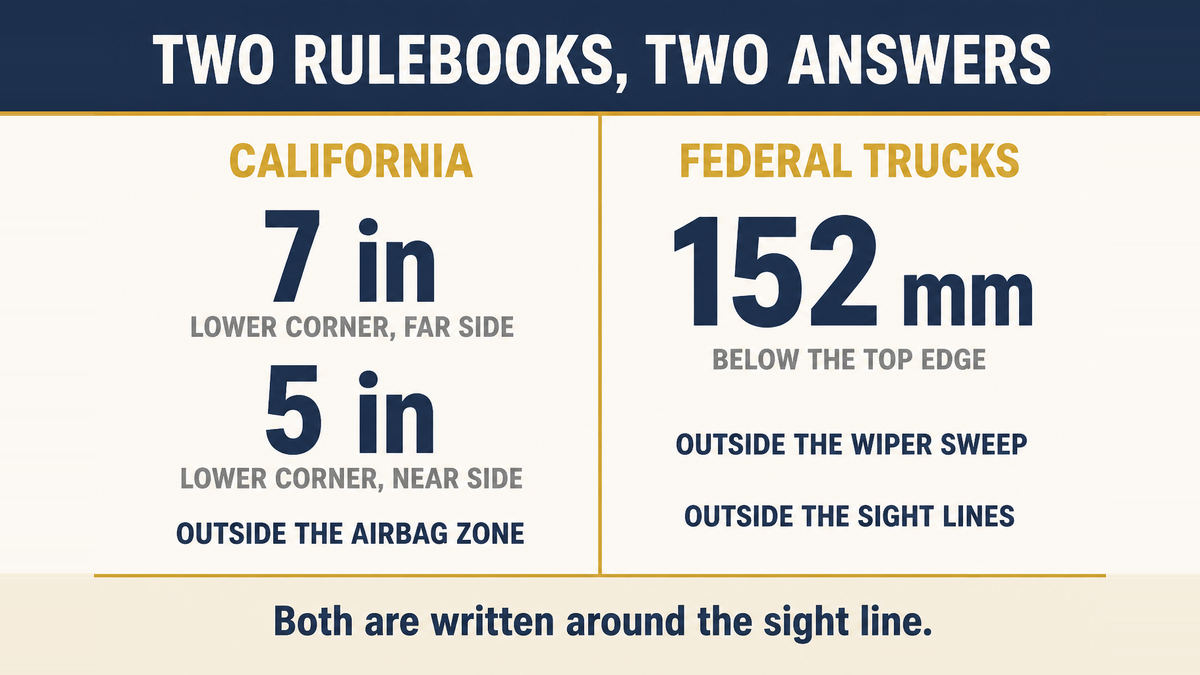
Every product in this series so far has been judged as a component of a vehicle. This one has no such judgement to offer, and that is the finding. There is no safety standard for a phone holder. The bracket, the suction cup and the magnet are not in any rulebook. What is written down is where the holder may put the phone, and it is written as an exception to a ban. In California Vehicle Code 26708 the default position is that no object may be placed on the windscreen at all, and a mounted device exists in one of two small squares cut out of that ban. In the federal rules for commercial vehicles the answer is completely different: 152 mm below the top edge of the windscreen, outside the wiper sweep. Two rulebooks, two opposite answers, one product.
1. What the Product Is, and Why Nothing Governs It
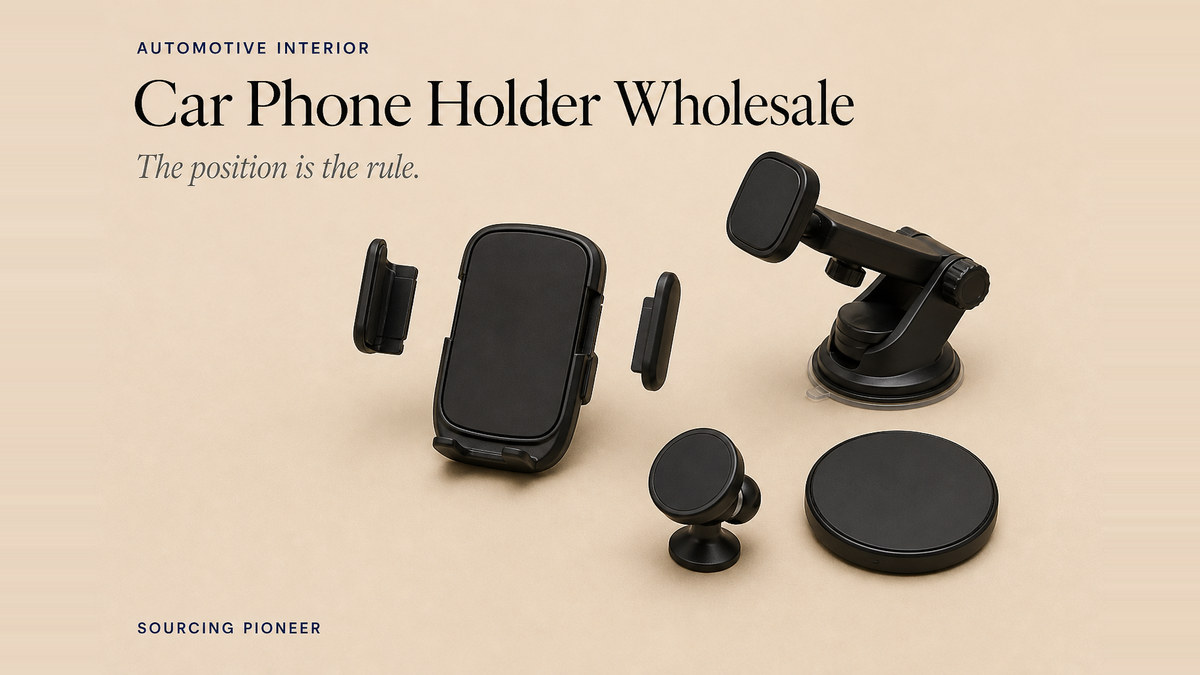
A car phone holder has three parts and only one of them is interesting. The cradle grips the phone. The coupling attaches the cradle to the vehicle. The coil, if there is one, charges the phone. The cradle is a shape the buyer can see and touch, and it is the part every quotation describes. The coil is a feature. The coupling is the product.
The reason the coupling matters is that the coupling is what decides where the phone ends up, and where the phone ends up is the only thing any rulebook has an opinion about. A suction cup can only attach to glass. An adhesive pad can attach to glass or to a dashboard. A vent clip needs a louvre and a louvre that will take the weight. A magnet needs a ferrous surface or a plate that is itself adhered. A clamp needs a cup holder aperture or a vent edge.
| Part | What it decides | Which regime sees it |
|---|---|---|
| The cradle | Whether the phone is held still enough to be tapped once | Traffic law, indirectly, through the word mounted |
| The coupling | Where on the vehicle the phone can be placed at all | Traffic law, and the federal rule for commercial vehicles |
| The surface it grips | Whether the coupling holds, and what it damages | Nobody, in any published rule |
| The coil, if any | Whether the holder works without a cable | Its own separate rules, outside this article |
| The screen the phone shows | Whether the driver may look at it at all | A third rule, on the display rather than the holder |
What this guide covers
- What the product is, and why nothing governs it
- The windscreen is closed by default
- California’s answer: two squares and an airbag zone
- The phone is tied to the windscreen paragraph
- The federal truck answer: six inches from the top
- One swipe or tap
- The screen has its own rule
- What the record says: the phone as an interference source
- Cradle, holder, suction: what the file means
- Five questions a quote should answer
- Six checks before you order
- Frequently asked questions
2. The Windscreen Is Closed by Default
The sentence that governs this product in California is a prohibition, not a permission.
“A person shall not drive any motor vehicle with any object or material placed, displayed, installed, affixed, or applied upon the windshield or side or rear windows.” — Vehicle Code 26708(a)(1)
Read that as a buyer and the shape of the problem is immediate. A mount stuck to the glass is an object affixed to the windscreen. What makes it lawful is not a rule about holders; it is a list of exceptions to that ban. The second paragraph of the same section goes further and bans any object that obstructs or reduces the driver’s clear view through the windscreen or side windows, whether or not it touches the glass. So a dashboard mount that leans into the sight line is outside the law even though it never touches the windscreen.
The exception list is long and mostly about other things: rear-view mirrors, sun visors that are not attached to the glass, rear window wipers, trunk hinges. Two entries matter here, and both are about a device rather than a fitting.
The first is an electronic communication device affixed to the centre uppermost portion of the windscreen interior, inside an area not greater than five inches square — but only if it lets enforcement or toll facilities talk to the vehicle. That is a transponder, not a phone.
The second is the one the trade sells against. Paragraph (12) allows a portable positioning system, and it specifies exactly where:
“A portable Global Positioning System (GPS), which may be mounted in a seven-inch square in the lower corner of the windshield farthest removed from the driver or in a five-inch square in the lower corner of the windshield nearest to the driver and outside of an airbag deployment zone, if the system is used only for door-to-door navigation while the motor vehicle is being operated.” — Vehicle Code 26708(b)(12)
Three things in that sentence are worth a line on a drawing. The area is a square, not a strip, and it sits in a corner rather than across the bottom. The near-side square is smaller than the far-side one. And the mount must be outside an airbag deployment zone, which is the only place in the whole section where the words airbag appear.
3. California’s Answer: Two Squares and an Airbag Zone
The geometry that a supplier has to hit is therefore small and specific, and it is easier to describe as a set of prohibitions than as a set of allowances.
- Not the centre of the windscreen. The five-inch centre-uppermost square exists, but only for a toll or enforcement transponder. A phone holder in that position has no exception behind it.
- Not the upper corners. Both permitted squares are in the lower corners.
- Not across the bottom. The allowance is a square in a corner, not a band along the base of the glass.
- Not over an airbag. The near-side square carries an express condition that the mount be outside a deployment zone.
- Not into the sight line. The obstruction ban in 26708(a)(2) applies independently of the squares.
For a supplier this converts into a design constraint that is easy to state and hard to satisfy: the coupling determines the corner, and the corner determines the square. A suction cup on a long arm is aimed at the middle of the windscreen because that is where a driver wants the screen. That is precisely where the exception does not reach. A vent-clip mount puts the phone in the centre of the dashboard and depends on the obstruction clause rather than on the square, which is a weaker position because it is judged by an officer rather than by a measurement.
None of this is a product requirement in the ordinary sense. Nothing has to be certified. The holder is not inspected, not marked, and not tested. What the law regulates is the result, and the result is decided by whoever fits it — which is the customer, in a driveway, with no tape measure.
4. The Phone Is Tied to the Windscreen Paragraph
There is one sentence in California law that speaks about a phone in a holder, and it is the sentence that makes a hands-free rule workable. The state bans holding a phone while driving, with a narrow allowance.
“A person shall not drive a motor vehicle while holding and operating a handheld wireless telephone or an electronic wireless communications device unless the wireless telephone or electronic wireless communications device is specifically designed and configured to allow voice-operated and hands-free operation, and it is used in that manner while driving.” — Vehicle Code 23123.5(a)
The section then allows a hand to touch the device in two conditions, and the first of them is the one that reaches the product:
“The handheld wireless telephone or electronic wireless communications device is mounted on a vehicle’s windshield in the same manner a portable Global Positioning System (GPS) is mounted pursuant to paragraph (12) of subdivision (b) of Section 26708 or is mounted on or affixed to a vehicle’s dashboard or center console in a manner that does not hinder the driver’s view of the road.” — Vehicle Code 23123.5(c)(1)
Two consequences follow, and both belong on a quotation.
A phone holder on the windscreen is governed by the navigation-device paragraph. The cross-reference is to paragraph (12) as a whole, and that paragraph carries the seven-inch and five-inch squares and the airbag deployment zone condition with it. There is no separate mounting rule for phones on glass; the phone borrows the navigator’s geometry.
A dashboard or centre console mount is judged by a different and vaguer test — whether it hinders the driver’s view of the road. That is not a dimension and cannot be drawn on a specification sheet. It is the reason a holder sold into this market needs an instruction sheet that tells the customer where to put it, because the standard the customer has to meet is a judgement rather than a measurement.
The penalty is worth quoting because it is small and it lands on the driver, not on the seller: a base fine of twenty dollars for a first offence and fifty dollars for each one after.
5. The Federal Truck Answer: Six Inches from the Top
The same product sold against a commercial vehicle meets a completely different rule, and it is a federal one. Where California cuts two squares out of the lower corners of the glass, the federal motor carrier rules allow an interior-mounted device near the top edge — as long as it keeps out of the wiper sweep.
“Antennas, and similar devices must not be mounted more than 152 mm (6 inches) below the upper edge of the windshield. These devices must be located outside the area swept by the windshield wipers, and outside the driver’s sight lines to the road and highway signs and signals.” — 49 CFR 393.60(e)(1)(i)
The same paragraph then gives a second, roomier allowance for equipment that qualifies as a vehicle safety technology: not more than 216 mm (8.5 inches) below the upper edge of the area swept by the wipers, not more than 175 mm (7 inches) above the lower edge of that area, and outside the driver’s sight lines. A dash camera or a driver-monitoring device sits in that paragraph. A phone holder does not.
Put the two regimes side by side and the sourcing problem is clear. A product with one recommended position cannot be sold into both markets, because the two rulebooks do not agree on where that position is.
| Question | California, passenger car | Federal, commercial vehicle |
|---|---|---|
| Which edge? | The lower corners only | The upper edge, within 152 mm |
| Which zonal shape? | A seven-inch square far side, a five-inch square near side | A band measured down from the top of the glass |
| What else is excluded? | The airbag deployment zone, and the driver’s clear view | The wiper sweep, and the driver’s sight lines |
| Which side of the glass? | On the glass, or on the dashboard | On the interior of the windscreen |
| Who is judged? | The driver, by an officer | The operator, at inspection |
The one thing the two regimes share is the drafting habit that makes them hard to sell against: both write the rule around the sight line rather than around the device. California says the mount must not reduce the driver’s clear view; the federal rule says it must be outside the sight lines to the road and to signs and signals. Neither gives a dimension for that. A supplier asked to certify a holder would have to certify a position on a windscreen it has never seen, in a vehicle it does not have.
6. One Swipe or Tap
The second condition in the phone section is the only sentence in these rulebooks that reads like a specification.
“The driver’s hand is used to activate or deactivate a feature or function of the handheld wireless telephone or wireless communications device with the motion of a single swipe or tap of the driver’s finger.” — Vehicle Code 23123.5(c)(2)
Two words in that sentence are a design brief. Single rules out a mount that needs to be steadied before it can be touched, because the second hand movement is the one that turns a lawful tap into an unlawful operation. Swipe or tap rules out a cradle so tight that the phone has to be worked out of it to be used, because then the device is being held and not mounted.
This is where a cheap holder fails in a way that no photograph shows. A spring-loaded clamp with a strong grip holds the phone perfectly and releases it with two hands. A magnetic mount holds a phone well and lets it rotate under a thumb, so a tap becomes a tap plus a reposition. A vent clip puts the screen on the end of a lever whose other end is a plastic louvre, and every tap pushes the whole assembly. The phone is held in all three cases. Only in none of them is the single tap free.
The reason the distinction is worth a section is the size of the thing it is meant to prevent. NHTSA records 3,208 deaths in motor vehicle crashes involving distracted drivers in 2024, and 315,167 people injured in the same year. Its own comparison is the useful one for a product discussion: reading or sending a text takes a driver’s eyes off the road for five seconds, which at 55 mph is the length of a football field. A mount that makes one tap possible is not a convenience feature. It is the part that decides whether the phone is used the way the statute allows.
7. The Screen Has Its Own Rule
There is a third rule, and it does not govern the holder at all. It governs what the phone is showing while the holder holds it.
“A person shall not drive a motor vehicle if a television receiver, a video monitor, or a television or video screen, or any other similar means of visually displaying a television broadcast or video signal that produces entertainment or business applications, is operating and is located in the motor vehicle at a point forward of the back of the driver’s seat, or is operating and the monitor, screen, or display is visible to the driver while driving the motor vehicle.” — Vehicle Code 27602(a)
The exception list is what a phone holder is sold against: a vehicle information display, a global positioning display, a mapping display, and a visual display used to enhance or supplement the driver’s view of the road. Anything else — a video, a stream, an application that produces entertainment or business content — is caught by subdivision (a) the moment it is visible to the driver, in a holder, forward of the back of the seat.
So the holder and the display are two different questions with two different answers, and a quotation should separate them. The holder is legal if the position is legal. The content is legal if it is a map. A supplier cannot promise the second and should not try. What a supplier can do is what the section rewards: sell a cradle whose natural position produces a map and not a movie, and print the difference on the insert.
For the commercial vehicle case there is one more reference worth knowing, because it shows the same division. The federal glazing rule requires that a commercial windscreen be free of discoloration or damage in the area above the top of the steering wheel, excluding a 51 mm (2 inch) border at the top and a 25 mm (1 inch) border at each side — and it lets required stickers sit at the bottom or sides, not more than 115 mm (4.5 inches) up from the bottom of the glass, outside the wiper sweep and outside the sight lines. Two rulebooks, written by two agencies, both working in millimetres, and neither of them mentioning the holder.
8. What the Record Says: The Phone as an Interference Source
Method first, because the numbers below are counts and not impressions. The federal recall file holds 245,845 records and no header row, so every field of every record is scanned rather than trusting a column map. Controls: brake appears in 28,639 records and air bag in 16,162. Every term is word-boundary matched and every figure is a de-duplicated record count.
| Term | Records | Campaigns |
|---|---|---|
phone | 186 | 36 |
cell phone | 11 | 2 |
cellphone | 0 | 0 |
mobile phone | 0 | 0 |
smartphone | 0 | 0 |
hands-free | 2 | 1 |
hands free | 6 | 2 |
handheld | 368 | 18 |
suction cup | 0 | 0 |
wireless charging | 0 | 0 |
wireless charger | 0 | 0 |
Six more zeros, and they are the six words the trade would use to describe this product. Smartphone does not appear in 245,845 records. Neither does cellphone, mobile phone, suction cup, wireless charging or wireless charger. The file's handheld records, 368 of them across 18 campaigns, are handheld fire extinguishers — the largest of them a Kiddie disposable unit on Western Star trucks, campaign 15V182000.
What the file does contain is more useful than an absence. A phone in a cabin appears twice, and neither time as a product to be held.
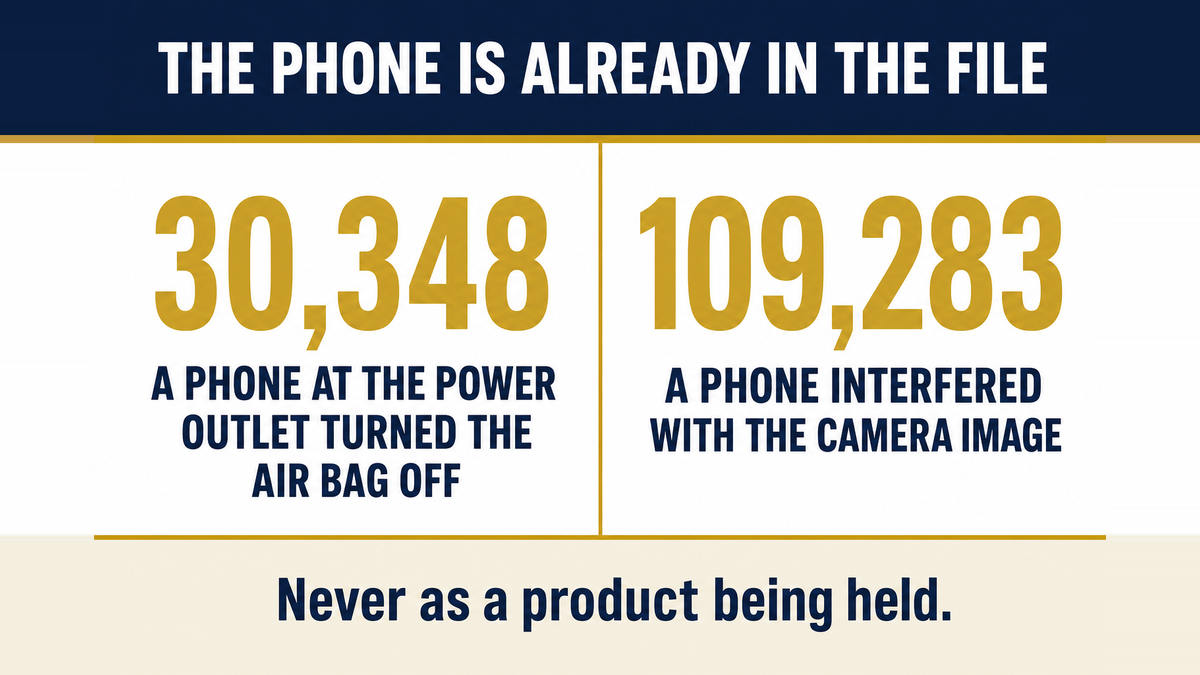
- Subaru Impreza, campaign 15V419000, 30,348 vehicles: the occupant detection system may switch off if a front seat passenger operates a device that is plugged into the power outlet such as a music player or cell phone. If it switches off, the front passenger air bag is turned off. This is an air bag campaign, and the phone is the trigger.
- Lincoln Aviator, campaign 24V368000, 109,283 vehicles: the image module can be affected by electromagnetic interference with a cell phone in the vehicle, causing the rear-view camera image to flicker or become distorted.
Read those two together and the finding is not that phone holders are dangerous. It is narrower and more interesting: the vehicle already has views about a phone in the cabin, and not one of them is about holding it. One of them is about the phone interfering with a sensor that decides whether an air bag fires. The other is about the phone interfering with a camera image. In both cases the phone is loose, unheld, and simply present — which is a description of the risk a holder is supposed to reduce.
Nothing in the file is about a holder. That is not because holders are safe and not because the file disagrees with the law; it is because the recall system records defects in vehicles as manufactured, and a holder is added afterwards by an owner. The product sits outside the system by construction, in exactly the way the air freshener in the previous article did.
9. Cradle, Holder, Suction: What the File Means
One more set of counts completes the picture, because the words this trade uses for its own parts are already in the file with completely different jobs.
| Term | Records | Campaigns | What it names in the file |
|---|---|---|---|
cradle | 151 | 17 | The structure an engine or a suspension sits in, and the bracket a bicycle or a kayak rests on |
holder | 600 | 68 | A fuse holder, in every sampled case |
suction | 79 | 12 | Vacuum — a suction hose, a suction pump, a suction jet, a suction strainer |
cup holder | 2 | 1 | A part of a child restraint seat |
windshield | 4,427 | 235 | The glass and the wiper |
mounting | 8,162 | 724 | Everything |
bracket | 5,865 | 647 | Everything |
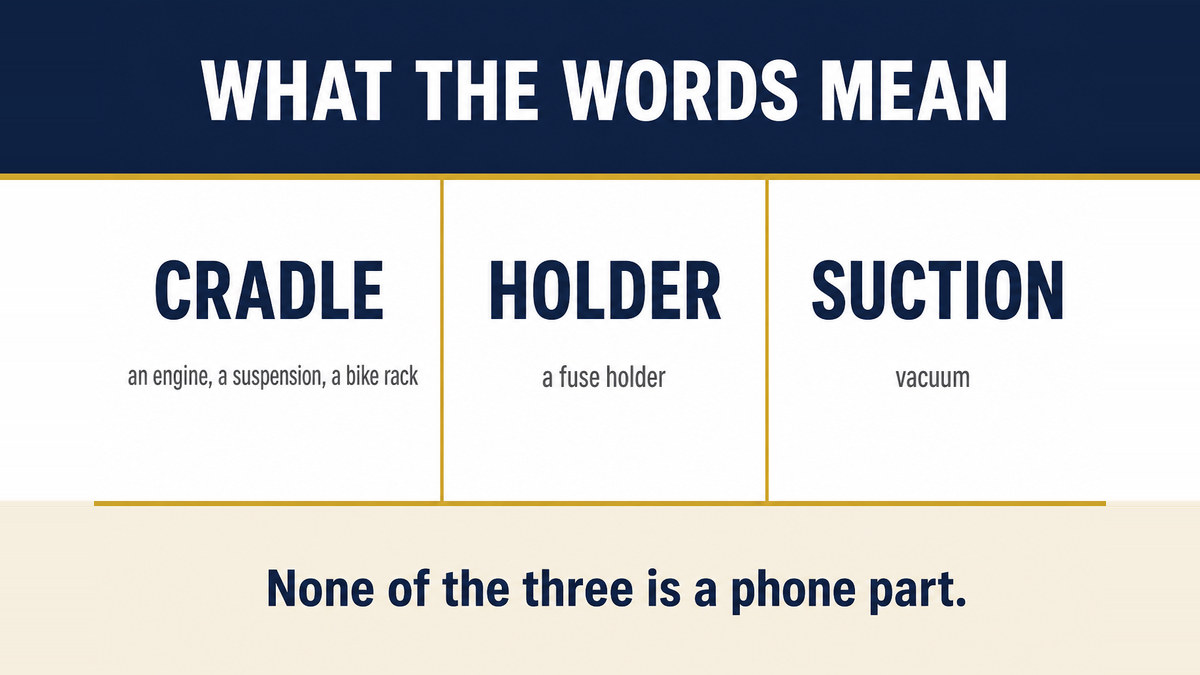
Neither cradle nor holder is a phone part in this file. A suspension cradle is the frame the front suspension bolts to — campaign 10V210000 is a case where the bell crank support brackets bolted to it could crack or separate from the main structure. An engine cradle holds the engine. A bike rack cradle is the hook a bicycle sits in.
And a holder is a fuse holder, once you look at it. The clearest run of campaigns in the sample is one fault repeated across many makers — an air conditioning evaporator unit with the same fuse holder, where the fuse loosens with time, temperature and vibration, and the holder may melt, and may be accompanied by flame, smoke and potential fire. The same wording appears under four different names, and campaign 11V088000 is the first of them.
The cup holder row is the smallest and the best. There are exactly two cup holders in 245,845 records, and both belong to a child restraint seat — a right-hand cup holder assembly and a left-hand cup holder assembly, parts 63124-02 and 63125-02, on campaign 25C005000. That is a child car seat. It is the only cup holder the vehicle safety record has ever had anything to say about.
Then there are the two words that are large and mean nothing, which is the same control this series has used since the work light article. Mounting appears 8,162 times and bracket 5,865 times, across 724 and 647 campaigns, and they are the file’s generic vocabulary for how anything at all is attached — a seat belt buckle, a fuel tank strap, a steering assist motor. And windshield appears 4,427 times, in 235 campaigns, and the sampled records are about the glass and the wiper: bonding strength in a rollover, a wiper system that fails without warning. Not one of them is about something a driver stuck to the glass.
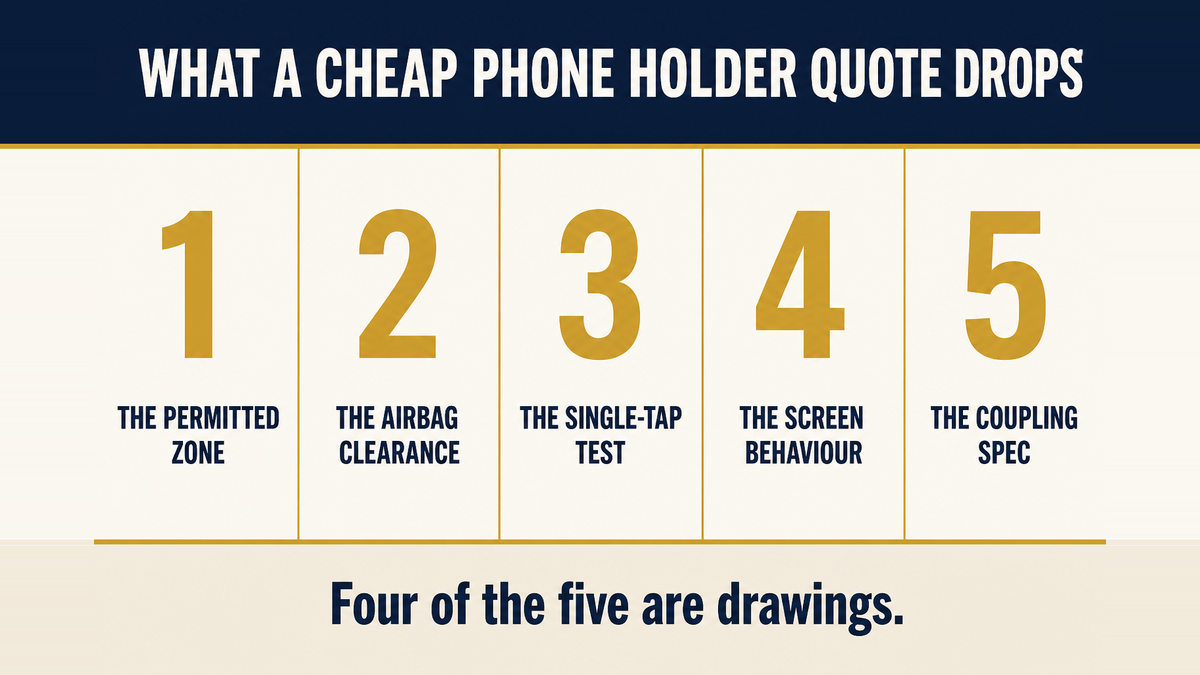
10. Five Questions a Phone Holder Quote Should Answer
A phone holder quote usually carries a grip type, a phone size range, a colour and a price. None of those tells you whether the product can be used lawfully. These five do.
- Which market is it going into, and what is the permitted zone there? California’s answer is two lower-corner squares; the federal commercial vehicle answer is a band 152 mm down from the top edge and outside the wiper sweep. One product cannot carry one recommended position for both.
- Where does the mount sit relative to an airbag deployment zone? The near-side square carries that condition in express words, and the phrase is the only mention of an airbag anywhere in the mounting section.
- Does the phone stay still when a finger touches it once? A single swipe or tap is what the statute allows. A cradle that needs steadying before it can be tapped turns a lawful action into an unlawful one.
- What is the holder designed to show? A mapping display is excepted from the screen rule; a video is caught by it. The holder decides which of the two the customer ends up with.
- What does the coupling grip, and what does it do to that surface? Glass, a dashboard top, a louvre or a cup holder aperture. This is the part of the product that decides the answer to question one.
11. Six Checks Before You Order
- A drawing with the permitted zone to scale for the destination market, with the holder’s own footprint and the phone’s footprint both inside it.
- The airbag clearance stated on that drawing, for the windscreen and for the side curtain, rather than left to the customer.
- A single-tap test with the largest phone the cradle claims to take, using one finger and one hand, filmed rather than described.
- The insert that tells the customer where to fit it, in the customer’s language, because the customer is the one who commits the offence and the fine is theirs.
- The coupling specification in writing — what it adheres to, what it leaves behind, and how it is released.
- The packaging, checked against the same list, since a carton that shows a phone in the centre of a windscreen is selling a position that no exception covers.
That list is what a factory audit turns into questions on site, and what a pre-shipment check confirms from the insert and the carton rather than from the moulding. On this product the audit is unusually cheap and unusually easy to get wrong, because the moulding will always pass and the instruction sheet is where the product either works or does not.
Nothing in the rulebooks judges a phone holder, and that absence is the shape of the rules rather than a hole in them. This one has no such judgement, and the absence is not a gap in the rules — it is the shape of the rules. A phone holder is not equipment installed in a vehicle; it is an object a driver chooses to add, and the only thing any regulator has written down is where the object may put the phone. California cuts two squares out of a ban on things stuck to the glass and puts one of them outside an airbag zone. The federal truck rule allows a band under the top edge and keeps it out of the wiper sweep.
The screen inside the holder is a third question with a third answer. And the federal recall file, which holds 245,845 records and six more of this trade’s own words at zero, names a phone twice — once interfering with the sensor that decides whether an airbag fires, and once interfering with a rear-view camera image. Neither time is it being held. So ask for the zone drawing, the airbag clearance, the single-tap test, the insert and the coupling specification in writing.
Frequently Asked Questions
Where can you legally mount a phone holder on a windscreen?
In California the default rule is that no object may be placed, displayed, installed or affixed upon the windscreen or side or rear windows, and a mounted device exists only inside an exception. The exception a phone uses is the one written for a portable positioning system: a seven-inch square in the lower corner of the windscreen farthest from the driver, or a five-inch square in the lower corner nearest the driver and outside an airbag deployment zone. The same section separately bans any object that obstructs or reduces the driver’s clear view, whether or not it touches the glass.
Is a phone holder on a dashboard legal?
It is judged by a different test. The phone section allows a device to be mounted or affixed to a dashboard or centre console provided it does not hinder the driver’s view of the road. That is a judgement rather than a measurement, which is why a holder sold into that market needs an insert telling the customer where to place it. The windscreen squares do not apply to a dashboard fitting, and neither does the airbag zone wording in the positioning system paragraph.
Why does the rule refer to a GPS rather than a phone?
Because the phone section borrows the navigator’s geometry. It allows a hand to touch a mounted device only if the device is mounted on the windscreen in the same manner a portable positioning system is mounted under that separate paragraph, or is mounted on the dashboard or centre console without hindering the driver’s view. The cross-reference is to the whole paragraph, so the seven-inch and five-inch squares and the airbag deployment zone condition come with it. There is no independent mounting rule written for phones on glass.
Can I watch video on a phone in a car holder?
Not while driving. A separate section bans driving with a television receiver, video monitor or screen, or any similar means of displaying a television broadcast or video signal that produces entertainment or business applications, operating forward of the back of the driver’s seat or visible to the driver. The exceptions name a vehicle information display, a positioning display, a mapping display and a display used to enhance the driver’s view. A map is excepted; a video is not. The holder is not what makes the difference.
Does a phone holder need any certification?
No. There is no safety standard for the holder, and nothing about it is tested, marked or inspected. The federal recall file holds 245,845 records and the words smartphone, cellphone, mobile phone, suction cup and wireless charger appear in none of them, because the system records defects in vehicles as manufactured and a holder is added afterwards by an owner. What is regulated is the position, and the position is decided by whoever fits the holder.
What does the recall file say about cradle, holder and suction?
All three are vehicle parts with other jobs. A cradle is the structure an engine or a suspension sits in, or the bracket a bicycle or kayak rests on. A holder is a fuse holder in every case sampled, and one run of air conditioner campaigns describes the same fuse holder where the fuse loosens and the holder may melt, with flame, smoke and potential fire. Suction means vacuum — a suction hose, a suction pump, a suction jet, a suction strainer. Suction cup appears zero times. There are also exactly two cup holders in the file, and both are parts of a child restraint seat.
A Windscreen Sketch With the Allowed Area Shaded
We return the permitted rectangle drawn over your own windscreen template, with the wiper sweep and the state that governs it.
Sketch My Windscreen
Questions & Comments
We read every one and reply within 24 hoursA phone holder is judged by where it puts the phone rather than by how it grips it. Send the mount type and the vehicle, and we will check the airbag zone, the sightline and the instruction sheet.