
Catalytic Converter Suppliers: A Life Written Into Law
 ·
Updated October 15, 2026
·
14 min read
No other part in this series has a life written into federal regulation. A catalytic converter does. United States rules name it as a major emission control component and give it a warranty period four times as long as everything else on the car — eight years or eighty thousand miles — and those same rules go on to prescribe what an aftermarket converter must still do after twenty-five thousand miles, how it must be labelled, and, remarkably, the exact words you may and may not use to advertise it. Even the phrase most suppliers want to print on the box is legally unavailable.
1. What a Catalytic Converter Has to Be
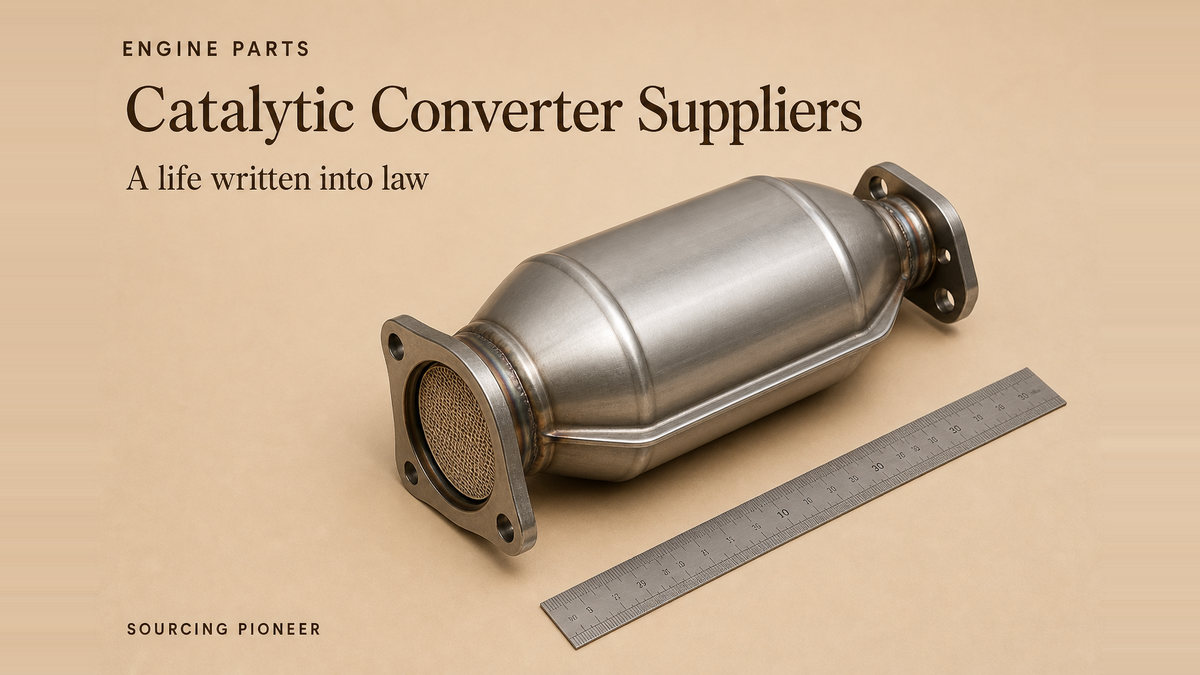
A catalytic converter is a can with a ceramic honeycomb inside it. The honeycomb is coated with a washcoat that carries precious metals, and the hot exhaust gases pass over that coating, which turns unburned hydrocarbons, carbon monoxide and oxides of nitrogen into less harmful gases. The metals are the active part; the honeycomb holds them; the can keeps it in place.
Two properties define the part, and they pull against each other. The first is conversion efficiency — how much of each pollutant the coating removes. The second is backpressure — how much the converter resists the flow of exhaust. A dense honeycomb converts well and restricts more; a free-flowing one restricts less and converts less. Everything in a spec sheet is a position on that trade.
| The element | What it decides | What a vague quote hides |
|---|---|---|
| The substrate | How much surface the coating has to work on | Cells per square inch, wall thickness and volume |
| The washcoat and precious metals | How much of each pollutant is converted | The loading in grams, and of which metals |
| The converter type | Whether it can reduce nitrogen oxides at all | Oxidation, three-way, or three-way plus oxidation |
| The can and its end pipes | Whether it survives heat cycles and vibration | The shell material thickness, and how it is closed |
| Backpressure | Whether the engine breathes | The figure at a stated flow |
| The heat shield and clearance | Whether what sits near it survives | Whether a shield is fitted, and the clearance to trim and lines |
| The label | Whether the part may be installed at all | The code, the year and month, and new or used |
What this guide covers
- What a catalytic converter has to be
- The inspection standard does not cover emissions hardware
- Eight years, or eighty thousand miles
- What an aftermarket converter has to prove
- The claim you may not make
- What the federal record says about this part
- In the record, the converter is rarely the failed part
- What a cheap converter quote drops
- Six checks and where the price comes from
- Frequently asked questions
2. The Inspection Standard Does Not Cover Emissions Hardware
The in-use inspection standard has 22 sections and none of them covers the exhaust, the emissions system or the converter. They deal with brakes, brake power unit, steering, suspension, tires and wheel assemblies.
That is where the pattern of this series would normally end. For this part it does not, because a different set of rules reaches the catalytic converter more directly than any inspection could — and those rules are about its life, its performance and its label.
3. Eight Years, or Eighty Thousand Miles
40 CFR 85.2103 sets out the federal emissions warranty. It begins by stating how the period is measured, in a way that should be written into every converter quotation.
(b) The warranty periods under this section apply based on the vehicle's age in years and on the vehicle's odometer reading. The warranty period expires based on the specified age or mileage, whichever comes first.
40 CFR 85.2103(b)
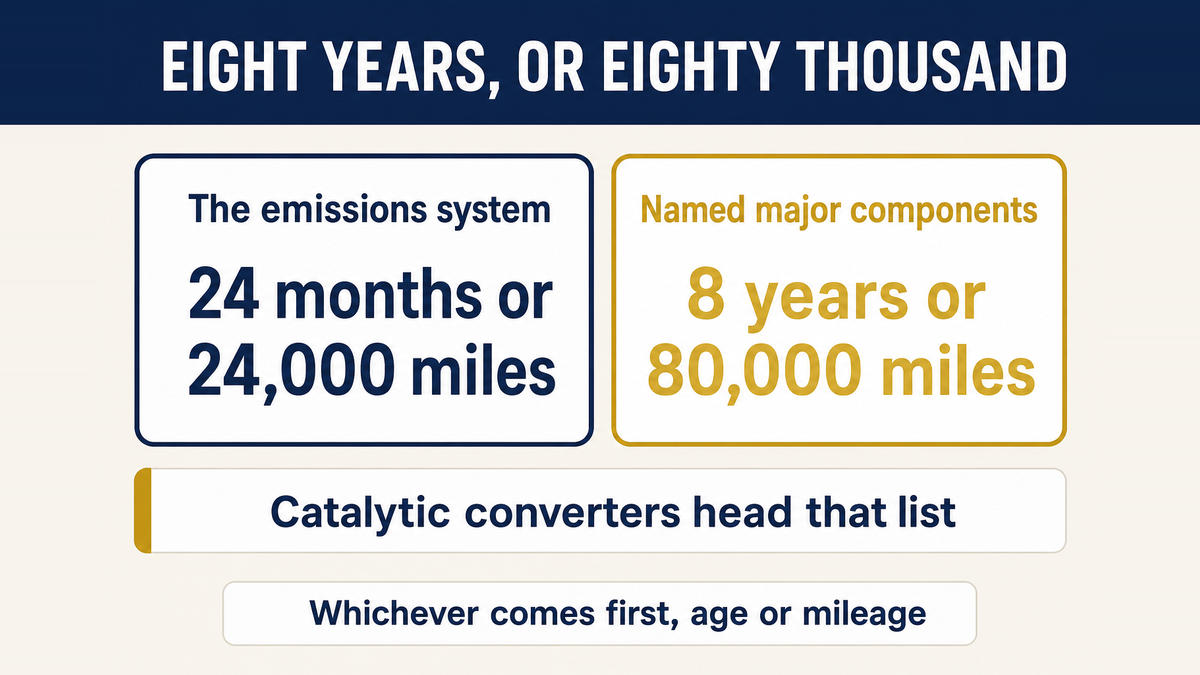
The general emissions defect warranty for a passenger car is two years or twenty-four thousand miles. Then the rule carves out a named list of components that get eight years or eighty thousand miles, and the catalytic converter is the first entry on it:
(d)(1) An emission defect warranty applies for light-duty vehicles, light-duty trucks, and medium-duty passenger vehicles for a warranty period of two years or 24,000 miles, except that the following specified major emission control components have a warranty period of eight years or 80,000 miles:
(i) Catalytic converters and SCR catalysts, and related components.
(ii) Particulate filters and particulate traps…
40 CFR 85.2103(d)(1)
The same eight-year figure appears in the emission performance warranty, which obliges a manufacturer to fix a vehicle that fails an approved emissions test at no cost to the owner — two years or twenty-four thousand miles in general, but eight years or eighty thousand miles where the failure comes from one of those named components.
Two practical readings follow. The first is arithmetic: a converter is warrantied for three and a third times the mileage of the rest of the emissions system, by name, in the regulation itself. The second is commercial, and it is the reason a wholesale market for this part exists at all in the shape it does. Eight years or eighty thousand miles is the line between a vehicle whose converter is the manufacturer's problem and a vehicle whose converter is the owner's. Every aftermarket converter sale happens on the far side of that line.
It is worth noting what the rule does not do. It does not say a converter must last eight years. It says the manufacturer must fix one that fails within that window. The distinction matters when you are reading a supplier's claim sheet.
4. What an Aftermarket Converter Has to Prove
Because a replacement converter has to keep the vehicle legal, the rules also describe what a supplier must be able to show. The agency's policy for aftermarket converters, part of 40 CFR Part 85 Subpart V, sets out a qualification process that is unusually specific for an aftermarket part — and it is published in full.
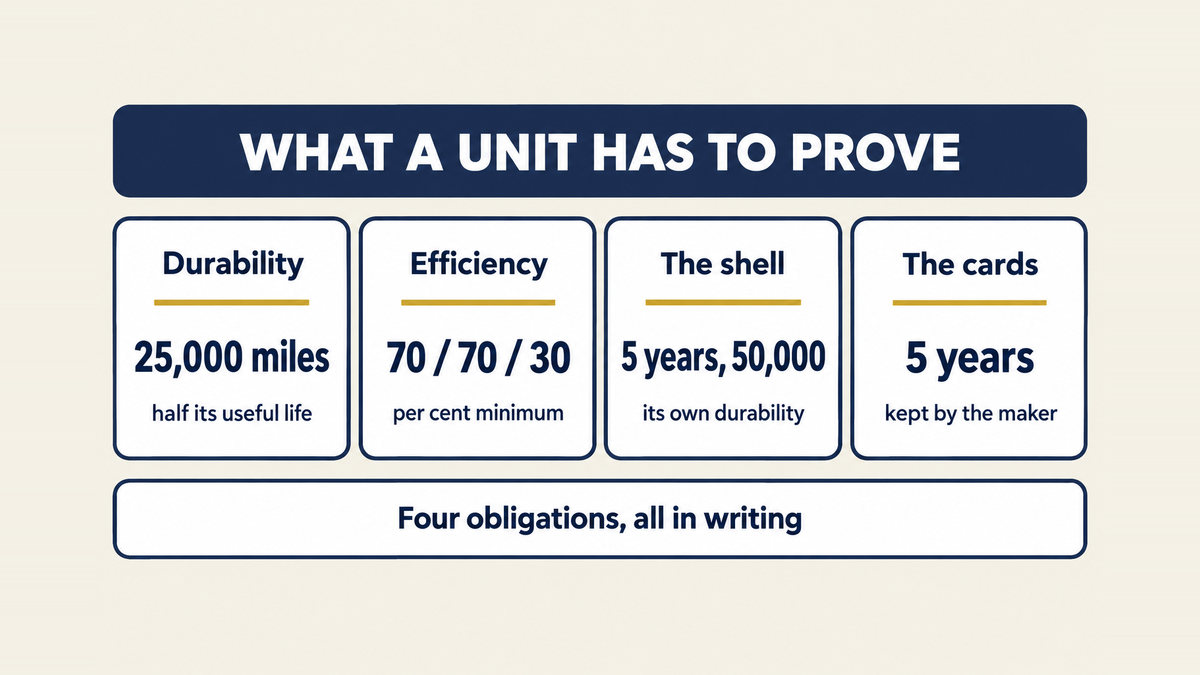
Durability. New converters must be tested after mileage accumulation, and the policy explains why the mileage is what it is: the converter must show that it meets the performance standards after 25,000 miles, "which is considered half their useful lives". At least two test converters per application category, run for 25,000 miles each, using the mileage cycle in Appendix IV of 40 CFR Part 86 or an equivalent road cycle. No maintenance of the converters is permitted during that accumulation. Bench testing may be substituted if the supplier can show it is at least as hard.
Efficiency. The test measures emissions with the converter fitted, then removes it and fits a pipe that reproduces its backpressure, and measures again. Efficiency is then computed from the two readings, and the policy states the minimums:
Application — Oxidation converter: minimum efficiency 70 per cent for hydrocarbons, 70 per cent for carbon monoxide, no requirement for nitrogen oxides.
Application — Three-way converter: 70 per cent HC, 70 per cent CO, 30 per cent for nitrogen oxides.
Application — Three-way-plus-oxidation: 70 per cent HC, 70 per cent CO, 30 per cent for nitrogen oxides.
The aftermarket converter policy, table 1, condensed
Two things in that table are worth pausing on. A three-way converter is required to reduce nitrogen oxides by at least 30 per cent while an oxidation converter has no requirement at all — which is why the type of converter is not a marketing detail but a legal one. And the test itself is defined by repeatability: two test runs count as a pair only if they agree within 10 per cent for hydrocarbons and carbon monoxide and 15 per cent for nitrogen oxides.
The shell. Separately from the catalyst, the policy requires the manufacturer to design and stand behind the outer shell, including the end pipes, to last five years or 50,000 miles from installation. The can is treated as its own durability problem, which is fair — a converter that still converts but has rusted through is scrap.
The paperwork. Each converter is to be supplied with a warranty application card recording the owner's details, the vehicle, the mileage, the installation date, the installing dealer and the part numbers, and the supplier must keep those cards for five years, reporting to the agency twice a year. The label is prescribed too: a visible, permanent, non-destructible mark carrying the manufacturer's code, the vehicle application code, the month and year of manufacture, and whether the unit is new or used.
Read the whole list and it describes a part with more mandated documentation than any other in this series.
5. The Claim You May Not Make
The most quotable sentence in the whole policy is a prohibition, because it closes off the marketing line that every converter supplier reaches for first.
A manufacturer's or remanufacturer's determination that its converters meet EPA's acceptance criteria does not constitute a certification, accreditation, approval, or any other type of endorsement by the Environmental Protection Agency… No claim of any kind such as "Approved [or Certified] by the Environmental Protection Agency" may be made in any advertising or other oral or written communications.
The aftermarket converter policy, manufacturer's representations
The policy immediately offers the wording that is allowed, and it is worth copying exactly, because it is the true sentence and the one a buyer can rely on. A supplier whose converter genuinely meets the criteria may say that it meets the emissions reduction requirements and criteria set by the agency, which would allow its proper installation without the installer being liable for breaking the tampering prohibition of the Clean Air Act.
Four other points in the policy bear directly on a sourcing decision.
Installation conditions. For fitting a converter not to count as tampering, it must go in the same location as the original, be the same type as the original, be the right converter for the application as the manufacturer specifies, connect properly to any existing air injection, and be fitted together with all the other converters the vehicle had if there was more than one. A three-way unit fitted where an oxidation unit was is not a variation; it is a violation.
Used converters are a separate regime. Only original-equipment converters can qualify when they are reconditioned, and there is no durability testing — instead every individual unit is tested. The container must have no leak paths and acceptable backpressure, the substrate must be sound and not melted or worn, and the policy adds a testable condition with no room for argument: "It shall not rattle." Reconditioned units must then meet a light-off and stabilised efficiency test, with minimums of 50 per cent for hydrocarbons and carbon monoxide at 120 seconds and 75 per cent at 200 seconds.
The agency can check. The policy reserves the right to inspect facilities and records and to run its own tests, and states that a manufacturer whose converters do not meet the criteria may be liable for causing tampering — and that continuing to install them can make the installer liable too. That is the clause that turns a supplier's test data into something a buyer has a real interest in.
A theft cover can be a recall. That is not in the policy, but it is in the record, and it belongs in this section because it is the same point from the other direction — see below.
6. What the Federal Record Says About This Part
Search the same federal recall file used throughout this series and the term catalytic converter appears in 130 records across 13 campaigns — a small count for a part fitted to every car built in the last forty years.
The filing shows why. Most of the campaigns are not filed under the converter at all. They sit under the exhaust system, the cooling system, the engine, the electrical wiring, the hybrid propulsion system, underbody shields, even the steering system. The converter is named because it is involved, not because it is the subject.
7. In the Record, the Converter Is Rarely the Failed Part
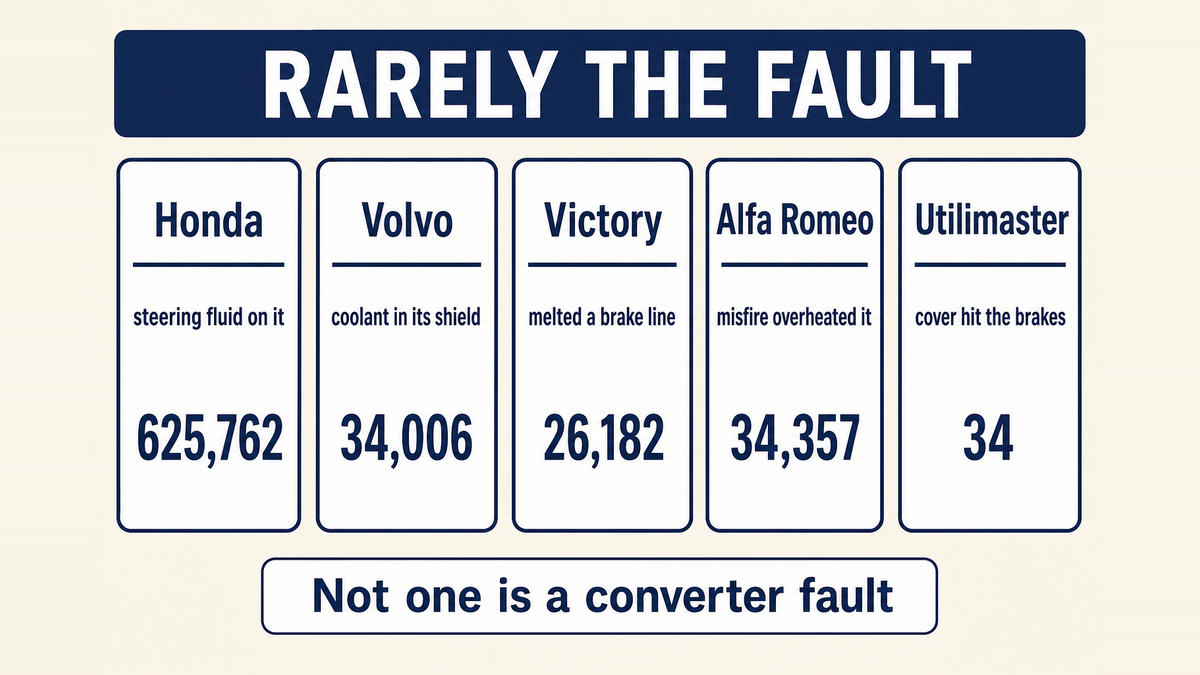
Read all thirteen campaigns and three roles appear, none of which is "a converter that stopped converting".
It is the hottest thing in the exhaust, and other people's fluids find it. Honda's campaign 12V222000, covering 625,762 Accords and Acura TLs, is about a power steering hose that can leak — and the record's own consequence is that power steering fluid can drip onto a hot catalytic converter, producing smoke and possibly an under-hood fire. Volvo's campaign 19V308000, 34,006 XC90s, concerns a coolant hose that cracks — and the coolant can then collect in the converter's heat shield insulation and catch fire when the vehicle is stationary. Victory motorcycles' campaign 17V647000, 26,182 bikes, found that heat from the catalyst could melt the rear brake line, and the remedy was to reroute the brake line away from it. Ducati's 12V392000 found a cable cover that could burn from the converter's heat.
It is the victim of a misfire, and sometimes it takes the engine with it. Alfa Romeo's campaign 18V636000, 34,357 Giulia and Stelvio vehicles, states that the engines may misfire, causing the catalytic converter to overheat and damaging nearby wiring and engine components; the fix was an engine control software update. Chrysler's campaign 18V740000, 10,260 Pacifica plug-in hybrids, is the same mechanism from the other direction: after running on electricity, the engine may not restart properly, letting unburned fuel enter the catalyst, where it can ignite. And Kia's campaign 19V120000, covering 378,967 Souls, is the most severe: high exhaust gas temperatures could damage the converter, leading to abnormal combustion and damage to one or more pistons, and a broken connecting rod could puncture the block and let oil reach the hot exhaust. The remedy was new engine control logic to protect the converter, plus replacing it.
And the parts around it are the parts that fail. BMW's campaign 23V294000 found that the fasteners joining the exhaust to the converter had not been tightened correctly, which a loose joint turns into a fire risk — the same class of defect as the cylinder head, turbo and injector campaigns in earlier articles. Mercedes' 16V831000 found not enough clearance between the converter and a composite underbody panel, which could melt. And Utilimaster's 22V833000 describes something worth reading twice: a catalytic converter theft deterrent cover that could contact and damage the hydraulic brake lines of 34 walk-in vans. An accessory fitted to stop the converter being stolen caused a loss of brakes.
8. What a Cheap Converter Quote Drops
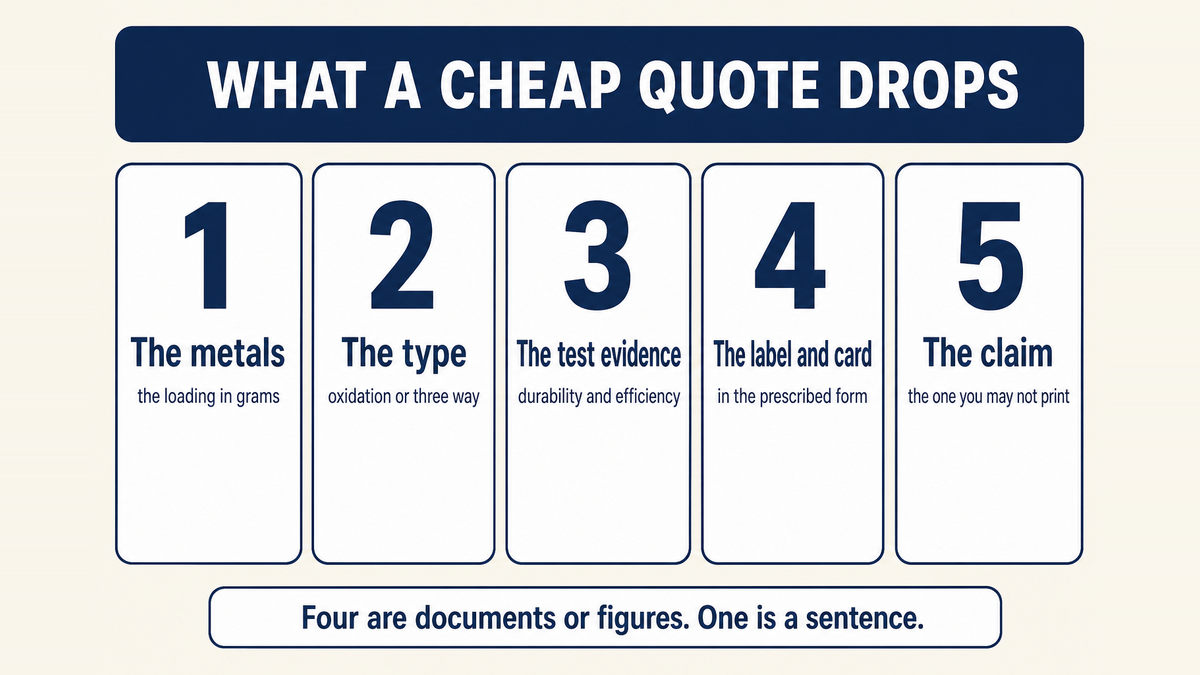
A converter's cost is in the precious metals, the substrate, the can and the testing. Five places a low quotation comes from:
The precious metal loading. The metals are the part that does the work, and the loading in grams is the number that a cheap unit reduces. It is also the number least likely to appear in a quotation, because it is invisible from outside and cannot be checked by weighing the box.
The converter type. Whether the unit is an oxidation converter or a three-way converter decides whether it is allowed to be installed at all, and the two have different legal requirements for nitrogen oxides. A supplier who quotes "a converter" has left out the legal question.
The test evidence. Durability after 25,000 miles, the efficiency figures against the table, and the shell's five-year design life. The policy expects this work to exist; a quotation that does not mention it has not established it.
The label and the card. The prescribed label and the warranty application card are part of the product, and the card has to be capable of being filled in by the installer and kept for five years.
The claim. The one line that must never appear on the packaging is a claim of agency approval. A supplier who offers to print it has told you something about how carefully they read the rules.
9. Six Checks and Where the Price Comes From
Six checks cover a catalytic converter before it is ordered.
- The converter type against the vehicle's original, so the unit may lawfully be fitted.
- The substrate: cells per square inch, wall thickness and volume.
- The precious metal loading, in grams, and which metals.
- The backpressure figure at a stated flow, so the engine still breathes.
- The shell and the end pipes: material thickness, and the durability the supplier will put in writing.
- The label, the application list and the warranty card, in the form the rules prescribe.
On the factory side the questions are about the coating and the test bench: where the substrate and the washcoat come from, how the metal loading is applied and checked, how the can is closed, and whether the supplier has run the 25,000-mile accumulation or can show an accepted bench equivalent. Our sequence is in the factory audit checklist, and the metal side is covered in metal stamping and machined parts. Where a supplier also holds a social or ethical audit, the scheme behind the certificate is worth reading — see social audit schemes compared.
A converter's price is built from the substrate, the washcoat and its precious metals, the can and its flanges, and then the testing. The metals dominate — which is why the price of a converter moves with metal markets rather than with labour, and why the cheapest units are cheap in exactly one dimension. There is also a second commercial effect worth knowing: because the metals are valuable, the part is stolen, which is why theft covers and security markings exist as a product category of their own.
A converter is bulky, its substrate is brittle and its flanges are easy to distort, so it travels in a carton with the ends protected rather than loose: see export packaging quality control and carton drop test standards. Because it moves largely on volume, the chargeable weight method is set out in how volume decides what a shipment is charged. How the goods are described for entry is covered in how an HTS code is assigned, and the origin paperwork in the certificate of origin guide.
10. Frequently Asked Questions
Does a catalytic converter fall under any federal inspection standard?
Not the in-use inspection standard, which has 22 sections covering brakes, brake power unit, steering, suspension, tires and wheel assemblies with no exhaust or emissions hardware section. A different set of rules reaches the converter far more directly, covering its warranty period, the performance an aftermarket replacement must show, and how it must be labelled.
How long is a catalytic converter warrantied?
Under 40 CFR 85.2103, the general emissions defect warranty for a passenger car is two years or 24,000 miles, but the rule names a list of major emission control components that get eight years or 80,000 miles — and catalytic converters and SCR catalysts head that list. The period expires on whichever comes first, the age or the mileage. The same eight-year period applies to the emission performance warranty where a failure comes from one of those named components.
What must an aftermarket converter show?
Under the agency's aftermarket converter policy, durability is shown after 25,000 miles of accumulation — described as half the unit's useful life — with at least two test converters per application category and no maintenance permitted during the run. Efficiency is measured with and without the converter and must reach 70 per cent for hydrocarbons and carbon monoxide, and 30 per cent for nitrogen oxides on a three-way unit; an oxidation converter has no nitrogen oxide requirement. The external shell including the end pipes must be designed and stood behind for five years or 50,000 miles, and each unit carries a prescribed label and a warranty card the supplier keeps for five years.
Can a converter be advertised as EPA approved?
No. The policy states expressly that no claim of any kind such as approved or certified by the Environmental Protection Agency may be made in any advertising or other written or oral communication. The wording that is permitted says the converter meets the emissions reduction requirements and criteria set by the agency, which would allow its proper installation without the installer being liable for breaching the tampering prohibition of the Clean Air Act.
Why do recalls mention catalytic converters so often?
Because in most of them the converter is involved without being at fault. Of the 13 campaigns that name one, several concern fluids reaching it — power steering fluid on 625,762 Hondas, coolant collecting in its heat shield on 34,006 Volvos, a rear brake line melted by its heat on 26,182 motorcycles. Others concern a misfire overheating it, including a Kia campaign on 378,967 vehicles where the resulting piston damage could breach the engine block. And one concerns a theft deterrent cover fitted around a converter that could damage hydraulic brake lines.
Three Claims You May Make, and One You May Not
We return the permitted claim language, the period it must survive, and the sentence that turns an ordinary listing into a violation.
Approve My Claims
Questions & Comments
We read every one and reply within 24 hoursTrying to get a supplier to state the precious metal loading instead of a part number, working out whether a unit is an oxidation or a three-way converter, or checking what test evidence comes with the box? Send us the vehicle and the market, and our team will put the specification in writing.