
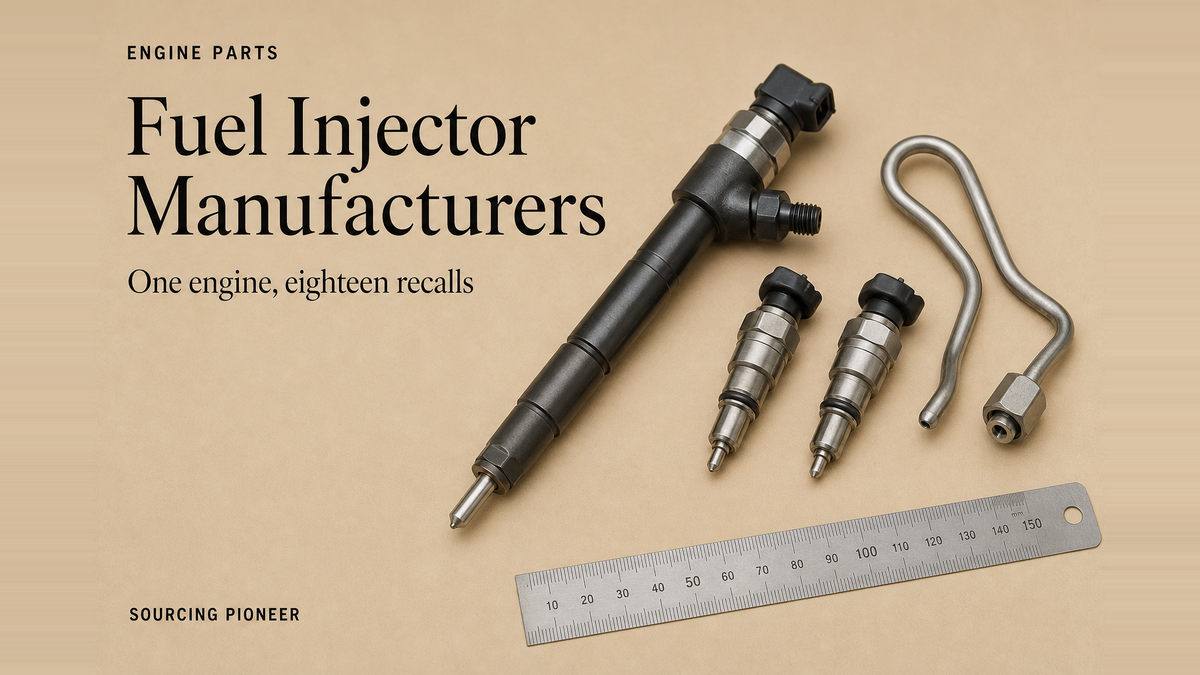
Fuel Injector Manufacturers: One Engine, Eighteen Recalls
 ·
Updated October 15, 2026
·
14 min read
A fuel injector is the part in this series where the specification is most completely documented: there are international standards for its dimensions by type, for how its flow is measured, for how the pump that feeds it is tested, and even for how clean it has to be. Almost none of that appears in the federal record, though. What the record shows is fire — in 34 of the 39 campaigns that name a fuel injector — and one case in which a single set of high-pressure fuel tubes on one engine produced eighteen separate recalls from eighteen different manufacturers inside three months.
1. What a Fuel Injector Has to Be
A fuel injector does two jobs that pull in different directions. It has to deliver a precisely measured quantity of fuel, and it has to deliver it as a spray fine enough to mix with air and burn cleanly. The first is a flow question and the second is a nozzle question, and both are settled long before the part reaches an engine.
Around the injector sits a system. Fuel arrives under pressure through a rail, is distributed to each injector by a high-pressure tube or gallery, and the injector is clamped into the head with a seal at the tip. On a common-rail diesel each injector also carries a solenoid or a piezo stack and a coding value, so the engine controller knows how much that particular injector actually flows. That is why injectors are so often described as a matched set: the numbers have to agree with each other and with what the controller has been told.
| The element | What it decides | What a vague quote hides |
|---|---|---|
| The nozzle and seat | How fine the spray is, and whether it seals when shut | The nozzle type, and the seat angle and width |
| Static and dynamic flow | How much fuel reaches the cylinder | The flow figures, and how they were measured |
| Flow matching across a set | Whether the cylinders are fuelled evenly | The spread allowed between injectors in one set |
| The solenoid or piezo stack | How fast it opens and closes | The response time, and the voltage it needs |
| The coding value | Whether the controller knows the real flow | Whether a code is supplied, and how it is written in |
| The tip seal and clamp | Whether combustion gas leaks past the tip | The seal material, the copper washer, and the clamp torque |
| Internal cleanliness | Whether the nozzle survives at all | The filtration and the cleaning process behind it |
What this guide covers
- What a fuel injector has to be
- The inspection standard does not cover the fuel system
- Fitment and flow are both standardised
- What the federal record files as an injector
- Fire appears in 34 of the 39
- One engine, eighteen recalls
- The remedy that escalated
- What a cheap injector quote drops
- Six checks and where the price comes from
- Frequently asked questions
2. The Inspection Standard Does Not Cover the Fuel System
The in-use inspection standard has 22 sections and none of them covers the fuel system, the injection system or the injectors. They deal with brakes, brake power unit, steering, suspension, tires and wheel assemblies, plus the heavier-vehicle brake systems. A fuel injector therefore has no federal figure to be measured against once the car is on the road.
What it does have, unusually, is a complete set of published international standards — for its shape, for its flow and for how clean it must be.
3. Fitment and Flow Are Both Standardised
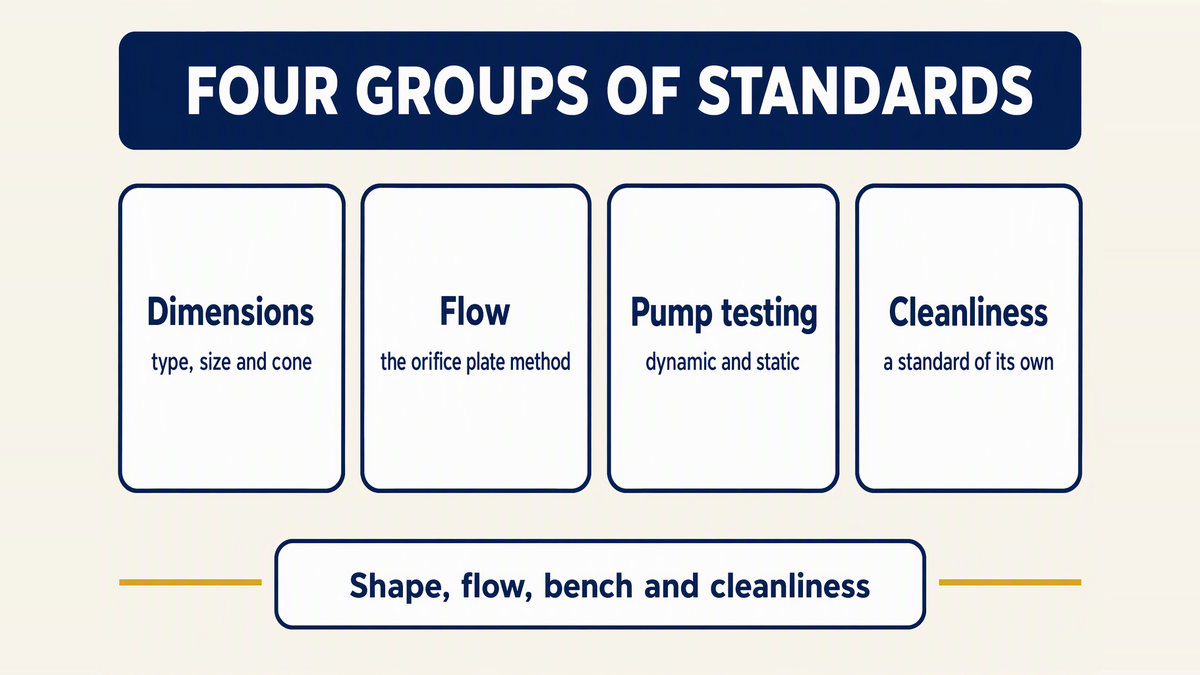
The fuel injection equipment family sits under a single classification heading at ISO, and reading that list is the fastest way to understand how this part is specified. It runs to several dozen standards and falls into four groups.
Dimensions. Injectors and their holders are standardised by type and size rather than by application. There is a standard for nozzle size "S", separate standards for clamp-mounted and flange-mounted and screw-mounted injector types, and standards for the 60° female cone used at every high-pressure pipe end. Even the end-mounting flanges for the high-pressure supply pumps used on common-rail systems have their own.
Flow. Two standards cover how the flow is measured at all: one for calibrating the nozzle and holder assembly used as the reference, and one for measuring flow against an orifice plate — a reference restriction that makes different injectors comparable with each other. The second of those is under revision, which tells you it is a live subject rather than a settled one.
Pump testing. The pump that feeds the injectors is covered separately, in three parts: dynamic conditions, static conditions, and the application and test procedures that tie the two together. Test pipes for those benches are standardised as well, so that a flow figure means the same thing in two different laboratories.
Cleanliness. And then there is a standard whose entire subject is the cleanliness of fuel injection equipment — a set of procedures for assessing it and a framework for measuring it the same way twice. That is remarkable for any component. A modern injector's clearances are measured in microns, and contamination is what destroys them.
Put together, those four groups answer the question this series keeps asking about every part: what can a buyer actually specify? For a fuel injector the answer is unusually complete. The shape, the flow, the reference bench and the contamination limit all exist as documents — which is why a quotation that gives only a part number has given very little.
4. What the Federal Record Files as an Injector
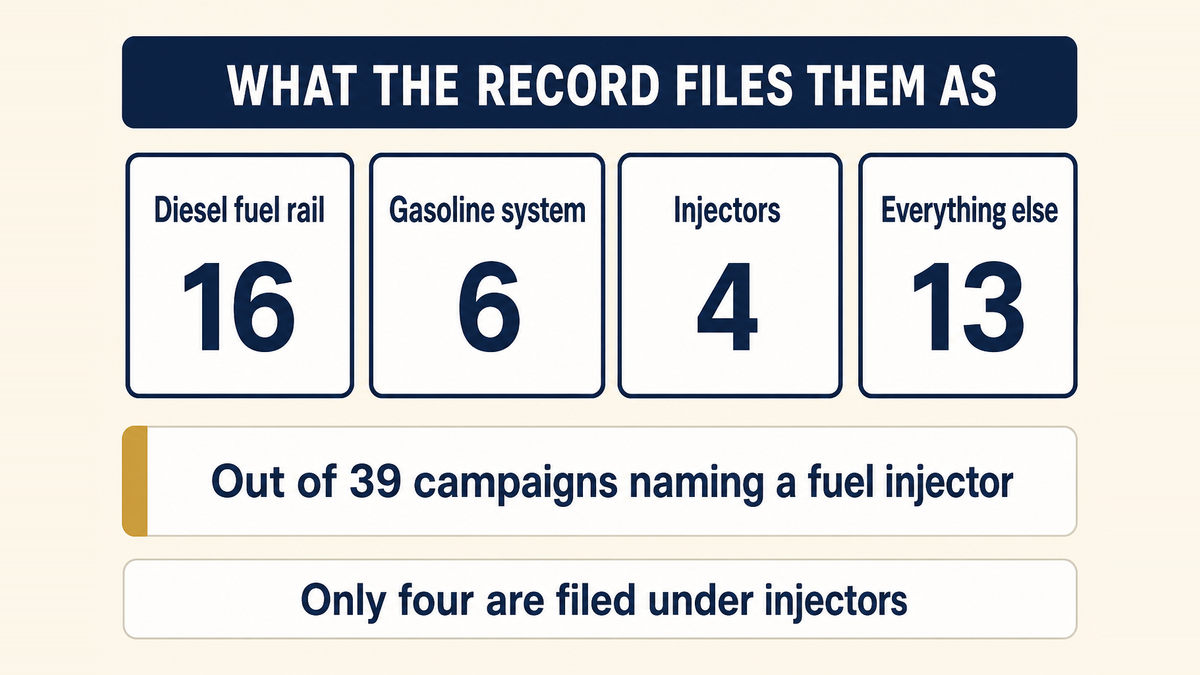
Search the same federal recall file used throughout this series and the phrase fuel injector appears in 1,234 records across 39 campaigns. The single word injector appears in 1,392 records across 51.
Where those campaigns were filed is more telling than the totals. Sixteen of the 39 sit under FUEL SYSTEM, DIESEL:FUEL INJECTION SYSTEM:FUEL RAIL — the rail the injectors are clamped to, not the injectors. Six sit under the gasoline injection system as a whole, and only four are filed under INJECTORS specifically. The rest are scattered across fuel delivery, electrical wiring and the engine.
So in the federal record, an injector problem is most often recorded as a problem with the hardware around it. That pattern has now appeared in every article of this series, and here it is at its strongest.
5. Fire Appears in 34 of the 39
The numbers from the 39 campaigns are blunt. Fire appears in 34 of them. Leaks or spills appear in 33. Stalling or loss of power appears in 32. Cracking appears in 22. Contamination, which is what the standards above spend a whole document on, appears in one.
That last figure is worth stating plainly rather than glossing over. In the field, injectors are recorded as failing by leaking and by cracking, not by being dirty — because a contaminated injector is usually a warranty repair rather than a safety recall. The cleanliness standard exists because contamination is the mechanism that wears the nozzle out; the recall file exists because a cracked or leaking injector is a fire risk.
A fire share of 34 out of 39 is the highest for any part in this series, against 95 of 233 campaigns for the fuel pump and 74 of 98 for the alternator. Fuel under pressure, in an engine bay, is simply the most direct route to that outcome, and it is why the three cases below deserve the space they get.
6. One Engine, Eighteen Recalls
This is the clearest example in the whole series of how a single component decision travels, and it is worth setting out in full.
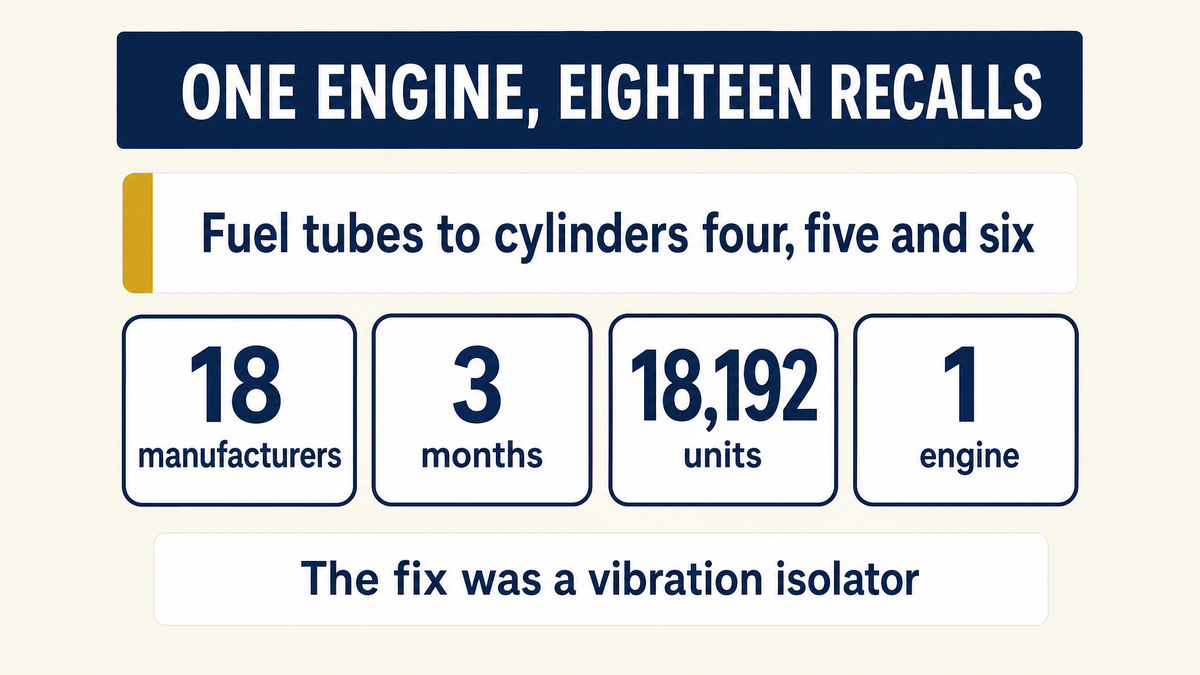
On one manufacturer's X12 heavy-duty diesel engine, the high-pressure fuel tubes running from the rail to the injectors for cylinders four, five and six could crack. The wording is identical in every campaign:
The fuel tubes between the fuel rail and the injectors for cylinders four, five, and six may fatigue and crack, which can result in a high pressure fuel leak.
A high pressure fuel leak in the presence of an ignition source can increase the risk of a fire.
The defect and consequence text, repeated across the campaigns below
Because that engine is sold to vehicle manufacturers rather than to the public, the defect did not produce one recall. It produced eighteen. Counting every campaign in the file that carries that exact sentence gives this list:
- The engine maker's own equipment campaign, 21E099000, covering 10,938 engines.
- Western Star 21V965000 — 2,843 vehicles.
- MCI 21V971000 — 1,125 motorcoaches.
- Autocar 21V956000 — 1,001, and Terex Advance 21V981000 — 1,016.
- Pierce 22V032000 — 243 fire trucks, plus Sutphen, Seagrave, KME, E-One, Ferrara, Spartan and Spartan Fire between them another 869 emergency vehicles.
- And five more, from Van Hool's 139 motorcoaches down to a highway carrier recalled one vehicle at a time.
Eighteen manufacturers, one engine, 18,192 vehicles and engines, filed between 2 December 2021 and 3 March 2022 — a window of about three months.
The remedy is the part a buyer should read twice. On engines with 75 miles or less, dealers were told to install vibration isolators on the fuel tubes. Above that mileage, engines received new fuel tubes with the isolators already fitted.
Not a stronger tube. Not a different tube material. A vibration isolator, because the failure was fatigue caused by the vibration of the system, and the fix was to change how the system vibrates.
7. The Remedy That Escalated
The second case is a different shape, and it shows what happens when the first fix is a workaround.
Ford's 1.5-litre engine has a fuel injector that can crack and leak fuel inside the engine compartment. The defect appears three times in the record, and the remedies tell their own story.
In November 2022, campaign 22V859000 covered 521,746 Escape and Bronco Sport vehicles. The remedy was to update the engine control software to include fuel injector leak detection and to install a drain tube — a software change to notice the leak, and a tube to carry the fuel away from hot parts.
In March 2024, campaign 24V187000 covered a further 42,652 vehicles with the same software update and the same drain tube.
In July 2025, campaign 25V467000 covered 694,271 vehicles — and this time the remedy was the hardware. Dealers were to update the software and replace the high-pressure fuel rail assembly and the fuel injectors, with the software update offered as the interim repair while parts were gathered.
Read as a sequence, a leaking injector was first addressed by teaching the car to detect the leak and drain it, and only three years later by replacing the rail and every injector. That is worth understanding on both sides of a transaction. From the buyer's side, it is the strongest possible argument that a leaking injector is not a small problem: the vehicle manufacturer itself spent three years and two other remedies before accepting that the parts had to change.
The third case is smaller and more surgical. Volkswagen's campaign 22V245000 covered 1,382 Atlas vehicles whose long fuel injectors may have been assembled without filters. A missing filter inside an injector caused fuel leaks and a fire risk. An omission at the bench, invisible from outside, and the whole set replaced.
8. What a Cheap Injector Quote Drops
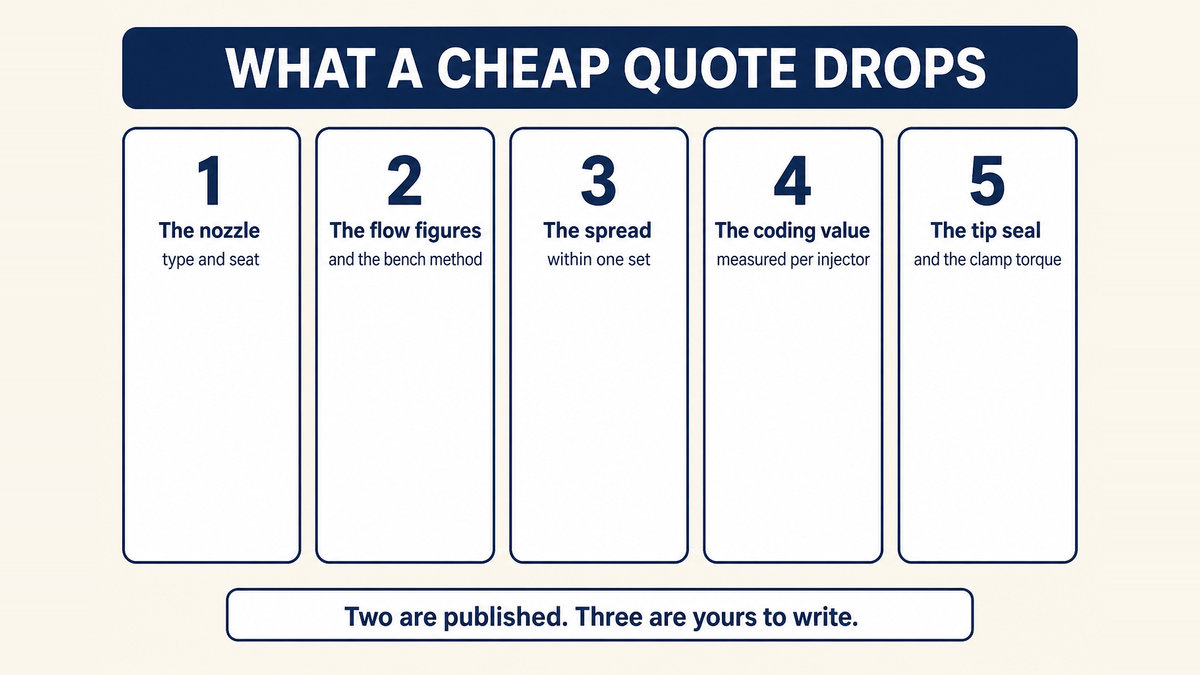
An injector's cost is in the nozzle, the seat, the solenoid or stack, the machining of the body and the flow bench time. Five places a low quotation comes from:
The nozzle type and seat geometry. The spray pattern and the shut-off both come from the nozzle, and the standard family above is organised by nozzle type and size rather than by application. A quote that names a part number without a nozzle type has left the important half unsaid.
The flow figures and the bench they came from. Static flow and dynamic flow are different measurements, and the reference matters — the standards exist so that two laboratories can disagree about an injector and settle it. A flow figure without a method is a marketing number.
The permitted spread within one set. An injector set is matched, and what holds the set together is the limit on how far apart the members may be. That limit is the thing a cheap set quietly widens.
The coding value. On a common-rail engine the controller has to be told what each injector flows. An injector supplied without its code, or with a code that was never measured, has moved a calibration problem onto whoever fits it.
The tip seal and the clamp. The seal at the nozzle tip is what keeps combustion gas out of the injector bore, and it is where the VW-led set above failed. Its material, its thickness and the clamp torque belong in the specification.
9. Six Checks and Where the Price Comes From
Six checks cover a fuel injector set before it is ordered.
- The nozzle type and size, named against the standard family rather than by application alone.
- Static and dynamic flow, with the bench method and the reference stated.
- The spread allowed within the set, so that the cylinders are fuelled evenly.
- The coding value, measured per injector and supplied with it.
- The tip seal and clamp: material, thickness and tightening torque.
- Internal cleanliness, with the cleaning and flushing process and the filtration used during assembly.
On the factory side the questions are about the bench rather than the machine: whether flow is measured on every injector or on samples, whether the injectors are matched into sets by measured flow or by part number, what the assembly area's cleanliness is, and whether the bench is calibrated against the reference nozzle the standards describe. Our sequence is in the factory audit checklist, and the machining side is covered in metal stamping and machined parts. Where a supplier also holds a social or ethical audit, the scheme behind the certificate is worth reading — see social audit schemes compared.
An injector's price is built from the nozzle, the seat, the actuator, the body machining, the flow bench time and the packaging. The nozzle and the actuator set the base. The bench time is the line that goes first, and it is the one line that a buyer can insist on: a set that has been flowed and matched costs more than a set that has merely been assembled, and there is no way to tell them apart once they are in a box.
Injectors are small, heavy for their size and easily damaged at the nozzle tip and the cone, so they travel in individual tubes or trays rather than loose: see export packaging quality control and carton drop test standards. Because they move largely on mass, the chargeable weight method is set out in how volume decides what a shipment is charged. How the goods are described for entry is covered in how an HTS code is assigned, and the origin paperwork in the certificate of origin guide.
10. Frequently Asked Questions
Does a fuel injector fall under any federal inspection standard?
No. The in-use inspection standard has 22 sections covering brakes, brake power unit, steering, suspension, tires and wheel assemblies, with no fuel system, injection system or injector section. A fuel injector has no federal figure to be measured against once the vehicle is in service.
What standards do apply to a fuel injector?
An unusually complete set of ISO standards, organised in four groups: dimensions, where injectors and nozzle holders are standardised by type and size, including the 60 degree cone used at high-pressure pipe ends and the end-mounting flanges of common-rail supply pumps; flow measurement, including a standard for measuring flow against an orifice plate; pump testing in dynamic and static conditions with its own application and test procedures; and a standard whose entire subject is the cleanliness of fuel injection equipment.
What does the federal record show about fuel injectors?
1,234 records in 39 campaigns for the phrase, and the filing is revealing: sixteen of the 39 sit under the diesel fuel rail the injectors are clamped to, six under the gasoline injection system as a whole, and only four under injectors specifically. Across the 39, fire appears in 34, leaks or spills in 33, stalling in 32 and cracking in 22. Contamination appears in one.
What happened with the eighteen recalls?
On one heavy-duty diesel engine, the high-pressure fuel tubes running from the rail to the injectors for cylinders four, five and six could fatigue and crack, causing a high-pressure fuel leak and a fire risk. Because that engine is fitted to vehicles from many manufacturers, the same defect sentence appears in eighteen separate campaigns, filed between December 2021 and March 2022, covering 18,192 vehicles and engines. The remedy was to fit vibration isolators to the fuel tubes.
What should a fuel injector quotation state?
The nozzle type and size against the standard family; static and dynamic flow figures with the bench method and reference stated; the spread allowed between injectors within one set; the coding value for each injector; the tip seal material, thickness and clamp torque; and the internal cleanliness process, including the filtration used during assembly.
Where the Fire Starts, in the Record
We return the flow figure per unit, the batch each one came from, and the failure pattern that appears in most of these campaigns.
Trace My Batch
Questions & Comments
We read every one and reply within 24 hoursA fuel injector is matched to an engine by flow and by spray, and a part number carries neither. Send the engine code and the flow target, and we will ask for the static and dynamic figures.