
Spark Plug Manufacturer: Heat Range Is an Engine Test
 ·
Updated October 22, 2026
·
12 min read
A gap can be measured with a wire gauge. A ceramic can be tested for breakdown. But the property that decides whether a spark plug belongs in an engine at all — its heat rating — is not a property of the plug. It is a number obtained by running a single-cylinder rating engine until the plug is a fraction away from pre-igniting, and reading the load at which it did. No bench, no drawing and no certificate substitutes for that engine. It is the only parameter in this series that a factory cannot measure on its own product.
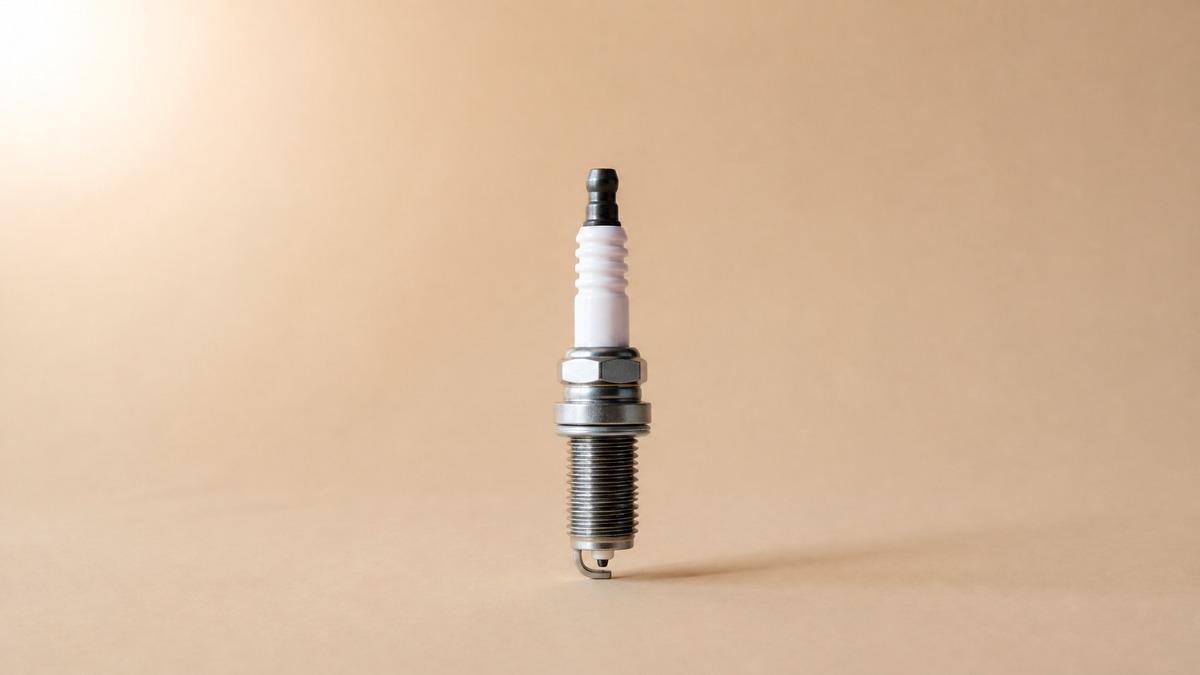
1. Five Parameters, and One That Is Not a Dimension
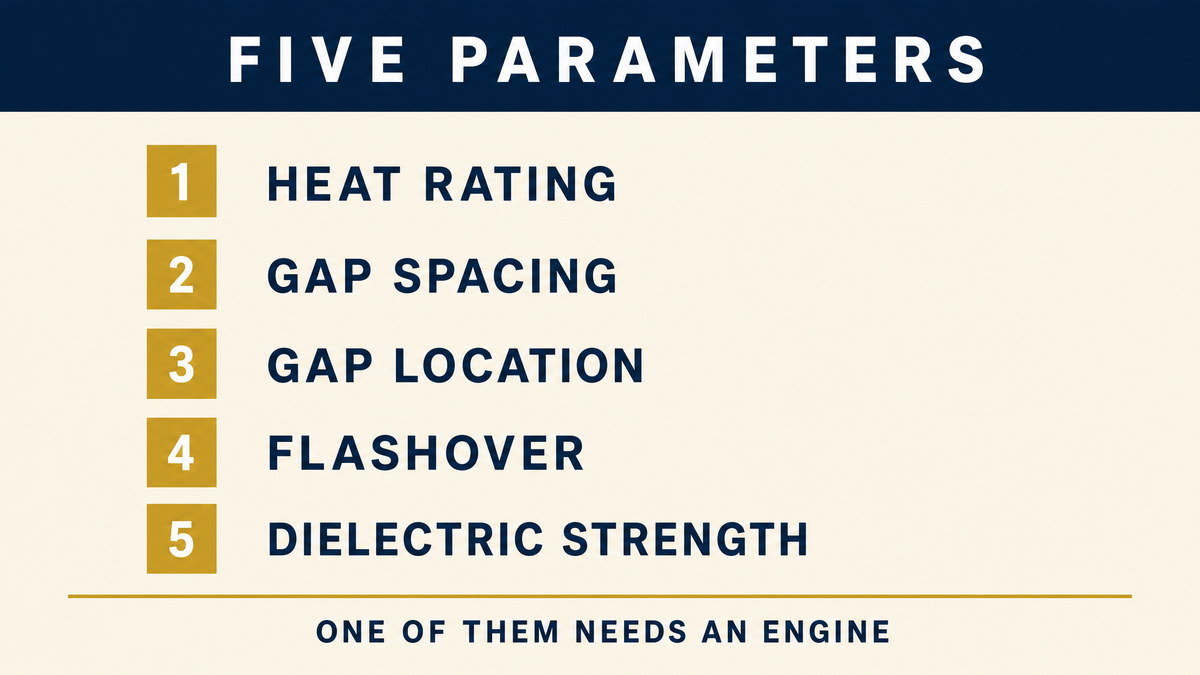
The aftermarket parts subpart lists spark plugs at 85.2122(8), and the list is short enough to hold in your head: heat rating, gap spacing, gap location, flashover and dielectric strength. The same paragraph defines its own terms, and the definitions are where the difficulty lives.
A spark plug is defined as a device to deliver high-tension ignition voltage to the spark gap in the combustion chamber. Gap spacing is the distance between the centre electrode and the ground electrode where the arc discharges. Gap location is the position of that gap in the chamber. Dielectric strength is the ability of the ceramic insulator to resist electrical breakdown. Flashover is a discharge at any point other than the gap — the voltage finding a path it was not meant to take.
Four of the five are geometry or material. You can put them on a drawing, measure them with a tool and argue about them across a table. The fifth is not like that, and the regulation defines it in a way that makes the difference unmistakable: heat rating is the measurement of engine indicated mean effective pressure at the point where the supercharge pressure sits 25.4 mm — one inch of mercury — below the pre-ignition point of the plug, rated according to SAE J549A.
Read it as a procedure, because that is what it is. You take an engine, load it, and raise the boost until the plug is about to make the fuel fire before the spark does. One inch of mercury before that moment, you read the load. That number is the heat rating. It belongs to the combination of plug and engine, and it is measured at the edge of destruction.
2. What the Test Actually Requires
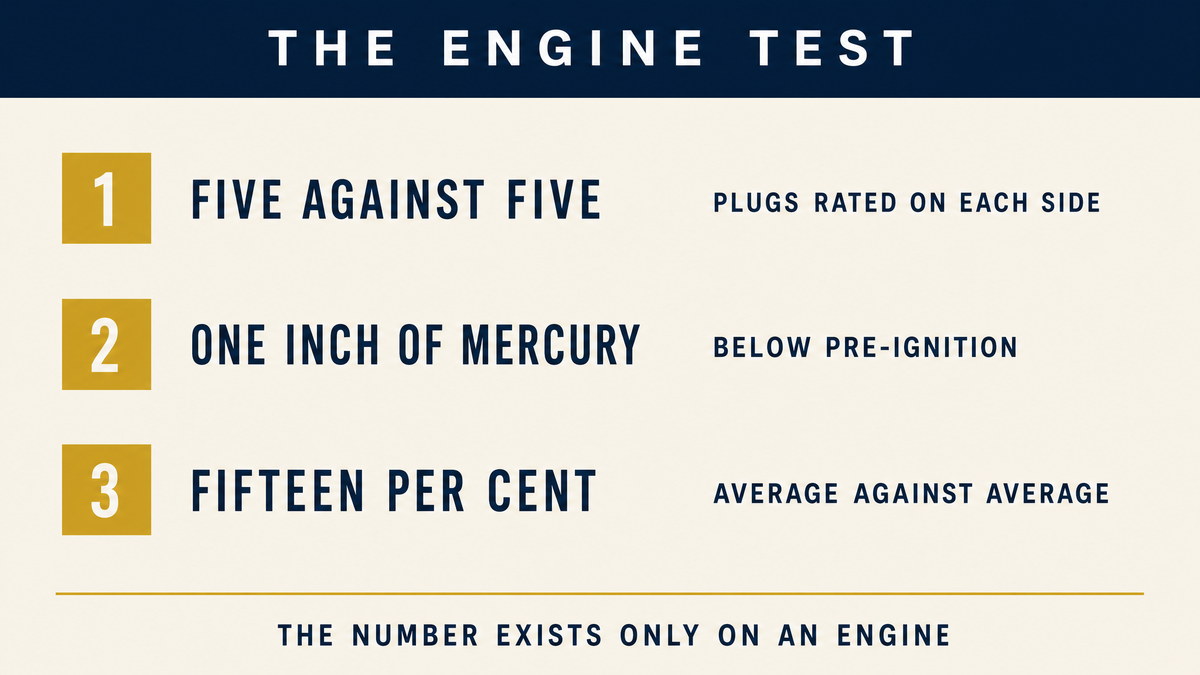
The appendix turns that definition into a comparison, and the comparison has three numbers in it that a buyer should be able to repeat from memory.
An SAE 17.6 rating engine is the rig. Not any engine, and not a bench rig: the SAE 17.6 Spark Plug Rating engine, run according to SAE J549A. At least five replacement plugs are rated, and at least five original equipment plugs are rated the same way, and the comparison is between the two averages.
Fifteen per cent is the tolerance. The average IMEP of the replacements must be within 15 per cent of the average of the originals — in either direction. A plug that runs colder than the original is as far out of specification as one that runs hotter, because both change when the engine reaches self-cleaning temperature and when it starts to knock.
| Parameter | How the appendix establishes it | What it costs to show |
|---|---|---|
| Heat rating | five replacements rated on an SAE 17.6 engine, average within 15 per cent of five originals | an engine, a rig, and ten plugs |
| Gap spacing | equivalent, or adjustable, to the gap recommended for the original plug | a gauge |
| Gap location | the same position in the chamber as the vehicle manufacturer specifies | a drawing and a shadowgraph |
| Flashover | no flashover at peak voltage with the boot fitted, with the gap 15 per cent larger than the manufacturer's specification | a voltage source and a boot |
| Dielectric strength | the ceramic's resistance to electrical breakdown | a hipot set |
The flashover clause is the most useful line in the whole appendix for a buyer, because it is the only one that states a test condition a factory can fail on the bench. The plug is fitted with its boot, the gap is opened 15 per cent wider than the vehicle maker's figure, and the terminal end must not arc at the peak voltage the application will see. A wider gap needs more voltage to jump, so the test deliberately pushes the ignition system towards the path of least resistance — which is the ceramic surface, the boot or the terminal.
That is also the connection to the rest of the ignition system. An engine that misfires under load has often had a plug replaced with one whose gap is right and whose insulation is borderline, and the flashover test is the one that would have caught it. The regulation names it for that reason: a plug that arcs outside the gap is a plug that stops lighting the mixture, and an unburnt mixture is an emissions event before it is a driveability complaint.
3. The Certificate Is the Same Machine as the Converter's
Spark plugs sit in the same subpart as the replacement converter covered earlier in this series, and they inherit the same gate. Under 85.2114 a part may be certified on emission-critical parameters only if those parameters are equivalent to those of the original equipment or previously certified part it is to replace. The label comes from 85.2119 as well: the words "Certified to EPA Standards" and the name of the manufacturer, or of the party designated to decide warranty claims, durable for the useful life interval, with the package carrying the vehicle list and any shortened interval.
What changes is where the risk sits inside that gate. Four of the five parameters can be matched by copying a drawing: set the gap to the original figure, put it in the same place, choose a ceramic that holds at the test voltage, and check that the boot does not arc. A factory with the original plug in hand can do all four without an engine.
The fifth cannot be copied. Heat rating is not a dimension that appears on a drawing; it is an outcome of a rating engine, and it moves with the electrode material, the insulator length, the shell geometry and the internal seal. Two plugs that look identical in a photograph can sit fifteen per cent apart on the rig, and one of them is outside the only tolerance the regulation names.
That is why the spark plug is the cleanest illustration of a rule this series keeps returning to: the part of the specification that is easiest to check is never the part that decides the outcome. Gap and thread are what a buyer inspects. Heat rating is what makes the engine run clean.
4. What You Can Check Without an Engine
Most of the article so far has been about what cannot be checked at a desk. This is the part that can, and it is worth doing before the technical questions, because it filters suppliers faster than any bench.
The box. A certified plug carries the statement Certified by (name) to EPA Emission Standards, a list of the vehicles or engines it is certified for, and a maintenance or replacement interval if it is shorter than the original equipment instruction. Those three items are the entire public face of a certification, and a carton that has none of them was not certified, whatever the plug inside it measures.
The name. Under 85.2113 a party that markets aftermarket parts under its own brand is a manufacturer for this purpose. If your private label appears on the box, the certification obligation is yours, and the name that has to be printed is the party standing behind the warranty — which may be you rather than the factory.
The plug's own code. Here there is a gap worth naming plainly: the federal text sets no marking duty on a spark plug. The code on the shell and insulator is the maker's own heat-range designation, an industry convention rather than a legal mark, and it is only meaningful if you know whose convention it is. Two manufacturers can print the same number for two different heat ranges, which is exactly why the regulation measures the rating instead of trusting the stamp.
And the fitment list. A list of vehicles tells you what will thread into the hole. It says nothing about whether the plug that threads in has the rating of the original, and the whole appendix exists because those are different claims.
5. Where the Price Difference Comes From
Two plugs for the same engine, one at a third of the other, differ in five places and only one of them is visible.
The centre electrode. Copper, platinum and iridium are three different products with three different lives, and the fine-wire iridium tip is a manufacturing problem before it is a marketing one. The ground electrode. A welded pad, a taper and a precious-metal chip all change how the gap holds over time. The insulator. Alumina grade and the glaze decide dielectric strength and how the ceramic behaves when it is hot and dirty.
The shell and the seal. Plating, thread tolerance and the internal glass seal that keeps combustion gas out of the boot. And the rating run. Ten plugs and an engine per comparison, which is a line item nobody photographs and the only one that produces the number the regulation actually asks for.
The two-price technique is the same as every row in this series, with a sharper edge here than anywhere except the converter. Ask for the unit price as quoted, and the price with the electrode material named, the ceramic grade named and a heat-rating comparison against a named original plug. On a plug the gap between the two is small per unit, and it is the difference between a part that passes an engine and a part that passes a photograph.
6. What the Record Counts, and What the Rule Counts
Method first, unchanged. The federal recall file holds 245,845 records across 15,305 campaigns, has no header row, and every field is scanned. Controls: brake 28,639, air bag 16,162. Twenty-five terms were counted.
| Term | Records | Campaigns | Which side of the divide it sits on |
|---|---|---|---|
ignition | 9,308 | 879 | the system, mostly switches and modules |
plug | 6,489 | 193 | the word, shared with glow plugs and drain plugs |
spark | 515 | 25 | the adjective, often a coincidence in a sentence |
misfire | 347 | 25 | the symptom a technician writes down |
coil | 217 | 41 | the part that carries the voltage |
insulator | 205 | 10 | the ceramic |
gap | 188 | 26 | the dimension |
electrode | 1 | 1 | the two pieces of metal that make the spark |
fouling | 0 | 0 | how a plug dies |
flashover | 0 | 0 | one of the five parameters |
preignition | 0 | 0 | the condition the heat rating is measured against |
iridium | 0 | 0 | the material on the tip |
p0300 | 0 | 0 | the code a misfire sets |
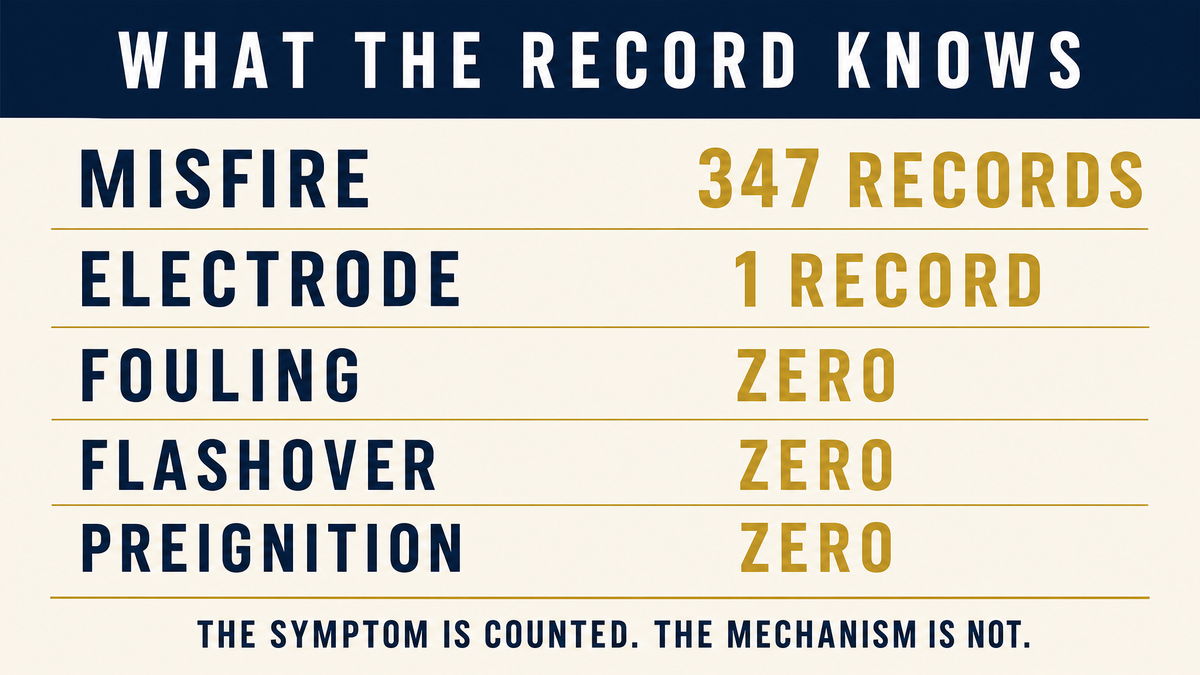
The heading is five campaigns. ELECTRICAL SYSTEM:IGNITION:COIL:SPARK PLUGS accounts for 5 campaigns; the coil heading above it has 9, and plain IGNITION has 316. A part that sits in every petrol engine on the road has almost no column of its own, because a plug that fails usually produces a misfire report rather than a plug report.
Six zeros, and all six are the code's words. fouling, flashover and preignition are the three mechanisms the appendix names or measures against. Not one appears in a quarter of a million rows. iridium does not appear either, and neither does p0300, the diagnostic code every misfire sets.
And one record for the electrode. The two pieces of metal between which the spark jumps are named exactly once, in one campaign, across the entire file. The record knows misfire at 347 — the word a technician writes on a job card — and it does not know the parts of the thing that misfired.
The finding. This row completes a pattern the last three rows were building. The converter row had a precise rule and a silent record. The fuel pump row had a silent rule and the deepest record in the batch. The spark plug has a precise rule and a record that speaks only its symptom: the code describes the mechanism, the record describes the complaint, and the only word they share is the one in the middle. That is not a gap in reporting. It is what happens when one document is written by engineers and the other by service writers.
7. Seven Questions a Spark Plug Quote Should Answer
- Which original plug was the comparison run against? Not which cars it fits — which plug, by part number, was on the rating engine as the reference.
- Five and five, and where is the sheet? The appendix asks for at least five replacements and at least five originals, averaged. A single plug rated once is not the test.
- What was the spread against the fifteen per cent? A result inside the tolerance and a result at the edge of it are different products at year three.
- Gap and gap location to whose figure? The vehicle manufacturer's, which means the answer is a number in millimetres and a position in a drawing.
- Was flashover tested with the boot fitted and the gap opened fifteen per cent? The only parameter the appendix tests at a condition a bench can reproduce, and the one most often skipped.
- What is the ceramic, and what voltage did it hold? Alumina grade and a dielectric figure. The code names dielectric strength as a parameter; a supplier should be able to name the material behind it.
- What does the better-specified plug cost? Named electrode material, named ceramic, and a rating sheet against a named original, priced beside the quoted plug.
8. Six Lines to Put in the Order
Six lines, and the first two are the ones no photograph can replace.
- The original plug and its rating. Part number, and the heat rating it carries on the vehicle it came from. Everything else is compared to this.
- The five-and-five comparison, with the figure. At least five of each, averaged, and the percentage against the fifteen per cent tolerance — stated, not implied.
- Gap and gap location to the vehicle maker's specification. A number and a position, with the source named.
- Flashover at a gap opened fifteen per cent, with the boot fitted. A pass or a fail at the peak voltage of the application.
- Ceramic grade and a dielectric figure. The material behind the parameter the code names.
- Two prices. As quoted, and with the electrode material, the ceramic and the rating sheet named. The difference is the design cost, isolated from labour and freight.
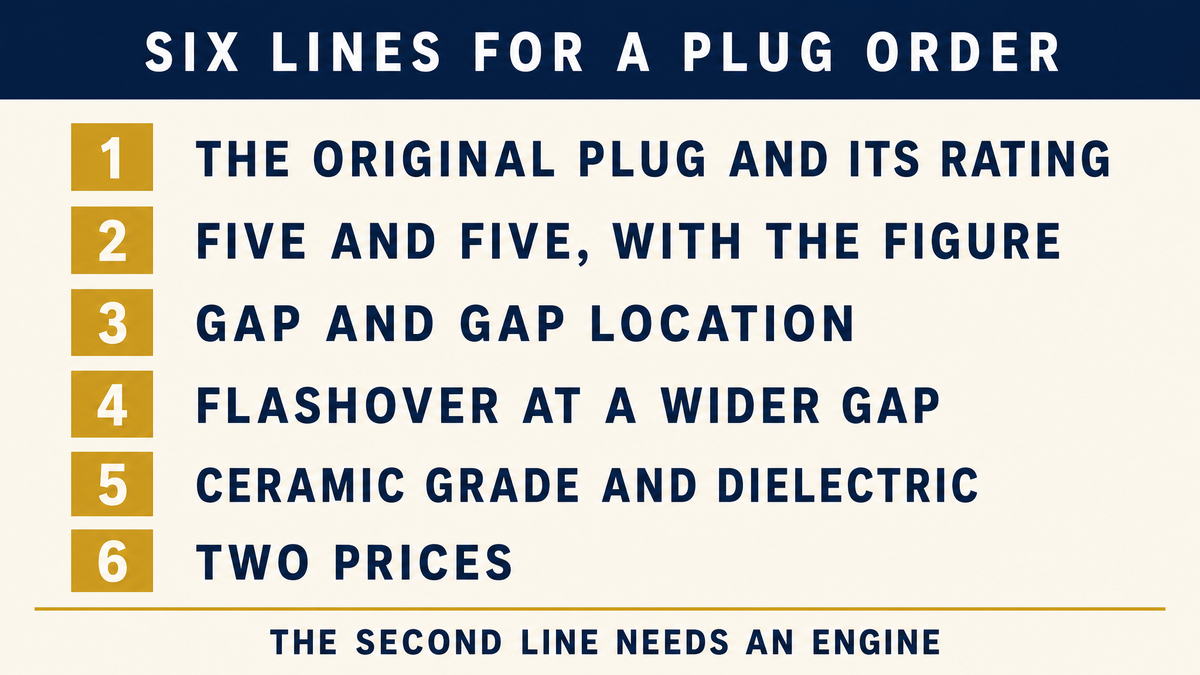
The first two lines are the difference between this part and everything else in the catalogue. A tyre can be checked against its sidewall, a lamp against its lens, a pump against a specification you wrote. A plug has to be checked against another plug, on a machine, and the result is a percentage rather than a pass stamp.
Two of the six sit outside the plug itself. A rating sheet is only evidence if somebody reads it against the drawing, and how an audit reads a laboratory report is where a claimed result becomes a fact. The other is the carton: a plug that arrives with a cracked insulator has failed the dielectric parameter before it is fitted, and the pre-shipment checklist is where that is settled — with how the packed volume decides the freight worth pricing at the same moment, because a carton of plugs is light and a pallet of them is a volume decision rather than a weight one.
Frequently Asked Questions
Is a spark plug certified by the EPA?
An aftermarket spark plug is an emission-related part under 40 CFR Part 85, Subpart V, and it sits at 85.2122(8) with five emission-critical parameters. The certification is made by the manufacturer, not issued by the Agency: the manufacturer notifies EPA of its intent, and the part and its package carry the statement and the name. A plug sold with no statement and no vehicle list has not been certified, whatever its rating sheet says.
What is heat rating, and why can a factory not measure it on its own product?
Heat rating is the indicated mean effective pressure measured at the point where supercharge pressure sits one inch of mercury, 25.4 mm, below the plug's pre-ignition point, rated according to SAE J549A. That is a running-engine measurement. It depends on the plug as installed and on the engine it is installed in, so a bench, a drawing or a photograph cannot produce it. The appendix names a specific rig, the SAE 17.6 Spark Plug Rating engine, because that is the only place the number exists.
How close does a replacement plug have to be to the original?
Within fifteen per cent. At least five replacement plugs and at least five original equipment plugs are rated, the averages are compared, and the replacement average must fall inside fifteen per cent of the original in either direction. The two-sided wording matters: a colder plug is as far out of specification as a hotter one, and the failure it causes is different rather than smaller.
Is there a mark a spark plug has to carry?
No. The federal text sets no marking duty on a spark plug at all, unlike a tyre or a headlamp. The code printed on the shell and insulator is the maker's own heat-range designation, an industry convention, and two manufacturers can print the same number for different heat ranges. The certification lives on the package, in the statement, the name and the vehicle list — which is why the box is the part of a certified plug you can check at a desk.
Can I fit one step colder?
You can fit whatever you like, but "one step colder" is a change of the only parameter the regulation measures, and the tolerance is two-sided. A colder plug runs below its self-cleaning temperature in normal driving, fouls, and misfires; a hotter one runs towards pre-ignition under load. Either moves the part outside the fifteen per cent band that defines equivalence with the original, which is why the recommendation is a rating, not a preference.
Why does an engine misfire after new plugs go in?
The record knows the symptom and not the cause: misfire appears in 347 records, while fouling, flashover and preignition return zero between them. In practice the causes are a gap set to the wrong figure, a heat range outside the band, a boot that arcs at peak voltage, or a ceramic that breaks down when hot. Four of those five are in the appendix, and the flashover test — boot fitted, gap opened fifteen per cent — is the one that catches the fault a bench can reproduce.
Four numbers describe a spark plug and all four can be measured on a bench. The fifth is not a property of the plug at all: it is a rating produced by running the plug in a calibrated engine and comparing it with a set of reference plugs.
That is why a factory can print a heat range and still not own the number. The rating belongs to the test engine, and the tolerance around it is wide enough that two suppliers quoting the same range are not necessarily quoting the same plug.
What You Can Check Without an Engine
We return the five parameters, the four you can check on a bench, and the heat range only a running engine can settle.
List My Bench Checks
Questions & Comments
We read every one and reply within 24 hoursA spark plug's heat range is produced in a reference engine rather than grown in the ceramic. Send both data sheets, and we will show where the two numbers really diverge.