
Cylinder Head Manufacturers: The Plugs and the Passages
 ·
Updated October 15, 2026
·
14 min read
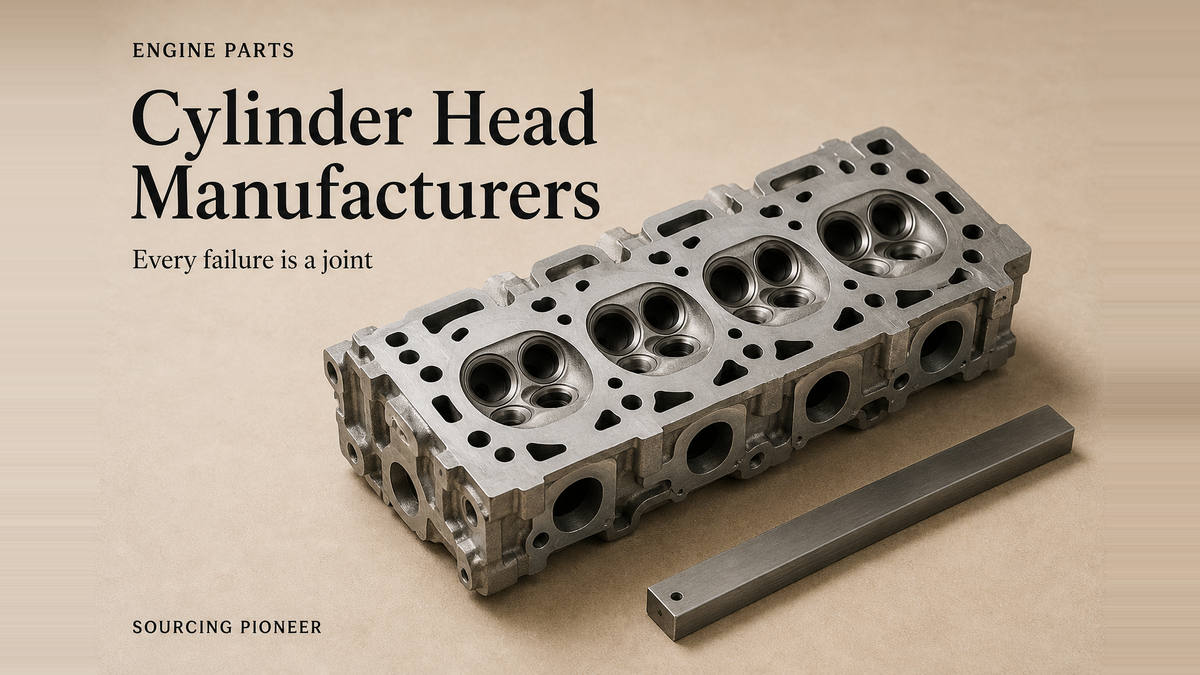
A cylinder head is the only engine part that has to be four things at once: a pressure vessel, a fluid seal, a bearing housing, and a casting full of passages that nobody can see once it is made. That last one is where this part differs from everything before it in this series. Read the public records for cylinder heads and you will not find a single complaint about the shape of a port or the design of a water jacket. Every one of them is about a joint, a hole or a fastener — and the newest cluster of them, filed in 2025, is about a part that was sold, recalled by number, and identified by serial number.
1. A Casting With Four Jobs
A cylinder head closes the top of the cylinders. It does four things at the same time, and the four pull in different directions.
It forms the combustion chamber, so it is a pressure vessel that takes the full heat of combustion. It carries the ports, so its internal shape decides how the engine breathes. It seals two fluids that must never meet: coolant, running through the passages around the chamber, and oil, running through the passages that feed the valve train. And it holds the valve train — valve seats and guides, cam bearing bores or rocker shaft mountings, and the holes every fastener screws into.
Then there is the part you cannot inspect at all. The internal passages of a head are formed by cores placed in the mould, and the openings the cores leave behind have to be closed once the casting is made. They are closed with plugs. So a cylinder head arrives at the end of its process with a set of internal voids sealed by a set of small parts that were fitted by hand or by press.
None of that is visible from the outside, and none of it is settled by the outline of the casting. What a buyer actually controls is the surfaces and the holes.
| The element | What it decides | What a vague quote hides |
|---|---|---|
| The deck face | Whether the head seals against the block | Flatness, surface finish, and how the figure was measured |
| The combustion chambers | Compression and how the charge burns | Volume, chamber finish, and valve seat concentricity |
| The valve seats and guides | Whether the valves seal and wear straight | Material, whether pressed or machined in, seat width and angle |
| The cam bores or rocker mountings | Whether the valve train runs true | Bore size and alignment, and the oil feed to them |
| The internal passages and their plugs | Whether coolant and oil stay where they belong | Whether the plugs are fitted, to what depth, and sealed with what |
| The bolt holes and mounting faces | Whether anything stays attached | Thread depth, thread class, and face flatness |
What this guide covers
- A casting with four jobs
- The inspection standard has no engine section
- What the federal record says about heads
- Every campaign is a joint, a hole or a fastener
- Four campaigns in seven months, the same six words
- The plugs have leaked for thirteen years
- The passages are the life of the part
- New, used or reconditioned
- What a cheap cylinder head quote drops
- Six checks and where the price comes from
- Frequently asked questions
2. The Inspection Standard Has No Engine Section
A cylinder head has no federal figure to be checked against in service. The in-use inspection standard is built as one section per system, and it covers brakes, brake power unit, steering, suspension, tyres and wheel assemblies. There is no engine section, so nothing in it directs an inspector to look at a head at all.
What governs the part instead is the record of what actually fails, and the rules that decide what may be sold for a given engine. Both are worth reading before a specification is written.
3. What the Federal Record Says About Heads
Search the same federal recall file used for the previous article and a different picture appears. The term cylinder head turns up in 63 records, belonging to 22 campaigns — several times the rate of the crankshaft, and for an obvious reason. A cylinder head fails in ways a driver notices. It leaks.
The term is also unusually clean. Of the 22 campaigns, 21 concern the engine part. The single exception is a hydraulic cylinder head on an aerial device — a different object that happens to share the name, the mirror image of the thermostat problem described earlier in this series.
For scale, in the same file: camshaft appears in 235 records across 17 campaigns, valve seat in 43 across 9, and head gasket in just 5 records in a single campaign. The gasket underneath the head is, in this record, almost invisible; the head above it is not.
4. Every Campaign Is a Joint, a Hole or a Fastener
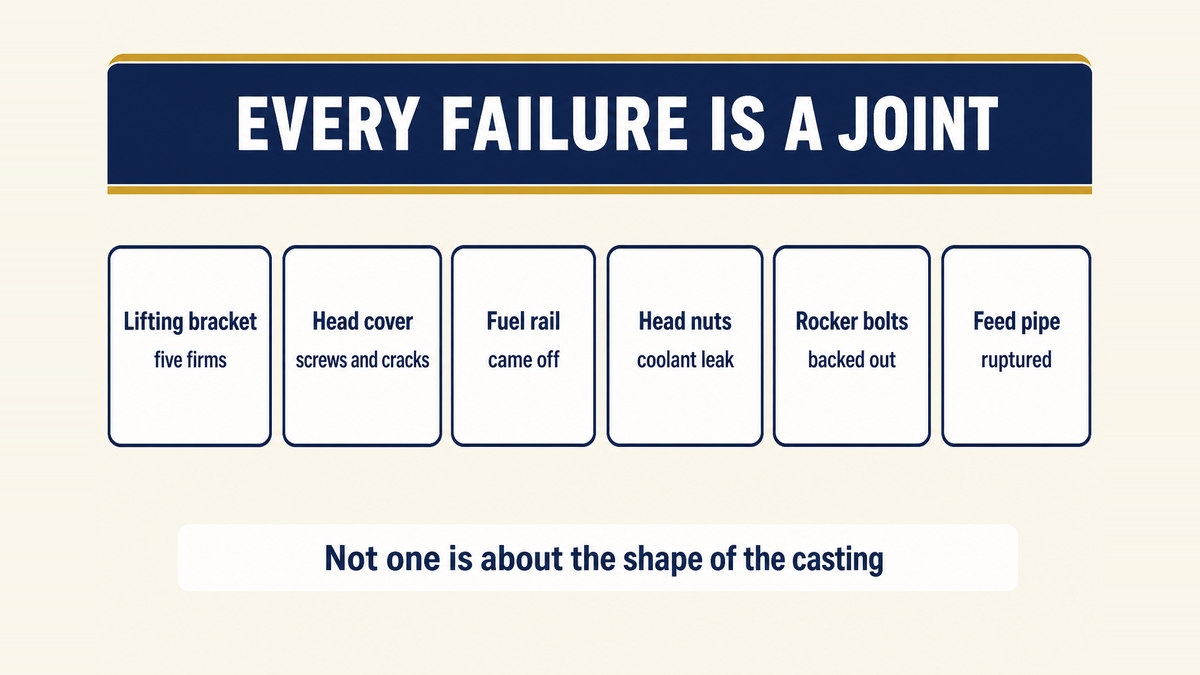
Read all 22 and the striking thing is what they are not about. Not one concerns the shape of a port, the volume of a combustion chamber or the design of the water jacket. Every campaign is about a joint, a hole or a fastener — the places where the head meets something else.
- Five campaigns, four truck makers, four months, one joint. Cummins filed (23E054000, 23E080000) for its B6.7 diesel engine and its L9N natural gas engine, Mack for the Granite and TerraPro, Freightliner for the M2 and 114SD, and Peterbilt for the 520 — all because the rear lifting bracket that attaches to the engine cylinder head could come loose. Cummins' remedy went as far as replacing the bracket, the bolts, the fuel lines and the cylinder heads where needed.
- The cylinder head cover. Audi's campaign (25V294000) for 2022–2024 Q5 Quattro and Q5 Sportback vehicles covers 89,417 vehicles because the cover screws may not have been tightened properly. BMW's (23V863000) covers five 2024 430i convertibles because the cover can crack. Both leaks end up on a hot engine.
- The fuel rail. Volkswagen recalled 55 vehicles (16V403000) because the rail could detach from the cylinder head. The remedy was to replace the cylinder heads.
- The cylinder head nuts. Yamaha recalled 3,116 scooters (20V277000) because the nuts could loosen, letting coolant foul the spark plug. The remedy was a new cylinder head gasket and proper tightening.
- The rocker arm shaft bolts. Honda recalled 6,954 motorcycles (14V056000) because the bolts were made incorrectly and could come out of the cylinder head entirely.
- The oil feed to the head. Lotus recalled 80 supercharged Evora cars (12V477000) because the pipe feeding oil to the cylinder head could rupture.
The record says something narrow and useful. The shape of the casting is settled by the engine it was designed for; that part is not the buyer's problem. What a head supplier controls is whether the faces are flat, the threads are sound, the plugs are sealed and the passages are open — and those four are exactly what the public record is full of.
5. Four Campaigns in Seven Months, the Same Six Words
The newest cluster in the file is also the most direct, and it is worth reading in full because the wording repeats almost exactly.
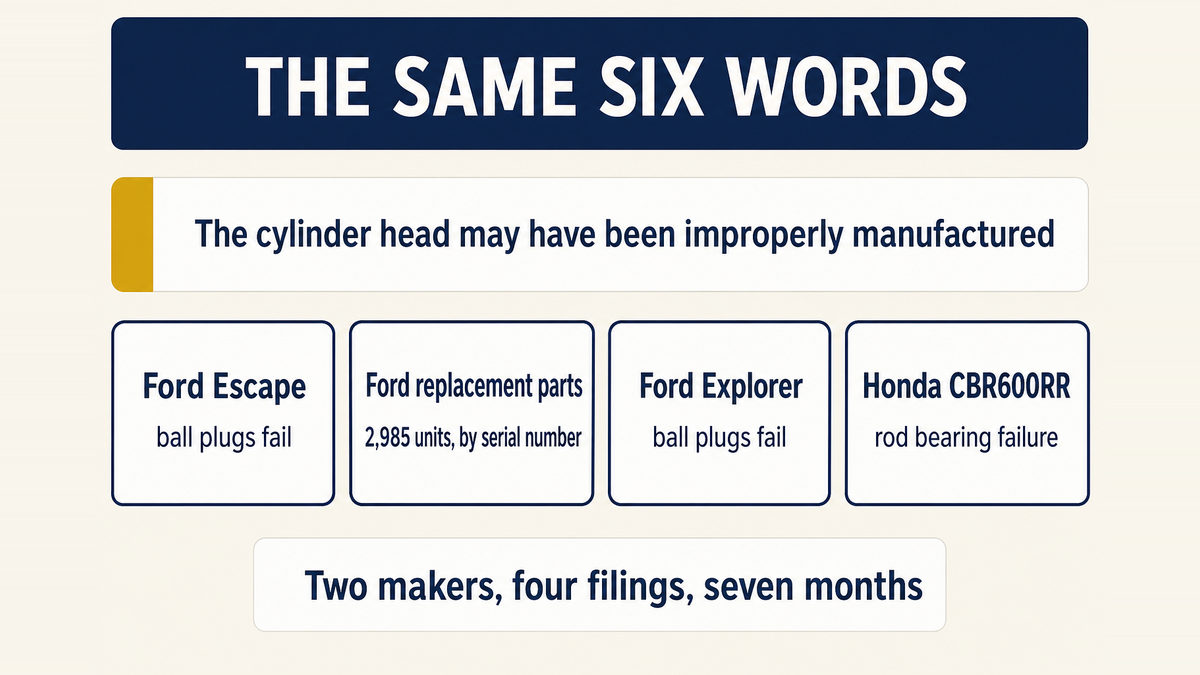
- Ford, campaign 25V372000, filed 4 June 2025, 404 vehicles. Certain 2023–2025 Escape and 2025 Bronco Sport vehicles. "The cylinder head may have been improperly manufactured, which can cause the ball plugs to fail, resulting in an oil leak." The remedy is to replace the cylinder head assembly.
- Ford, campaign 25E039000, filed 4 June 2025, 2,985 units. This one covers cylinder heads and long block engines sold as replacement parts, described by part number. Same words: improperly manufactured, ball plugs failing, oil leaking. The remedy: "Dealers will inspect the cylinder head serial number, and replace the cylinder head assembly as necessary."
- Ford, campaign 25V828000, filed 2 December 2025, 6 vehicles. Certain 2026 Explorer, Mustang and Lincoln Corsair and 2025 Maverick vehicles. Same words again, same ball plugs, same oil leak.
- Honda, campaign 25V891000, filed 22 December 2025, 1,337 motorcycles. Certain 2024–2026 CBR600RR motorcycles. "The cylinder head may have been improperly manufactured, which can lead to rod bearing failure, possibly resulting in rear wheel lock up or oil leaking onto the rear tire." The remedy is to replace the engine assembly.
Four filings by two manufacturers in seven months, all carrying the same cause, and all ending in a replaced assembly rather than a repaired joint. But the second of the four is the one a buyer of cylinder heads should keep, because it describes the part's commercial life rather than a vehicle's.
That campaign covers cylinder heads sold as replacement parts. They were identified by part number, and the way a dealer was told to tell an affected part from an unaffected one was to read a serial number on it.
Read that as a supplier's risk statement and it is blunt. A replacement cylinder head can leave a factory with a defect that cannot be seen on the part, and the only thing separating the bad ones from the good ones is a number stamped on the casting. If you buy cylinder heads to resell, traceability is not paperwork. It is the difference between fixing the affected units and withdrawing a batch.
6. The Plugs Have Leaked for Thirteen Years
Look up what a ball plug is and the file becomes more interesting. A cylinder head's internal passages are formed by cores, and the openings the cores leave have to be closed. The closures are plugs — cup plugs, ball plugs, core plugs. In the trade they are often called freeze plugs, though nothing about them is designed to freeze. They are a joint, and they are the least glamorous feature on the part.
Ford's own history on one engine family shows how long a plug can stay a problem. In 2012 the company recalled 6,146 Escape vehicles (12V431000) with 1.6-litre engines because a cylinder head cup plug could come loose and let coolant escape. The consequence recorded then was that as the coolant evaporated on the hot engine, the glycol could ignite. The remedy was to seal the existing plug and add a secondary cover over it.
Thirteen years later, three of the four 2025 campaigns above are about cylinder head ball plugs failing and leaking oil. The plug changed, the leak changed from coolant to oil, and the outcome did not change at all.
That is why plugs deserve a line of their own in a specification rather than a general instruction to seal everything. A plug pressed into a hole of the wrong finish, or seated to the wrong depth, or sealed with a material that does not suit the fluid, looks no different from a correct one on a finished part. It becomes visible only when it leaks.
7. The Passages Are the Life of the Part
The other half of the same subject is the passages, and here the file holds one of the most specific defects in this whole series. Ford's campaign 17V672000, filed on 25 October 2017, covers 22 F-150 pickups with 3.5-litre engines. The cylinder heads, it records, "may have been machined without lubrication supply holes for the camshaft bearing journals".
Not a hole in the wrong place. No hole at all. The consequence in the record is that without lubrication the engine will fail. Kawasaki's campaign 10V016000 is the opposite failure at the same feature: a blocked oil passage restricted oil flow to the cylinder head, and the remedy was to inspect the oil system and repair the head.
This continues the point made for the crankshaft, one level up. There, the oil holes are drilled through the journals, and the two properties worth writing into a specification are the finish of the hole and the hardness of the journal. A cylinder head carries the same argument about a casting: the oil that feeds the valve train and the camshaft runs through passages formed by cores inside the mould and then drilled and finished at the machine. Those passages are the part of the head no buyer ever sees, and they are the ones the record keeps naming.
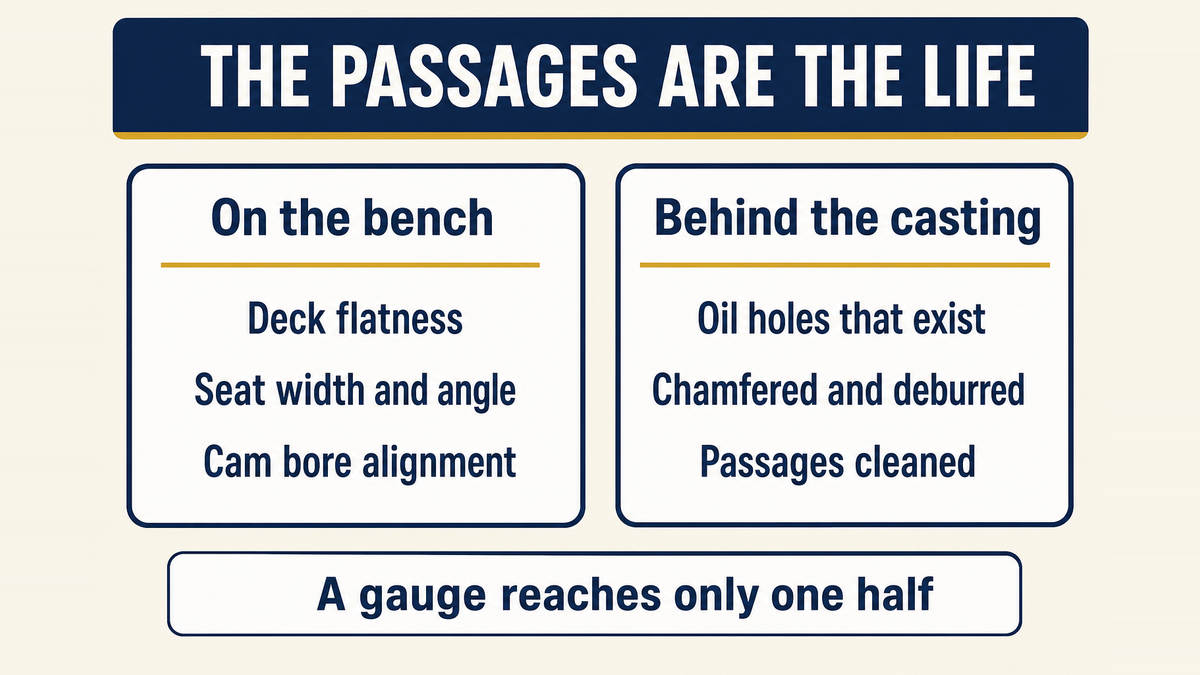
So the specification for a head has two halves that a buyer can actually hold the supplier to. The first is the visible machining: deck face flatness, valve seat width and concentricity, cam bore size and alignment. The second is the invisible work: that the oil holes exist, are the right size, are chamfered, are deburred, and that the passage behind them was cleaned. A supplier can show the first with a gauge. The second takes a pressure test and a schedule.
8. New, Used or Reconditioned
Two things in this article's own search results make the rebuilt question unavoidable for a cylinder head in a way it was not for the parts before it.
The first is that the top result for the phrase is a remanufacturer — a business whose trade is taking used cylinder heads and returning them to service. A part that is routinely rebuilt is a part where the buyer's first question has to be what they are actually being offered.
The second is the 2025 campaign above, where cylinder heads sold as replacement parts were recalled by part number and the fix was to read a serial number.
The rule is the same one quoted in the previous article, and it is worth repeating here because it names the three possible states of a part in three words. Under the federal rule on rebuilding an engine, the parts installed must be "new, used, or rebuilt" so that a person familiar with engine design and function would expect the engine to control emissions at least as well as it did with the original parts — and the work must be recorded in a list of the parts and components used, kept for at least two years.
For a cylinder head the practical version is shorter. Reconditioned heads are a normal part of this market and are not a problem in themselves. What matters is that the state of the part is stated. A head that has been decked to remove warping has lost some of its height, and on a modern engine that changes the compression ratio. A head with a crack repaired by welding is not the same structure as a new casting. Neither of those makes the part unfit to sell. They are the reasons a supplier has to say which of the three the part is.
9. What a Cheap Cylinder Head Quote Drops
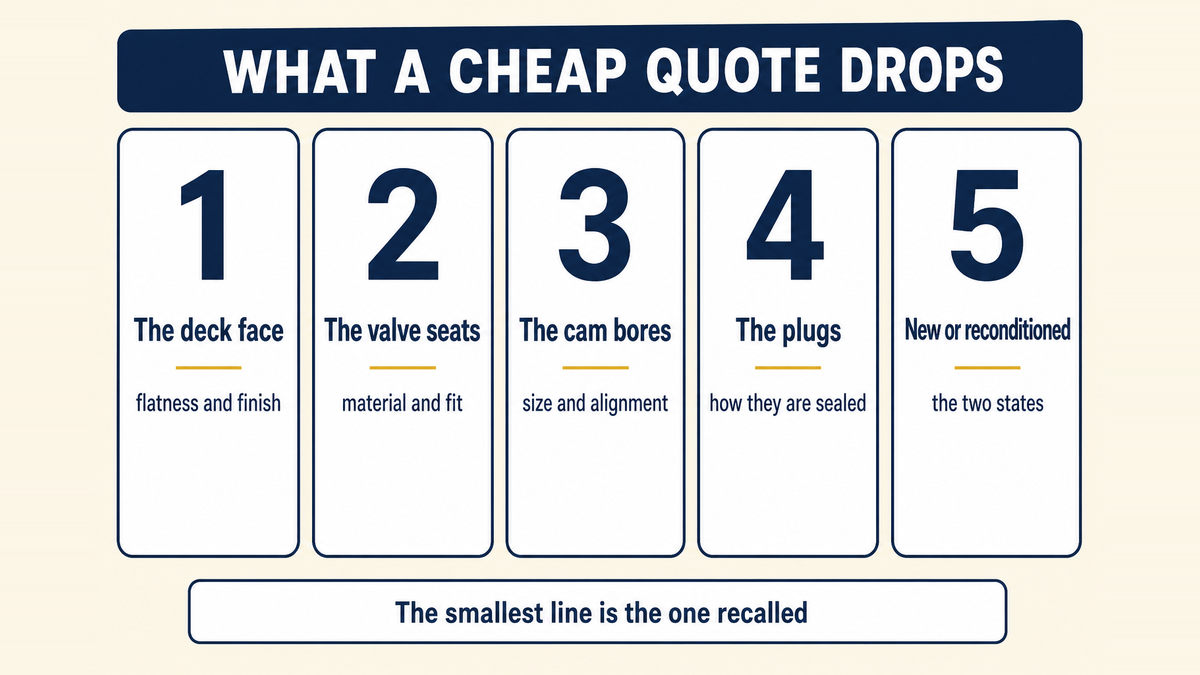
A cylinder head's cost sits in machining, testing and the plugs far more than in the metal. Five places a low quotation comes from:
The deck face. Flatness and surface finish, with the figure and the method. This is the face that seals combustion pressure, coolant and oil at once, and it is the first thing a supplier is tempted to quote as "machined".
The valve seats. The material, and whether the seat was pressed in or machined into the casting. Seat width and angle decide whether the valve seals hot.
The cam bores. Size and alignment. A camshaft running in bores that are out of line will wear the head and the camshaft together, and no bearing can correct it.
The plugs. Which plugs, fitted to what depth, sealed with what. This is the smallest line in the quotation and the one the 2025 campaigns are entirely about.
New or reconditioned. Two words, and the two states the rebuilding rule asks about.
10. Six Checks and Where the Price Comes From
Six checks cover a cylinder head on a sample table.
- Deck face flatness, measured with a straight edge and a feeler gauge or a flatness gauge, in several directions and not in one.
- Valve seat width and position, and how the seat was put in — pressed or machined in.
- Cam bore size and alignment, since misalignment cannot be corrected later by any bearing.
- Every plug, checked for presence, depth and seal — the feature with the longest history in this article.
- A pressure test of the water jacket. A head can look perfect and still leak, and this is the only check that finds a passage problem before the engine runs.
- The oil holes — that they exist, that they are the right size, that they are chamfered and deburred and the passage behind them is clean — plus a statement of whether the part is new or reconditioned.
On the factory side the usual questions apply: whether the castings come from the supplier's own foundry or a third party, whether the seats and guides are fitted in house, and who signs off the first article. Our sequence is in the factory audit checklist, and the machining side is covered in metal stamping and machined parts. Where a supplier also holds a social or ethical audit, the scheme behind the certificate is worth reading — see social audit schemes compared.
A cylinder head's price is built from the casting, the machining of the deck and the bores, the fitting of seats and guides, the plugs, the pressure test and the final cleaning. The casting sets the base cost, but the checks do not scale with volume the way machining does, which is why a low quotation usually comes out of the testing and the plug work rather than out of the alloy.
Cast aluminium is light for its volume but a head is bulky, so it takes up space before it takes up weight — the method is set out in how volume decides what a shipment is charged. How the goods are described for entry is the subject of how an HTS code is assigned, and the origin paperwork behind it is set out in the certificate of origin guide.
11. Frequently Asked Questions
Does a cylinder head fall under any federal inspection standard?
No. The in-use inspection standard is organised as one section per system and covers brakes, brake power unit, steering, suspension, tyres and wheel assemblies, with no engine section. Nothing in it directs an inspector to look at a cylinder head, so the part carries no federal figure or marking to be checked in service.
What does the federal record show about cylinder head failures?
The term appears in 63 records of the recall file covering 2010 onwards, belonging to 22 campaigns, of which 21 concern the engine part — the exception is a hydraulic cylinder head on an aerial device. Not one campaign is about the shape of a port or the design of a water jacket. Every one is about a joint, a hole or a fastener: the lifting bracket, the head cover, the fuel rail, the head nuts, the rocker shaft bolts and the oil feed pipe. Four campaigns filed between June and December 2025 share the same cause sentence, that the cylinder head may have been improperly manufactured.
What should a cylinder head quotation contain that a cheap one leaves out?
The deck face flatness and surface finish with the figure and method, the valve seat material and whether the seat is pressed or machined in, the cam bore size and alignment, which plugs are used and how they are seated and sealed, the result of a pressure test of the water jacket, and a statement of whether the part is new or reconditioned.
Is a reconditioned cylinder head acceptable?
It is a normal part of this market — the leading result for the phrase is a remanufacturer — and it is not ruled out. The federal rule on rebuilding an engine names parts that are "new, used, or rebuilt" and requires the work to be recorded in a list of the parts used, kept for at least two years. What matters is that the state is declared. A head that has been decked to remove warping has less height than a new one, and a head repaired by welding is not the same structure as a new casting.
Why does a replacement cylinder head have a serial number?
Because in 2025 Ford recalled 2,985 cylinder heads and long block engines sold as replacement parts, described by part number, in which ball plugs could fail and leak oil. The remedy was to inspect the cylinder head serial number and replace the assembly where needed. A serial number is what lets a maker separate the affected parts from the unaffected ones — and what lets a buyer trace a batch back to the shift that made it.
A Pressure Decay Test, Run Before Shipment
We return the decay curve per casting, the plug and fastener torque values, and the campaign pattern this casting family repeats.
Run My Decay Test
Questions & Comments
We read every one and reply within 24 hoursA cylinder head is judged by flatness and by the valves it carries, not by its casting. Send the engine and the drawing, and we will set flatness, seat runout and the pressure test.