
Crankshaft Manufacturers: The Oil Hole, Then the Journal
 ·
Updated October 15, 2026
·
13 min read
A crankshaft is the clearest test of an idea that runs through this whole series: for a part like this, a supplier's process is the product. Two facts make the case. The first is how rarely the part appears in the public record — search the federal recall file and the word turns up in fewer than one record in a thousand, and most of those mentions are not about the crankshaft at all. The second is that when the record does name it as the part that failed, not one of the causes is a design fault. Every case comes back to how a hole was finished, how a surface was ground, or how the metal was treated. The remedy follows the same pattern: in a car, a crankshaft is almost never replaced on its own.
1. A Crankshaft Is a Set of Dimensions
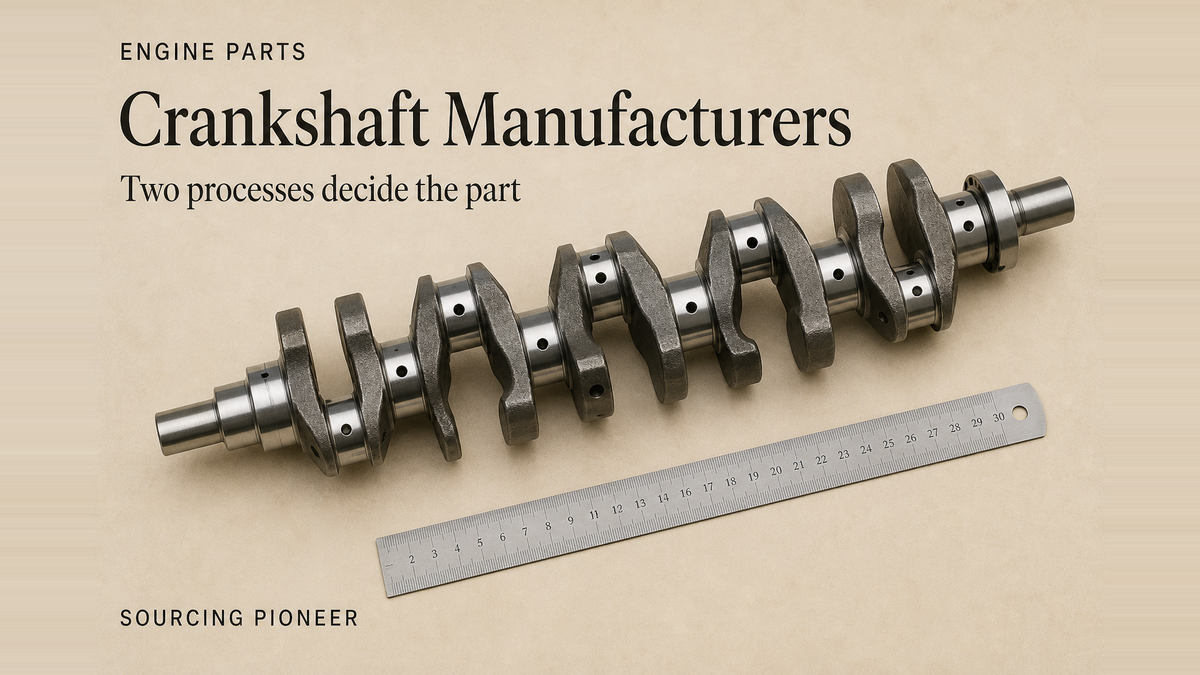
A crankshaft turns the up-and-down motion of the pistons into rotation. The connecting rods push and pull on its offset journals, and the shaft carries that load through its main journals into the block.
That is the whole of its job, and every part of it is a measurement. Main journals run in the block's bearings. Rod journals, often called pins, carry the connecting rods. Fillets are the curved corners where a journal meets a counterweight, and they are where bending stress gathers, which is why the radius there matters more than it looks. Oil holes are drilled through the journals so that oil can reach the rod bearings. At the front there is a nose carrying a pulley, damper or sprocket, and at the back a flange carrying the flywheel or flexplate.
None of that is a shape preference. A crankshaft that is a few thousandths of an inch out on a journal will not hold an oil film at the bearing that rides on it. A shaft that is not balanced will shake the engine at speed. So when a supplier describes a crankshaft, what matters is a set of numbers and the processes used to hold them.
| The element | What it decides | What a vague quote hides |
|---|---|---|
| The main journals | Whether the shaft turns true in the block | Diameters, tolerance and roundness |
| The rod journals | Whether the rod bearings survive | Size, roundness and surface finish |
| The oil holes | Whether oil reaches the rod bearings | The chamfer, the deburring and how clean the passage is |
| The fillets | Where bending stress gathers | The radius, and whether grinding left it alone |
| The surface hardness | How the journals wear | The method and the depth |
| The nose and the flange | Whether the pulley and flywheel run true | Runout and the joint faces |
What this guide covers
- A crankshaft is a set of dimensions
- The inspection standard has no engine section
- What the federal record says about the part
- When the record does name the part
- The oil hole comes first, then the journal
- The remedy is never the crankshaft alone
- New, used or rebuilt — and what ships together
- What a cheap crankshaft quote drops
- Six checks and where the price comes from
- Frequently asked questions
2. The Inspection Standard Has No Engine Section
A crankshaft therefore has no federal figure to be checked against in service. The in-use inspection standard is built as one section per system, and it covers brakes, brake power unit, steering, suspension, tyres and wheel assemblies. There is no engine section, so nothing in it tells an inspector to measure a journal.
That places the crankshaft in the same position as the other engine internals in this series. What governs it is the engine it goes into, and the rules that decide what may be sold for that engine and what the part has to be declared to be. Both of those turn out to matter a great deal for this component.
3. What the Federal Record Says About the Part
Because there is no inspection figure to work from, the useful question is what the public record actually contains. The vehicle safety agency publishes its full recall file, so this can be measured rather than guessed at. We downloaded the release covering recalls from 2010 onwards, searched every record for the word, and counted.
The file holds 245,845 records. The word crankshaft appears in 238 of them, and those records belong to 32 separate campaigns. For scale, the same file contains 28,639 records mentioning brakes, 16,162 mentioning air bags and 9,707 mentioning a fuel pump. Measured that way, brakes appear in about one record in nine; a crankshaft campaign works out at roughly one for every 7,700 records in the file.
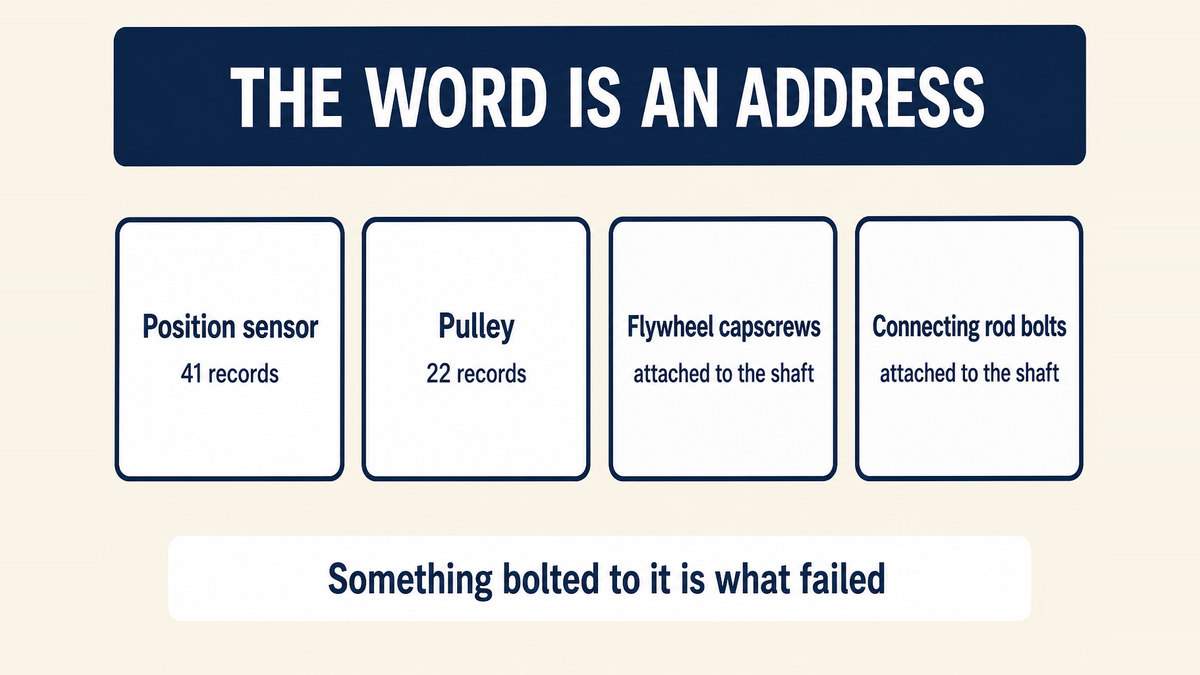
What those 238 records are about is more useful than the number itself. Of the 238, 41 say crankshaft position sensor — a sensor that reads the shaft, not the shaft. Another 22 say crankshaft pulley — an accessory bolted to the nose. In both cases the crankshaft is being named as an address rather than as a failure.
The clearest example is also one of the earliest in the file. Toyota's campaign 11V539000, filed on 9 November 2011, covers 2004 and 2005 Camry, Camry Solara, Highlander and Sienna vehicles plus two Lexus models. The defect was in the crankshaft pulley, and it was a bonding problem:
THE AMOUNT OF ADHESIVE AGENT APPLIED BETWEEN THE OUTER RING AND THE TORSIONAL RUBBER DAMPER (INNER RING) IN THE CRANKSHAFT PULLEY MAY BE INADEQUATE. IF THE ADHESIVE IS INSUFFICIENT, THERE IS A POSSIBILITY THAT THE OUTER RING MAY BECOME MISALIGNED AND IT MAY NOT PROPERLY ROTATE WITH THE INNER RING, CAUSING NOISE AND/OR ILLUMINATION OF THE BATTERY DISCHARGE INDICATOR LIGHT.
Toyota campaign 11V539000, agency recall record (read 15 October 2026)
The consequence reached further than noise. In some cases the belt for the power-steering pump could come away from the pulley, and the driver could lose power steering. The remedy was to examine the pulley to see whether it was made by the American supplier, and to replace the pulley where it was. Nothing was done to the crankshaft, because nothing was wrong with it.
Two more shapes of the same pattern are worth knowing. Several campaigns turn on the fasteners that hold something to the shaft: Cummins filed 21E009000 for X15 diesel engines because the capscrews attaching the flywheel to the crankshaft could be under-torqued, letting the flywheel come loose. Land Rover's 15V069000 concerns connecting rod bolts that could let a rod separate from the crankshaft. And Polaris filed 14V227000 because the crankcase had been machined incorrectly, leaving too little clearance between the crankcase and the crankshaft, which could seize the engine.
So the first thing the record says is that a crankshaft's interfaces — its nose, its flange, the journals carrying the rods, and the clearance around them — are where trouble shows up. The part itself is usually the last thing to be blamed.
4. When the Record Does Name the Part
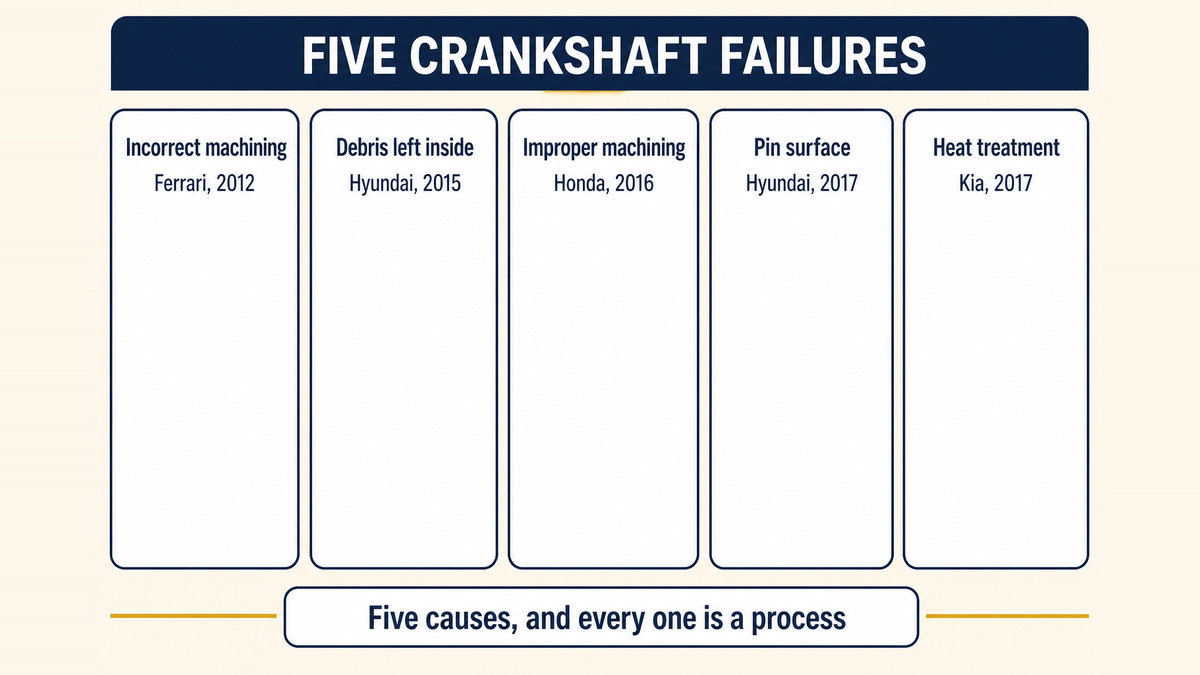
Thirty-two campaigns mention the crankshaft. Five of them name it as the item that failed, and those five are the most useful documents in this article, because between them they list every cause that has actually happened.
- Ferrari, campaign 12V211000, filed 14 May 2012. The crankshaft in the 2011–2012 458 Italia and the 2012 California "may fail due to incorrect machining". The consequence recorded is that the engine may seize, suddenly making the car undrivable.
- Hyundai, campaign 15V568000, filed 10 September 2015, for 2011–2012 Sonata. "Metallic debris may not have been fully removed during manufacturing of the engine crankshaft." Debris left inside the part can restrict oil flow through the connecting rod bearings and damage the rod, producing a metallic knocking noise before the engine fails.
- Honda, campaign 16V528000, filed 12 July 2016, for CBR300R and CB300F motorcycles. An improperly machined crankshaft could cause the connecting rod bearing retainer to fail.
- Hyundai, campaign 17V578000, filed 21 September 2017, for 2017 Santa Fe with 3.3-litre engines. The crankshaft assemblies "may have been produced with surface irregularities in the crankshaft pin", causing engine bearing wear.
- Kia, campaign 17V586000, filed 25 September 2017, for 2017 Sorento with 3.3-litre engines. The crankshaft "may have been improperly heat treated and may fail". The record adds a consequence worth reading twice: a failed crankshaft stalls the engine, and a failed crankshaft also increases the risk of a fire.
Look at that list as a manufacturer and the pattern is not subtle. Not one of the five is a design fault. There is no complaint about the shaft's shape, its counterweights or its geometry. The five causes are incorrect machining; debris left inside the part; machining again; surface irregularities on a journal; and heat treatment. All five are steps in making the part, and two pairs of them are the same step described in different words.
There is one more thing in that list. Hyundai's report date for the Santa Fe campaign is 20 September 2017 and Kia's for the Sorento is 21 September 2017 — one day apart. Both concern 3.3-litre engines, both remedies began on 6 November 2017, and one names the pin surface while the other names heat treatment. Two brands filed within a day of each other, for the same engine size, on two different process steps.
5. The Oil Hole Comes First, Then the Journal
If you have to pick one thing to check on a crankshaft, the record points at the oil holes. Several of the failures above are about the machined and cleaned condition of the part rather than about its dimensions, and the Hyundai Sonata campaign shows why that matters so much.
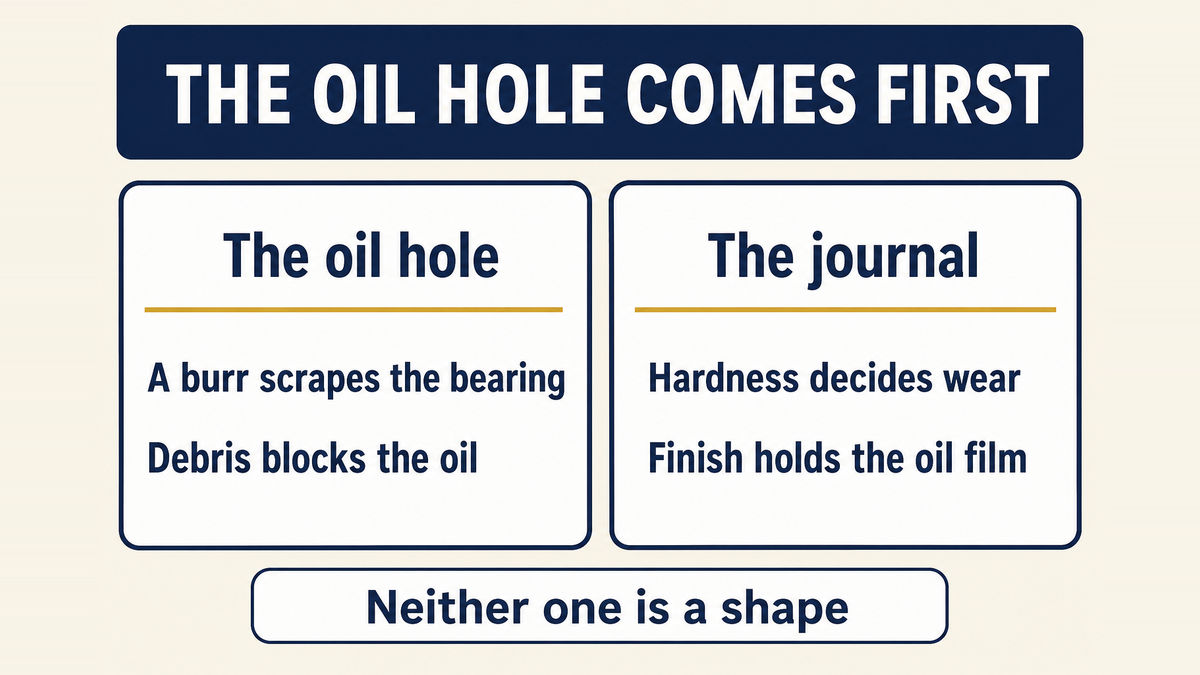
A crankshaft's oil holes are drilled at an angle through each journal so that pressurised oil can travel from the main bearing up to the rod bearing. Oil leaves the hole on the surface of the journal — the same surface the bearing rides on. That exit is the risk. A burr left at the edge of the hole is a cutting tool sitting inside the bearing, and swarf left in the passage is a blockage waiting to happen. Neither can be seen from the outside of a finished part, and neither appears in a dimensional check.
Why the record keeps returning here is simple: the rod bearing is the first to suffer. If oil flow is reduced or the oil is contaminated, the bearing wears, clearance opens, and the rod begins to knock. That is the sequence Hyundai described in 2015, and it is also the mechanism behind Honda's 2016 campaign for an improperly machined crankshaft that could fail the rod bearing retainer.
The second discipline is the journal surface and what sits beneath it. Kia's 2017 campaign is about heat treatment: the journals and fillets of a crankshaft are surface-hardened, because that is where the load lands, and if the process is not right the part can hold the correct dimensions and still break. Hyundai's campaign in the same week is about surface irregularities on the pin — a shape problem at a scale smaller than a tolerance. Together the two cover what a drawing cannot tell you: how hard the surface is, and how smooth it is.
The upshot for a specification is narrow and specific. Two things are worth writing down: the oil-hole finish — the chamfer at the exit, how the hole is deburred, and how the passage is cleaned — and the journal hardness with a stated depth and a stated method.
6. The Remedy Is Never the Crankshaft Alone
Read the remedy lines in those campaigns and one thing stands out. In almost every case the maker replaced the engine or the engine sub-assembly, not the crankshaft.
- Kia, 17V586000: inspect the crankshaft and, where needed, replace the engine sub-assembly.
- Hyundai, 17V578000: inspect and replace the engine, where needed.
- Hyundai, 15V568000: replace the engine assembly where needed — and extend the warranty on the engine sub-assembly, or short block, to ten years or 120,000 miles for original and later owners.
- Ferrari, 12V211000: offer the owner the choice of repairing or replacing the engine.
- Land Rover, 15V069000: replace the affected engines.
- Honda, 16V528000: replace the crankshaft assembly — the one case where the part itself was the remedy, and it was a motorcycle.
- Toyota, 11V539000: examine and replace the pulley.
The commercial reading is straightforward. In a car, a crankshaft is not normally sold as a service part on its own; it is part of a short block. So a fault in the crankshaft becomes an engine-level claim, and the cost of getting it wrong is measured in engines rather than in parts. That is why the ten-year, 120,000-mile short-block warranty in the Hyundai campaign is the most telling line in the whole file: an engine maker's answer to a crankshaft process fault was to stand behind the block for a decade.
For a buyer, that is the reason a crankshaft argument never really stays about the unit price. The part's cost sits inside the cost of a much larger claim, and the number that carries the risk is the warranty term, not the quotation.
7. New, Used or Rebuilt — and What Ships Together
Two sets of rules bear on a crankshaft that most buyers never connect: the emission rules for rebuilding an engine, and the trade orders that decide when a box of engine parts is treated as an engine.
The rebuilding rule first. The federal emission rules include a section on rebuilding an engine, and it exists to keep a rebuild from breaking the tampering rule. It defines rebuilding as a major overhaul in which you replace the engine's pistons or power assemblies, and it says what is not a rebuild — scheduled maintenance such as replacing fuel injectors, and unscheduled work of the kind that happens in normal life. The rule's own example is that replacing a water pump is not rebuilding an engine.
What follows is the part that matters to a supplier. A rebuild has to rest on a reasonable technical basis that the rebuilt engine's emission controls work as well as they did in its certified form, and the rule states the condition like this:
Install parts—new, used, or rebuilt—so a person familiar with engine design and function would reasonably believe that the engine with those parts will control emissions of all pollutants at least to the same degree as with the original parts.
40 CFR 1068.120(d)(1), eCFR (read 15 October 2026)
Three words, in the regulation: new, used, or rebuilt. That is exactly the choice this article keeps returning to, and the rule then requires records that list the parts and components used in the rebuild, kept for at least two years and shown to the agency on request.
Follow that back to the supplier and the demand is plain. A buyer who rebuilds has to be able to say what went in. A supplier who cannot state whether a crankshaft is new, used or rebuilt has left their customer unable to answer.
The trade rule reads the other way, and it is the most commercially charged fact in this article. The United States maintains antidumping and countervailing duty orders on certain vertical shaft engines and parts of them from China. Those orders were first published in March 2021 and were continued on 11 August 2026. What the scope says about parts is what matters:
For purposes of these Orders, an unfinished engine covers at a minimum a sub-assembly comprised of, but not limited to, the following components: crankcase, crankshaft, camshaft, piston(s), and connecting rod(s). Importation of these components together, whether assembled or unassembled, and whether or not accompanied by additional components such as an oil pan, manifold, cylinder head(s), valve train, or valve cover(s), constitutes an unfinished engine for purposes of these Orders.
91 FR 53844, 20 August 2026, Federal Register (read 15 October 2026)
The scope also states where those sub-assemblies enter, under a specific tariff heading, and adds a sentence that rules out one obvious route around it: components added in a third country do not take the engine out of scope. Enforcement has moved the same way, with a circumvention inquiry opened in July 2025 at a manufacturer's request, covering the smaller engine band.
For a crankshaft buyer the reading is concrete. A crankshaft on its own is one product. A crankshaft shipped together with the crankcase, camshaft, piston and connecting rod is, for entry purposes, an unfinished engine. The same five parts, in the same box, land in two different places. Whether the parts travel together is therefore a decision that belongs in the sourcing plan, not in the shipping department.
8. What a Cheap Crankshaft Quote Drops
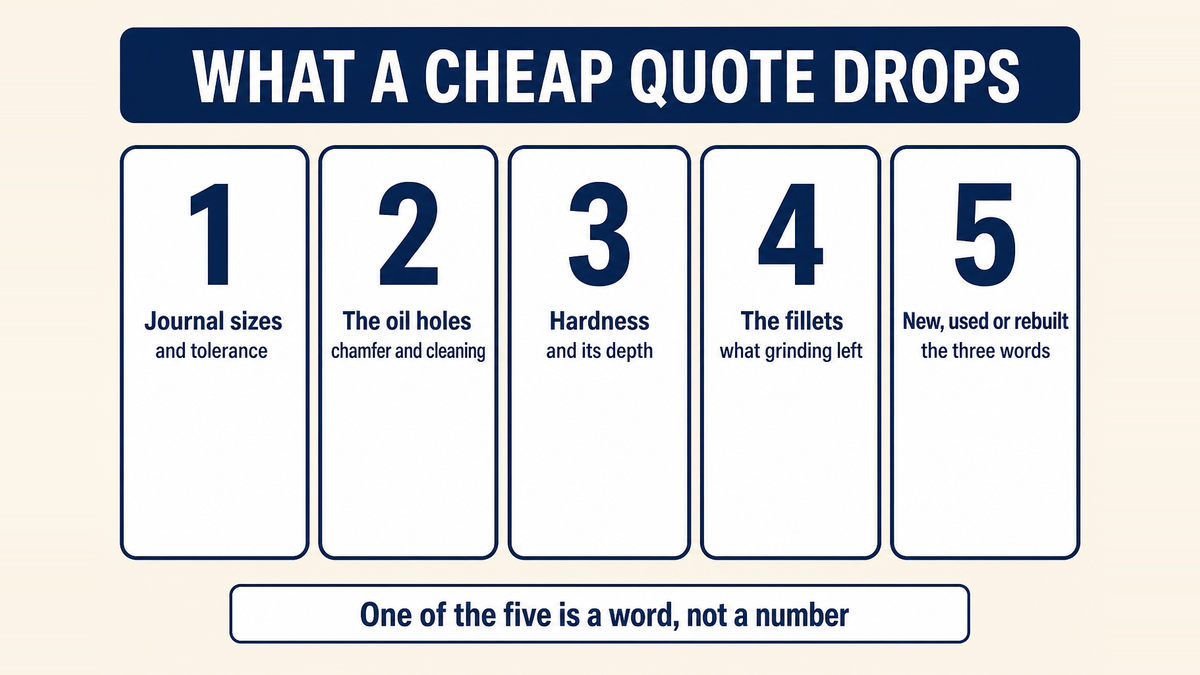
A crankshaft is a heavy steel part whose cost is mostly in processes, and processes do not appear in a photograph. Five places a low quotation comes from:
The journal sizes and their tolerance. The diameter of each journal sets the bearing clearance that the engine was designed around. A quote that gives one figure for "the journals" has not described a crankshaft.
The oil holes. The chamfer at the exit, how the hole is deburred, and how the passage is cleaned. This is work rather than material, which is exactly why it is the first thing given up.
The hardness and its depth. Not a claim that the journals are hardened, but the method and the figure. This is the property that decides whether the part lasts.
The fillets. Whether grinding left the radius the drawing calls for. A fillet that has been ground away takes the part's resistance to bending with it.
New, used or rebuilt. One word, and the word the rebuilding rule asks about.
9. Six Checks and Where the Price Comes From
Six checks cover a crankshaft on a sample table.
- Journal diameters, measured with a micrometer at several points along each journal and at both ends, because a journal can be tapered.
- Roundness on the rod journals, since a pin that is not round cannot hold an oil film.
- The oil-hole exit, examined closely and probed, plus the cleanliness of the passage behind it.
- Fillet radius, checked with a radius gauge against the drawing rather than by eye.
- Hardness, measured at a stated place, with the method and the depth on the report.
- Straightness, runout and balance — a shaft that is not true cannot be corrected by bearings — and a statement of whether the part is new, used or rebuilt.
On the factory side the usual questions apply: who supplies the forgings or castings, whether heat treatment and final grinding are done in house, and who signs off the first article. Our sequence is in the factory audit checklist, and the machining side is covered in metal stamping and machined parts. Where a supplier also holds a social or ethical audit, the scheme behind the certificate is worth reading — see social audit schemes compared.
A crankshaft's price is built from the blank, the machining of journals and oil holes, the heat treatment, the final grinding and the balancing. The blank and the machining set the base cost. Heat treatment, grinding and the work on the oil holes are where the part's life is decided, and they are where a supplier can save without changing how the part looks.
Weight is high for its size, because steel is dense, so a crankshaft moves largely on mass — the method is set out in how volume decides what a shipment is charged. A quotation worth comparing names the journal sizes and tolerance, the oil-hole finish, the hardness and its depth, the fillet radius, the runout and balance limits, and whether the part is new, used or rebuilt. How the goods are described for entry is the subject of how an HTS code is assigned, and the origin paperwork behind it is set out in the certificate of origin guide.
10. Frequently Asked Questions
Does a crankshaft fall under any federal inspection standard?
No. The in-use inspection standard is organised as one section per system and covers brakes, brake power unit, steering, suspension, tyres and wheel assemblies, with no engine section. Nothing in it directs an inspector to measure a crankshaft, so the part carries no federal figure or marking to be checked in service.
Does the federal recall record show crankshafts failing?
Rarely, and the pattern is more useful than the count. In the recall file covering 2010 onwards, the word crankshaft appears in 238 of 245,845 records, belonging to 32 campaigns. Most of those mentions are not about the part itself: 41 records name a crankshaft position sensor and 22 name a crankshaft pulley. Where the part is named as the failed item, the causes are manufacturing process steps — machining, debris left inside the part, surface finish on a journal, and heat treatment — rather than a fault in the design.
Which two things should I check first on a crankshaft?
The oil holes and the journal surface. The oil holes are drilled through the journals so oil can reach the connecting rod bearings, and the exit sits on the bearing surface, so a burr or debris there damages the bearing the shaft has to run in. The journal hardness and finish decide how that bearing surface wears. Between them they cover the causes that appear most often when the part is named in a recall.
If I import a crankshaft together with the rest of the bottom end, does that change anything?
Yes. The antidumping and countervailing duty orders on certain vertical shaft engines and parts of them from China define an unfinished engine as a sub-assembly that includes at least the crankcase, crankshaft, camshaft, piston and connecting rod, and state that importing those components together — assembled or unassembled — makes an unfinished engine. Sub-assemblies enter under a specific tariff heading, the orders were continued on 11 August 2026, and components added in a third country do not take the goods out of scope.
Is a rebuilt crankshaft allowed?
The federal emission rule on rebuilding engines names parts that are "new, used, or rebuilt" and requires a rebuild to control emissions at least as well as the original parts did, with a record listing the parts and components used, kept for at least two years and shown on request. A rebuilt crankshaft is therefore contemplated rather than ruled out — but it has to be declared as rebuilt and supported by that record.
Every Journal, Its Tolerance, and the Hole
We return main and rod diameters with their tolerance bands, the oil hole position and chamfer, and the hardness method used.
Chart My Journals
Questions & Comments
We read every one and reply within 24 hoursTrying to get a supplier to state the oil-hole finish instead of just saying the holes are deburred, working out whether a crankshaft is new, used or rebuilt, or checking whether shipping the bottom end together changes the declaration? Send us the engine and the market, and our team will put the specification in writing.