
Control Arm Manufacturers: An Axle Positioning Part, and the Two Ends That Wear
 ·
Updated October 15, 2026
·
12 min read
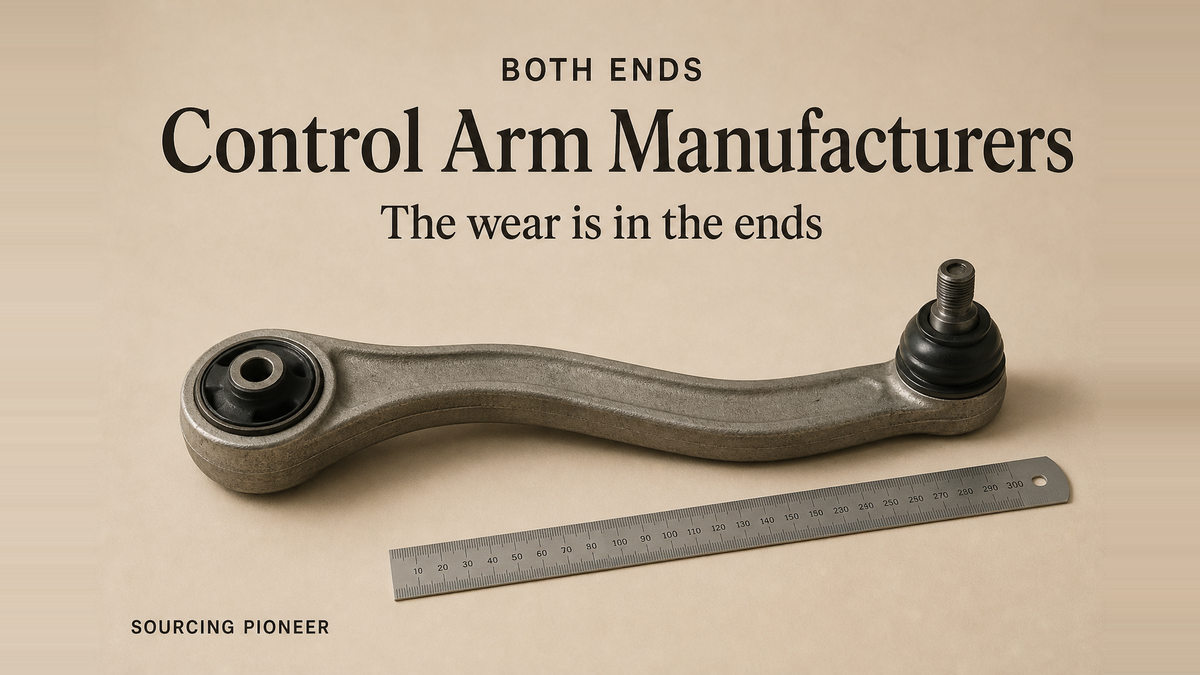
A control arm is the link that holds a wheel where the designer put it. It carries no load in the sense a spring does, and it damps nothing in the sense a shock absorber does. Its whole job is position, and the rules say so in the plainest way available: the commercial vehicle rule groups it under a heading called axles and calls it an axle positioning part. That single phrase explains why the criteria for this part are about shape, attachment and alignment — and why almost none of them describe the arm itself. The arm is a welded steel assembly, and the wear that gets it failed lives in two small components at its ends.
1. What a Control Arm Is
A control arm — a wishbone, a track control arm, a link — is a steel arm with a pivot at each end. One end attaches to the vehicle body or subframe through a bush, which allows the arm to swing while isolating noise. The other end attaches to the wheel hub assembly, either through a bush with a separate ball joint or through an integrated ball joint that also lets the hub steer.
Everything about the part follows from that. The arm locates the wheel, so its length and its pivot points set the wheel's position — and therefore the alignment. The ends allow movement, so they are the parts that wear. And because the arm is steel in a wheel arch, it is exposed to everything the road throws at the underside of a car.
| The element | What it decides | What a vague quote hides |
|---|---|---|
| The arm itself | Wheel position and alignment | Pivot-to-pivot length and angles |
| The bush | Noise, comfort, and staying located | Rubber hardness and bonding method |
| The ball joint | Whether the hub can steer freely and safely | Preload and the condition of the seal |
| The coating | How long it resists corrosion | Coating type and coverage at the welds |
What this guide covers
- What a control arm is
- The rule calls it an axle positioning part
- The wear lives in the ends
- The boot has one job
- Corrosion is the named mechanism
- Adjustable arms are a separate product
- What a cheap control arm quote leaves out
- What to check on a sample
- Where the unit price comes from
- Frequently asked questions
2. The Rule Calls It an Axle Positioning Part
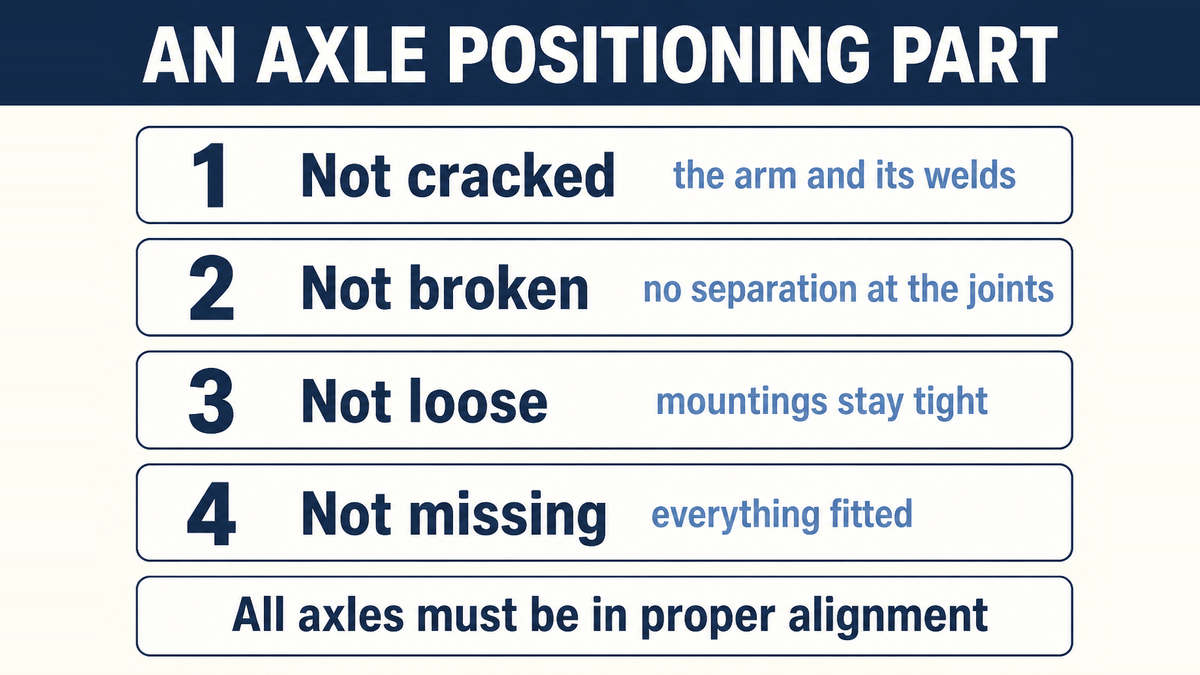
The most useful sentence written about a control arm is in the commercial vehicle rules, and it never uses the words control arm at all. It uses a functional name instead, and then states four conditions and one alignment requirement:
Axles. No axle positioning part shall be cracked, broken, loose or missing. All axles must be in proper alignment.
Federal Motor Carrier Safety Administration, 49 CFR 393.207(a), Suspension systems (read 15 October 2026)
Read the four conditions as a checklist against the product. A control arm may not be cracked, broken, loose or missing — and because it positions the axle, the vehicle's alignment is a requirement in its own right. A part whose only real function is position is regulated on exactly that: the position must be right.
The light vehicle rule says the same thing from the structural side, and adds the two ends explicitly:
Ball joint seals shall not be cut or cracked. Structural parts shall not be bent or damaged. Stabilizer bars shall be connected. Springs shall not be broken, or extended above the vehicle manufacturer's design height. Spacers, if installed, shall be installed on both front springs, both rear springs, or on all four springs. Shock absorber mountings, shackles, and U-bolts shall be securely attached. Rubber bushings shall not be cracked, extruded out from or missing from suspension joints. Radius rods shall not be missing or damaged.
National Highway Traffic Safety Administration, 49 CFR 570.8(a), Suspension systems (read 15 October 2026)
So the criteria for this part are short, and every one of them is a property a buyer can specify: not bent, not damaged, not cracked, not broken, not loose — and the parts at the ends in good order.
The heavier-vehicle version of the same rule is almost identical, with one addition that decides what a supplier can ship. Where the light rule asks only that a ball joint seal shall not be cut or cracked, the heavy rule adds three words:
Ball joint seals shall not be cut or cracked, other than superficial surface cracks. Ball joints and kingpins shall not be bent or damaged.
National Highway Traffic Safety Administration, 49 CFR 570.61(a), Suspension system (read 15 October 2026)
The same boot is therefore judged differently depending on the weight class: a superficial crack that the light-vehicle rule does not excuse is explicitly tolerated on a heavier one. A buyer shipping a single boot specification into both markets is selling against two acceptance standards without saying so.
There is one further consequence buried in that alignment requirement. A control arm sets the wheel's position, so an arm whose pivot points are a few millimetres out changes camber and toe on that corner — and misalignment shows up as uneven tyre wear long before it shows up as a handling complaint. That matters commercially because a wholesale buyer who supplies an arm that is dimensionally out will hear about it through the end customer's tyre bill rather than through a return. The dimensional tolerance on a control arm is not a manufacturing detail; it is the part's function, measured somewhere else on the vehicle.
3. The Wear Lives in the Ends
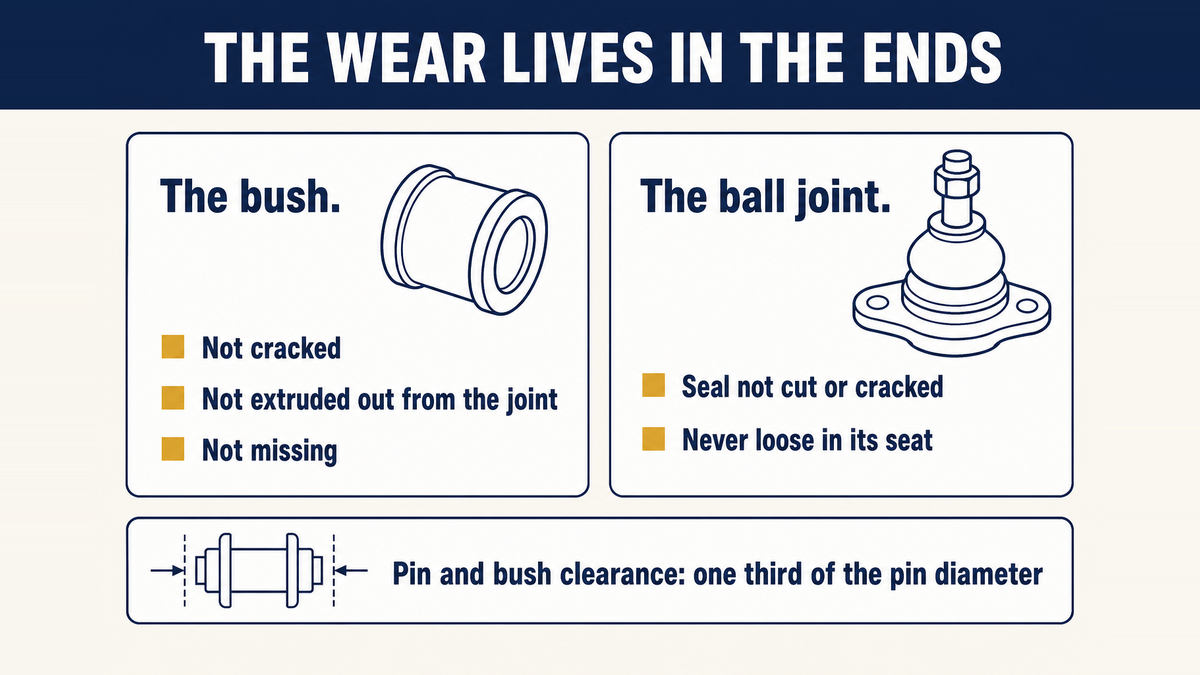
Now the sentence that should change how a control arm is quoted. The rule does not ask whether the arm is worn. It asks whether the rubber is, and it names three ways for a bush to fail:
Rubber bushings shall not be cracked, extruded out from or missing from suspension joints.
National Highway Traffic Safety Administration, 49 CFR 570.8(a), Suspension systems (read 15 October 2026)
"Extruded out from" is the phrase to sit with. A bush that is squeezed out of its joint has not simply aged — the rubber has been pushed past where it was designed to sit, which means the load path, the rubber itself or the way it is held in the arm was wrong. Cracked rubber is wear; rubber that has been extruded out of the joint is a design or process failure, and it is the one a buyer is most likely to receive from a factory that treated the bush as a bought-in commodity.
The British inspection document goes further and puts a number on bushing wear, at least for the pinned joints it applies to: "A suspension anchor/shackle pin and or bush excessively worn… Diametric clearance in excess of one third diameter of pin." A third of the pin diameter is the line between a worn bush and a failed one, and it is a criterion that a supplier can be asked to design against.
The same document explains what the bushes are for in one line, and the wording is a requirement rather than a description. Where bonded bushes and mountings are used, "these must be in such a condition as to adequately locate the suspension unit". The test is not how the rubber feels — it is whether the suspension is still located by it.
4. The Boot Has One Job
Ball joints and bushes are protected by a rubber boot, and the rules treat the boot as an item in its own right rather than as trim. The American requirement is short — "Ball joint seals shall not be cut or cracked" — while the British inspection document states both the defect and its purpose:
Suspension joint dust covers. Dust cover. Missing or severely deteriorated so as to no longer prevent the ingress of dirt.
Driver and Vehicle Standards Agency, Categorisation of vehicle defects, part 1, IM 48 Suspension (read 15 October 2026)
The purpose is stated in the wording: keep dirt out. A boot is not there to look finished. It is the only barrier between a precisely machined and greased joint and the grit thrown up by a road, and once dirt is inside, the joint wears at a rate that has nothing to do with how well the arm was built.
Two commercial consequences follow. First, the boot and the grease are part of the specification, not accessories — a boot material that hardens in cold weather or cracks under ultraviolet light will fail the criterion that matters. Second, a boot that is missing or split is a defect on its own even when the joint underneath is still sound, which means the boot is a warranty exposure that a supplier can be asked to address up front rather than after the first shipment returns.
5. Corrosion Is the Named Mechanism
The British entry for the arm itself lists its failure modes, and one of them is corrosion rather than wear. The severity of the defect is then judged by what it does to control:
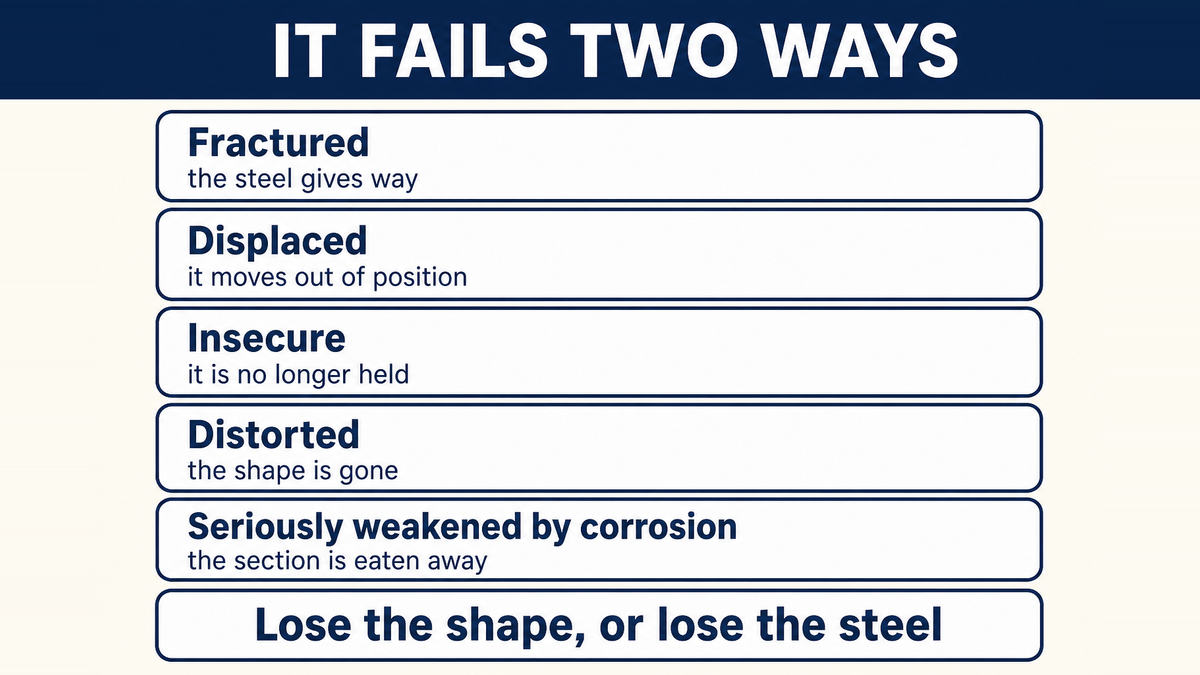
Suspension Arms/Linkages/Sub-frames. An arm, linkage or sub frame fractured/displaced/insecure/distorted/seriously weakened by corrosion damage or wear/is adjustable and has a loose adjustment or its locking device is insecure or missing.
Driver and Vehicle Standards Agency, Categorisation of vehicle defects, part 2, section 5, Axles, wheels, tyres and suspension (read 15 October 2026)
Four words matter here: fractured, displaced, insecure, distorted. Add "seriously weakened by corrosion damage or wear" and the picture is complete — a control arm fails either by losing its shape or by losing its steel. A bent arm is a geometry failure. A corroded arm is a section-thickness failure, and it is the one that a photograph of a new part cannot detect.
That makes the coating a functional specification rather than a finish. On a press-formed and welded arm the coating has to cover the welds and the inside of any enclosed section, because those are precisely where corrosion starts and where a buyer cannot easily look. Where the severity is judged, the document is explicit that it turns on the effect: "Fracture, displacement or distortion adversely affecting directional control" sits in a different severity band from the same defect "which has no immediate effect on the control of vehicle".
6. Adjustable Arms Are a Separate Product
One clause in the same line applies to a product most buyers do not realise they are buying. After listing fracture, displacement, insecurity and distortion, the entry adds: "is adjustable and has a loose adjustment or its locking device is insecure or missing".
An adjustable arm exists to let alignment be set and then held. It therefore carries a locking device, and that device is a defect item in its own right. For a buyer this changes the specification in a specific way: an adjustable arm needs the adjustment range stated, the locking method described, and a check that the lock stays set. An arm that adjusts beautifully and drifts after a thousand kilometres has failed the criterion that the rule cares about, which is that the position must not move.
It also changes the risk profile. A fixed arm is judged on its shape and its bushes; an adjustable arm adds a joint that a fitter can leave loose, which means the fitting instruction matters as much as the part. If you sell into both, the two should not share a single line in a quotation.
7. What a Cheap Control Arm Quote Leaves Out
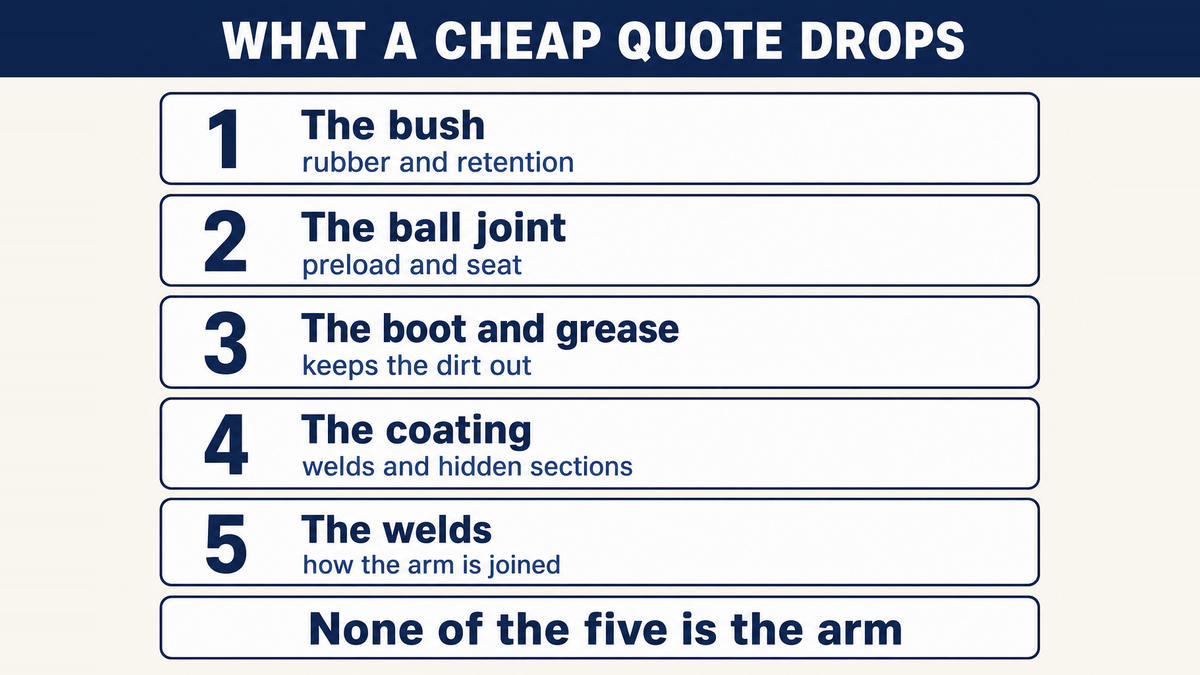
The arm is the visible part and the cheapest thing in the assembly, which is exactly why a quotation that leads with the arm is telling you very little. Five places a low quote tends to come from:
The bush. Rubber hardness, the bonding method and how the rubber is retained in the arm decide whether it stays in place or gets extruded out of the joint. A bush supplied as an inexpensive commodity will meet nobody's specification, because none was written.
The ball joint. Preload and the condition of the seat decide whether the joint moves freely or develops play. This is a precision assembly inside a low-cost part, and it is where a cheap quote is most exposed.
The boot and the grease. A boot that does not seal lets dirt in, and the grease that was never specified is the one that leaks out. Both are visible checks at inspection and both cost very little to do properly, which is why both are commonly the first thing trimmed.
The coating. Coverage at the welds and inside enclosed sections, because that is where corrosion begins and where an inspector will eventually look. A coating that reaches only the surfaces visible in a photograph is a coating that has not done the job the defect entry describes.
The welds. The arm is a formed or stamped assembly joined by welding, so the weld is the part's structural integrity. Weld quality is a process question — procedure, operator qualification and inspection — and it belongs in the factory conversation covered in metal stamping and machined parts.
8. What to Check on a Sample
Because the criteria are shape, attachment and the two ends, a sample check is mostly dimensional and mostly about the joints. Six checks cover the ground.
- Pivot-to-pivot dimensions against the drawing, on more than one piece — the arm's only real function is position, so its length is its specification.
- Bush retention. Whether the rubber can move in its housing under load, and how the rubber is held — bonded, pressed, or retained by the arm's own forming.
- Ball joint feel and preload. Movement that is free but not loose, checked against the seat rather than by hand alone.
- The boot. Material, thickness, coverage and how it is retained at both ends. This is the item most likely to be missing from a sample that was assembled for photographs.
- Coating on the welds and inside sections. Where the corrosion entry says failure will start.
- Weld procedure and inspection records, plus the fasteners and any locking device for adjustable variants.
On the factory side the usual visit checks apply, and our sequence is in the factory audit checklist. Where a supplier also holds a social or ethical audit, the scheme behind the certificate is worth reading — see social audit schemes compared.
9. Where the Unit Price Comes From
A control arm's price is built from the steel and the forming, the welding, the bush, the ball joint, the coating, and the packing. The steel and forming set the base cost. The welding sets the labour and the process control. The two ends are small parts with large influence: they are where the tolerances are tightest and where a buyer's specification has the most effect per dollar.
Weight then decides how the goods move, because an arm is a bulky steel part that is charged on what it weighs — the reverse of the calculation in how volume decides what a shipment is charged. Arms are also an awkward shape to stack, so the packing method and the quantity per carton matter more than they do for a compact part.
A quotation worth comparing therefore names the pivot-to-pivot dimensions, the bush material and method of retention, the ball joint specification, the boot, the coating specification, and the weld standard. How the goods are described for entry is the subject of how an HTS code is assigned, and the origin paperwork behind it is set out in the certificate of origin guide.
10. Frequently Asked Questions
What is an axle positioning part?
It is the functional name the commercial vehicle rules use instead of naming the components. The rule states that no axle positioning part shall be cracked, broken, loose or missing, and that all axles must be in proper alignment. A control arm, a radius rod, a leaf spring and a track bar all position an axle, so all of them fall under that description rather than under a list of part names.
What fails first on a control arm?
The ends rather than the arm. The inspection rule names three ways a rubber bushing can fail — cracked, extruded out from the joint, or missing — and requires that a ball joint seal not be cut or cracked. Rubber that has been pushed out of its joint is not simple wear; it means the rubber, the load path or the way the rubber is held was not right for the job.
Why does a ball joint boot matter so much?
Because the inspection document states its purpose: a dust cover must not be missing or deteriorated to the point where it no longer prevents the ingress of dirt. That is the only barrier between a machined, greased joint and road grit, so a split boot leads to wear that has nothing to do with how well the arm was made. A missing or split boot is also a defect in its own right even when the joint beneath is still sound.
Is a bent control arm a different problem from a worn one?
Yes, and the rules treat them as separate failure families. The inspection entry lists an arm that is fractured, displaced, insecure, distorted, or seriously weakened by corrosion damage or wear. Fracture and corrosion are failures of material; displacement and distortion are failures of shape. A bent arm is a geometry problem, which is why an alignment requirement sits alongside the structural conditions.
What should a control arm quotation contain?
The pivot-to-pivot dimensions, the bush material and how the rubber is retained in the arm, the ball joint specification and preload, the boot material and retention, the coating specification with coverage at the welds, and the weld standard. For an adjustable variant, add the adjustment range and the locking method, because a loose or missing locking device is itself a listed defect.
A Drawing the Pressing Shop Can Work From
We return the ball joint and bushing specification at each end, the boot material, and the corrosion coating the standard names.
Specify My Two Ends
Questions & Comments
We read every one and reply within 24 hoursA control arm is a weldment with two joints, and the joints decide whether it passes. Send the part number and the vehicle, and we will specify the bushings, the ball joint and the weld inspection.