
Automotive Coil Springs: Fracture, Location, and the Ride Height You Choose
 ·
Updated October 15, 2026
·
13 min read
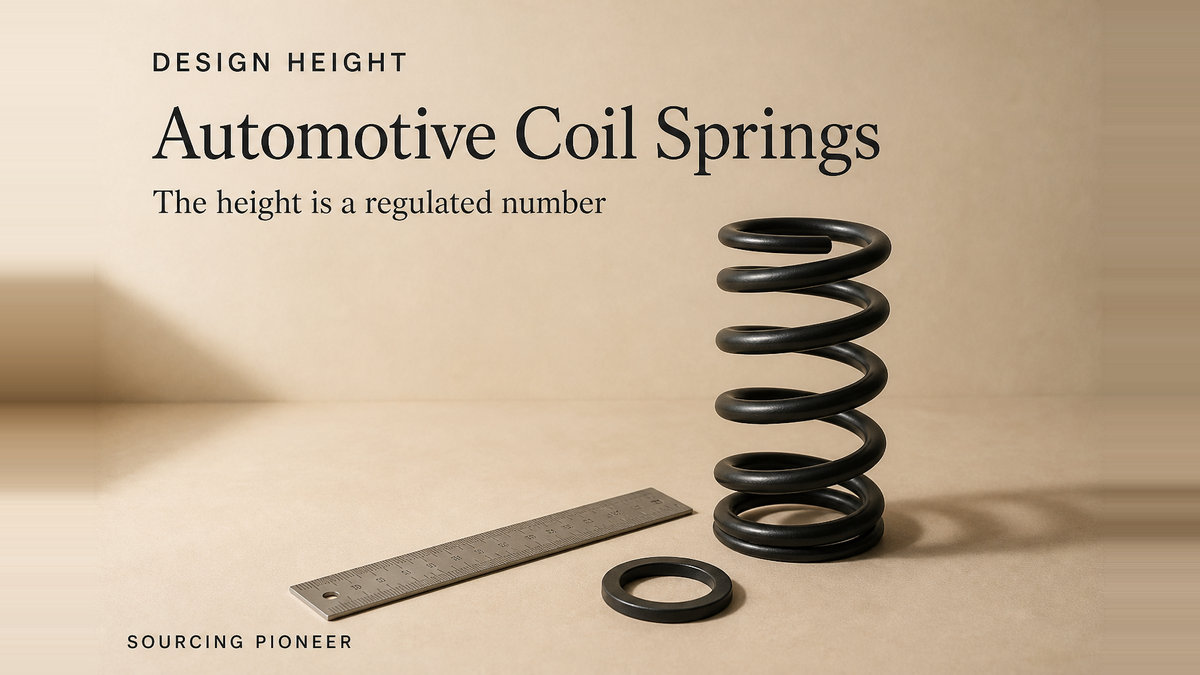
A coil spring is the simplest part in this whole cluster: a bar of spring steel wound into a helix, with no seal, no fluid and no electronics. It is also the only part here that is checked against a dimension the vehicle maker set rather than against a marking or a certificate. Federal inspection rules require springs not to be broken and not to be extended above the vehicle manufacturer's design height. That single clause is where a spring stops being a comfort part and becomes a market-access decision — because the height a spring gives a car is something another inspection item also depends on.
1. What a Coil Spring Is, and the Two Numbers That Define It
A coil spring is a helical bar of spring steel. Push it and it compresses; take the load off and it returns. That is the whole function, and it carries the vehicle's weight at each corner while absorbing road input.
Two numbers define it, and a quotation that gives neither is not a quotation.
- Rate — how much load it takes to compress the spring by a given distance. Rate decides how firm the car feels and how much load it carries before it settles.
- Free length and load height — how long it is unloaded, and how long it is under the vehicle's weight. Free length plus rate is what produces the ride height the vehicle was designed around.
Those two numbers interact. A spring can be shorter and stiffer, or longer and softer, and still sit the car at a similar height while behaving completely differently on the road. That is the reason "same height, same spring" is not a safe assumption, and it is why the useful comparison between two factories is a pair of numbers rather than a centimetre figure.
Manufacturing runs along the same axis. Springs are wound from wire that has been formed and heat treated, then set so the spring does not settle further in service, and finally coated — because a bare steel helix in a wheel arch is a corrosion part as much as a spring. Each step is a cost that a photograph cannot show, and one of the official defect categories in section 2 is a fracture.
| The decision | What it decides | What a vague quote hides |
|---|---|---|
| The wire and the rate | Load carrying and ride firmness | Rate, and the load at ride height |
| Free length | Whether the car sits at design height | The height the spring was designed for |
| Setting and heat treatment | Whether it settles or fractures | Whether the spring is preset at all |
| The coating | How it survives a wheel arch | Coating type and thickness |
What this guide covers
- What a coil spring is, and the two numbers that define it
- Three things an inspector checks
- Ride height is a regulated dimension
- What a height change touches next
- A fracture is officially a random failure
- What a cheap spring quote leaves out
- Springs that ship as an assembly
- What to check on a sample
- Where the unit price comes from
- Frequently asked questions
2. Three Things an Inspector Checks
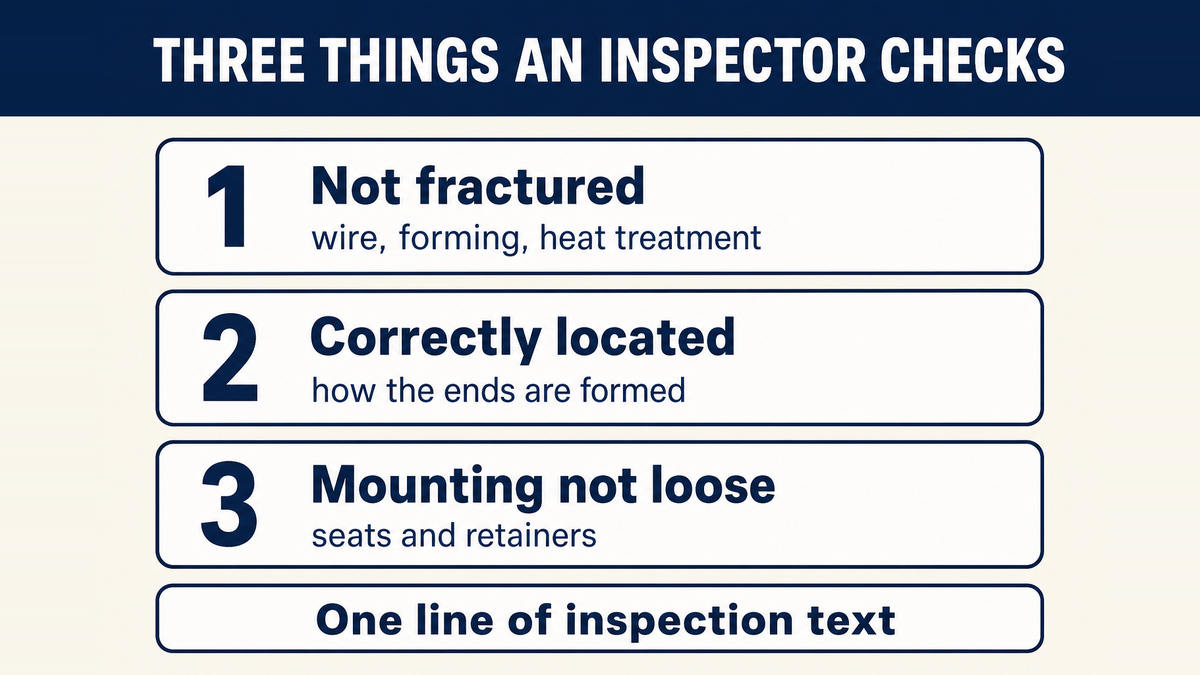
Springs are inspected in plain language, and the wording of the rules is worth reading because it is a specification list dressed as a checklist. The British categorisation document for vehicle inspection puts all three criteria in one line:
Spring holding down bolts loose or missing. Coil spring incorrectly located, spring fractured or mounting loose.
Driver and Vehicle Standards Agency, Categorisation of vehicle defects, part 2, section 5 (read 15 October 2026)
The heavier-vehicle part of the same document is shorter and uses one word where the other uses two: "Coil Spring fractured/damaged or missing." The American rules agree on the core criterion and state it twice, once for inspection and once for commercial operation:
Springs shall not be broken, or extended above the vehicle manufacturer's design height.
National Highway Traffic Safety Administration, 49 CFR 570.8(a), Suspension systems (read 15 October 2026)
Coil springs. No coil spring shall be cracked or broken.
Federal Motor Carrier Safety Administration, 49 CFR 393.207(d), Suspension systems (read 15 October 2026)
Three criteria fall out, and each one is a manufacturing property rather than an installation preference.
Fracture is the criterion every rule names. It is a material and process property: the steel, how the spring was formed, how it was heat treated, and whether it was set afterwards. A buyer cannot inspect for it in a carton, which is why the sampling in section 8 leans on the factory's process records rather than on the part itself.
Location is the criterion that catches bad installation and bad design at once. "Incorrectly located" covers a spring that is not seated properly in its seat, which is a question of how well the spring's ends were formed for the seat they sit in. A spring with the wrong end configuration will fit in a carton and not fit the car.
Mounting appears as "mounting loose" and, in the same line, as "spring holding down bolts loose or missing". Those are the seats, insulators and retainers rather than the spring — and they are the parts most often left out when a supplier quotes the helix on its own.
3. Ride Height Is a Regulated Dimension
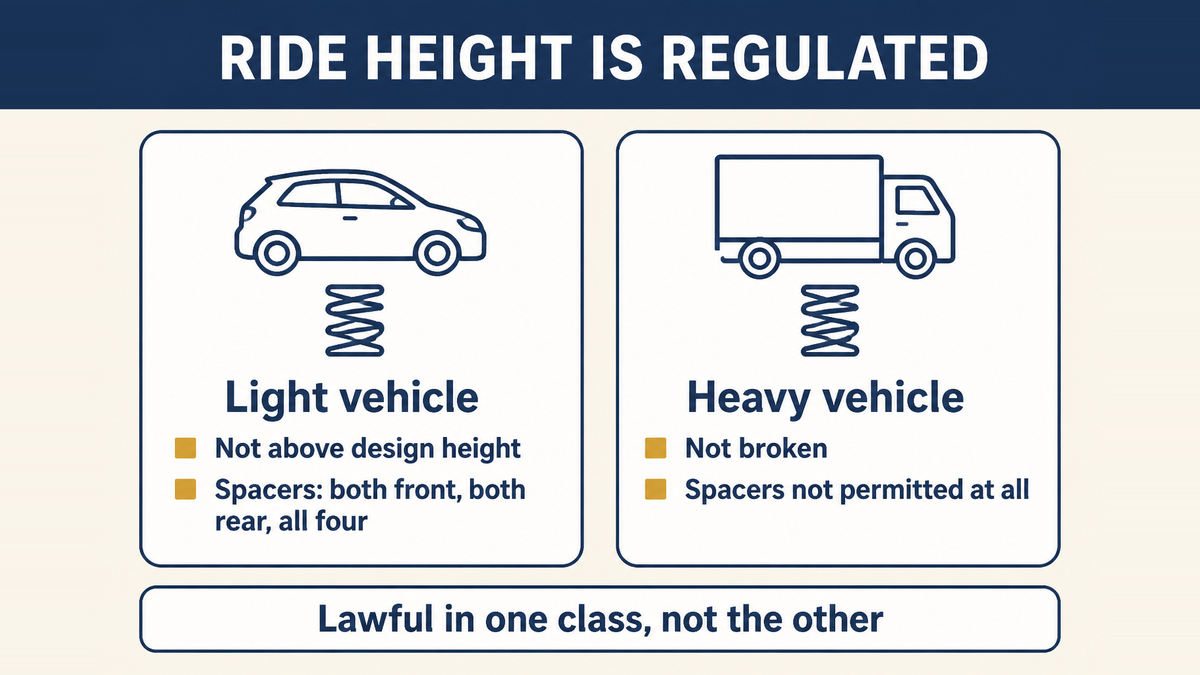
Now the clause that separates a spring from every other part in this cluster. The federal rule does not only ask whether a spring is intact; it asks how tall it leaves the vehicle, and the answer is measured against a figure the vehicle maker set:
Spacers, if installed, shall be installed on both front springs, both rear springs, or on all four springs.
National Highway Traffic Safety Administration, 49 CFR 570.8(a), Suspension systems (read 15 October 2026)
Read the two clauses together. On a light vehicle a spring may be assisted by a spacer, but only if the spacer is applied symmetrically — both front, both rear, or all four. And the spring may not lift the vehicle above the maker's design height in the first place.
On heavier vehicles the rule closes the door entirely: "Springs shall not be broken and coil springs shall not be extended by spacers." No symmetry allowance, no exception. A spacer that is lawful on a light vehicle is not lawful on a heavy one.
That produces a hard commercial line for anyone selling springs that change ride height. The product is not a spring with a different number attached; it is a spring that moves the vehicle out of a dimension the inspection rule references by name. So the question a buyer should put to a factory is not "how much does it lift" but three others:
- What height does this spring produce on the specific vehicle, loaded, and against what design figure?
- Is the resulting height inside the range the rules allow where the goods are being sold?
- If a spacer is part of the kit, is it applied symmetrically — and is the vehicle light enough for a spacer to be allowed at all?
Those are market questions, and they belong in the enquiry letter rather than in the after-sales inbox.
4. What a Height Change Touches Next
The ride height clause matters more than it first appears because a spring does not only change how the car sits. Change the front height and you change the angle of everything mounted to the front of the car — including the headlamps. Headlamp aim is inspected as an item in its own right, and the inspection document gives it a category of its own with its own severity language:
Aim of Headlamps. Headlamp aim too high or too far to the right. Headlamp aim too low or too far to the left… If the degree of misalignment of the headlamp aim does not warrant an immediate prohibition, but an instrumented check shows that the headlamp aim falls outside the statutory test limits, an Inspection Notice should be issued.
Driver and Vehicle Standards Agency, Categorisation of vehicle defects, IM 67 (read 15 October 2026)
So a spring that changes front ride height can fail a vehicle on an item that has nothing to do with springs. That has three practical consequences for a supplier.
It makes the fitting instruction part of the product. If a height change requires the lamps to be re-aimed, the instruction sheet belongs in the box, and a supplier who ships a lift spring without one is shipping a part that can create a defect elsewhere on the vehicle.
It changes what a bundle should contain. A kit that changes height and does not address aim is incomplete, and the completeness of the kit is a line item the buyer can specify.
It makes "fits the vehicle" the wrong question. The right question covers what the part does to the vehicle afterwards — height, alignment and aim. That is a broader claim than most quotations are willing to make, which is exactly why it is worth asking for in writing.
5. A Fracture Is Officially a Random Failure
One line in the same document explains why a buyer cannot shift spring quality onto the end user's maintenance schedule. When the inspection system decides whether defects indicate a failure of maintenance, a spring fracture is singled out as the opposite:
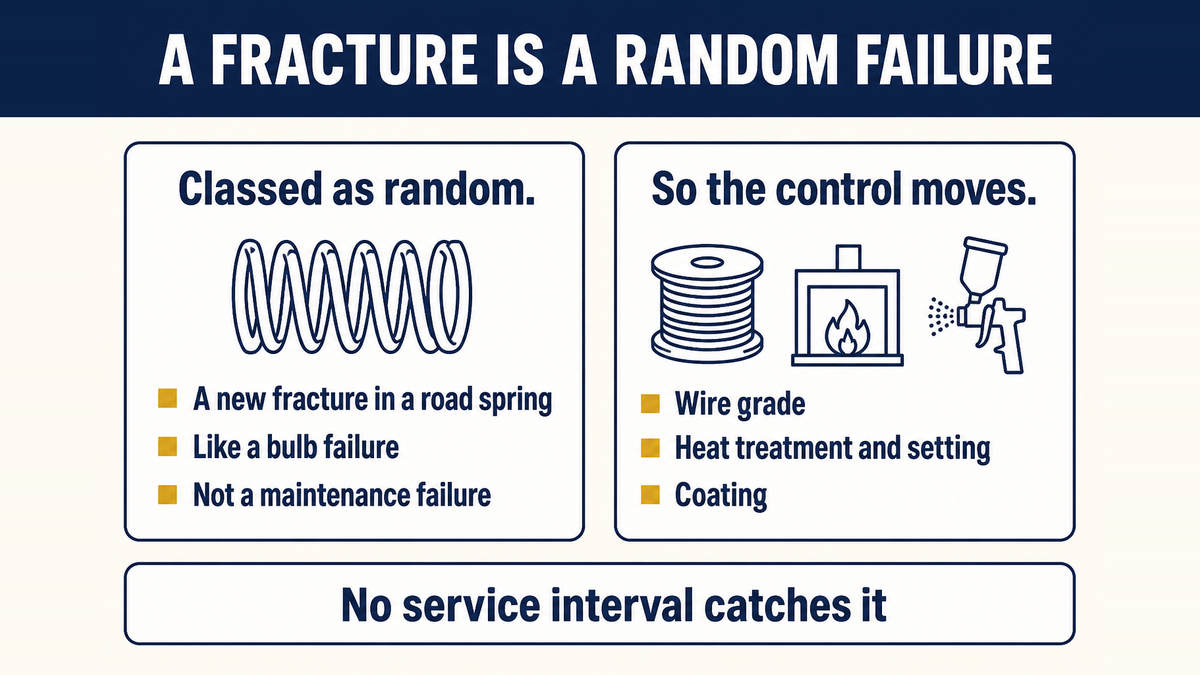
Defects(s) NOT considered to be maintenance related – 'X' Appropriate for defects of an entirely random failure nature such as a lighting bulb failure or a new fracture in a road spring leaf, having arisen through a random failure of a component, and where it is also apparent that it would not have been noticed by the driver.
Driver and Vehicle Standards Agency, Categorisation of vehicle defects, introduction (read 15 October 2026)
That is a striking classification. A new fracture in a spring is treated as a random component failure, on the same footing as a bulb going out — not as something a routine check should have caught.
The sourcing reading is direct. If the official position is that a spring can fail at random and without warning, then the only place that failure can be prevented is in the part: the wire, the forming, the heat treatment, the setting and the coating. There is no inspection interval that will catch it for you, and no maintenance schedule that shifts the risk. For a wholesale buyer it also sets expectations for the conversation with a customer — a spring fracture is a part-quality event, not a servicing lapse.
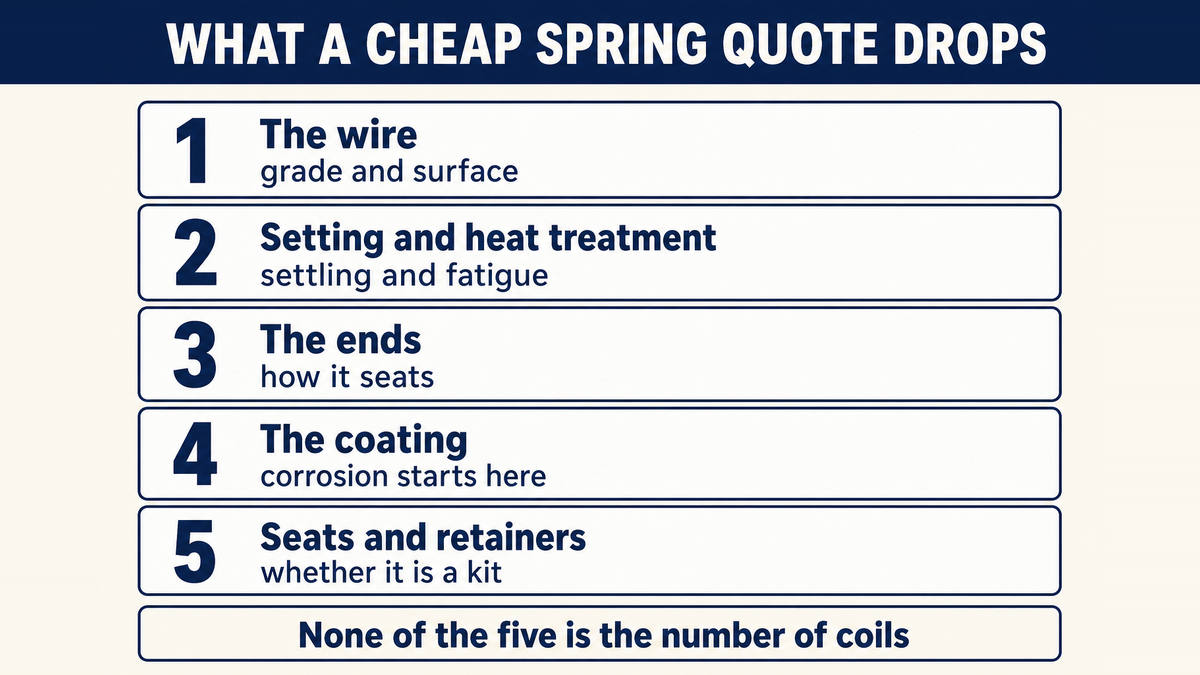
6. What a Cheap Spring Quote Leaves Out
A spring looks like a single object, so a quotation that describes it as one hides every decision that decides whether it survives a wheel arch. Five places a low quote tends to come from:
The wire. The steel grade and the wire's surface condition set the fatigue behaviour of the finished spring. This is the first cost line and the one a buyer is least able to check on a finished part, which makes the factory's incoming material record the useful document.
Setting and heat treatment. A spring that is not properly set will settle once it is in service, and a car that sits lower than intended is a car outside its design height. The treatment cycle is time and energy — a natural place to trim.
The ends. How the ends are formed and ground decides whether the spring seats correctly. "Incorrectly located" is one of the three inspection criteria, and it starts at the end of the wire, not on the vehicle.
The coating. A spring lives in a wheel arch, exposed to water, salt and grit. Coating type and coverage decide how much of the section is lost to corrosion over the part's life, and corrosion is how a spring becomes a fracture. Coating is a process step with its own cost, and it is easy to thin.
The seats, insulators and retainers. Everything that holds the spring to the car, and everything the inspection line calls holding down bolts and mountings. Whether they ship in the box is the difference between a kit and a component.
7. Springs That Ship as an Assembly
Springs are often sold as part of a larger unit — a coil-over or strut assembly where the spring, the damper, the mount and the bearing leave the factory together. That changes the specification in two ways.
The first is that the assembly carries the height. When the spring is built into the unit, the free length and rate have already been chosen to produce a specific ride height, so the buyer is specifying a height rather than a spring. Section 3's question — what height does this produce on this vehicle, and is it inside what the rules allow — becomes the central question rather than a later one.
The second is that the mount and the bearing become part of the wear path. A coil spring rotates very slightly as it compresses, and the bearing at the top is what allows that movement. A mount that is worn or a bearing that is dry is felt as a noise and can end as a broken spring, because the spring is then being asked to twist against something that will not let it.
For any assembly, the same process questions apply as for any machined part — who holds the drawing and who checks the first article — which is the ground covered in metal stamping and machined parts.
8. What to Check on a Sample
Fracture cannot be seen in a carton, so the sample stage for springs is mostly about measurements and records. Six checks cover the ground.
- Free length and rate, on more than one piece. Measured, not quoted. Variation inside one batch tells you more about the process than the average does.
- Load at ride height. The number that actually decides whether the vehicle sits where it should. Ask for it at the height the application uses, not at an arbitrary compression.
- The ends. Formed and ground ends that match the seat in the application. Check against the seat rather than against a drawing alone.
- Coating coverage. Thickness and coverage at the ends and at the inside of the coil, where coatings are thinnest and corrosion starts.
- The process records. Wire grade on the incoming certificate, and the heat treatment and setting cycle. For a fracture-prone part this is the evidence that matters.
- The kit. Seats, insulators, retainers and holding down bolts present, and the fitting instructions included where a height change affects another item.
On the factory side the usual visit checks apply — where the wire comes from, whether the winding, heat treatment and coating are in-house, and who signs off the first article. Our sequence is in the factory audit checklist, and where a supplier also claims social or ethical audits, the scheme behind the certificate is worth reading — see social audit schemes compared.
9. Where the Unit Price Comes From
A spring's price is built from the wire, the forming, the heat treatment and setting, the coating, and the kit. The wire sets the material cost and, being steel, most of the weight. Forming and treatment set the machine and energy time, and they are where volume changes the price. Coating is a process step that can be thinned without changing how the part looks. The kit is the smallest line and the one that decides whether the customer can fit the part.
Weight then decides how the goods move, because a spring is dense steel and is charged on what it weighs rather than on the space it takes — the reverse of the calculation in how volume decides what a shipment is charged. Springs are also awkward to pack, because an unconstrained coil is a shape that wants to interlock with its neighbours.
A quotation worth comparing therefore names the wire grade, the rate, the free length and the load at ride height, the treatment and setting cycle, the coating, and every part that ships with the unit. How the goods are then described for entry is the subject of how an HTS code is assigned, and the origin paperwork behind it is set out in the certificate of origin guide.
10. Frequently Asked Questions
What is a coil spring checked for at inspection?
Three things, and they are stated in one line: the spring must not be fractured, it must not be incorrectly located, and its mounting must not be loose. The same line adds that spring holding down bolts must not be loose or missing. In the United States the equivalent rule requires that springs shall not be broken, and the commercial vehicle rule adds that no coil spring shall be cracked or broken.
Is ride height regulated?
Yes, at least indirectly. The federal inspection rule for light vehicles requires that springs shall not be broken or extended above the vehicle manufacturer's design height, and permits spacers only if they are fitted to both front springs, both rear springs, or all four. On heavier vehicles the rule states that coil springs shall not be extended by spacers at all, so the same product is lawful on one weight class and not on the other.
Does changing ride height affect anything else?
Yes. Raising or lowering the front of a vehicle changes the angle of the headlamps, and headlamp aim is inspected as an item with its own defect category and its own severity language. A spring that changes front height can therefore put a vehicle out of line on something that has nothing to do with springs, which is why the fitting instruction and the completeness of the kit belong in the specification.
Can a spring fracture be prevented by maintenance?
Not according to the official classification. The document used for vehicle inspection in the United Kingdom lists a new fracture in a road spring leaf as a defect of an entirely random failure nature, alongside a lighting bulb failure, and explicitly not as evidence of a failure of maintenance. If the failure can happen at random and without warning, the only place it can be prevented is in the wire, the forming, the heat treatment, the setting and the coating.
What should a spring quotation contain?
The wire grade, the spring rate, the free length and the load at ride height, the heat treatment and setting cycle, the coating type, and every part that ships with the unit including seats, insulators, retainers and holding down bolts. Two springs with the same ride height can have different rates and behave completely differently, so rate and load at ride height are the numbers that let you compare two factories on the same basis.
Before and After, Measured at the Same Corner
We return the fitted height at each corner against the specification, with the part number that produced the number you are reading.
Compare My Ride Height
Questions & Comments
We read every one and reply within 24 hoursComparing springs from two factories when neither will quote a rate and a load at ride height, working out whether the height a kit produces is allowed where you sell, or checking what a "complete kit" actually contains? Send us the application, the load and the market, and our team will put the spring specification in writing.