
Shock Absorber Manufacturers: No Oil at the Seal, and No More Than Two Bounces
 ·
Updated October 15, 2026
·
13 min read
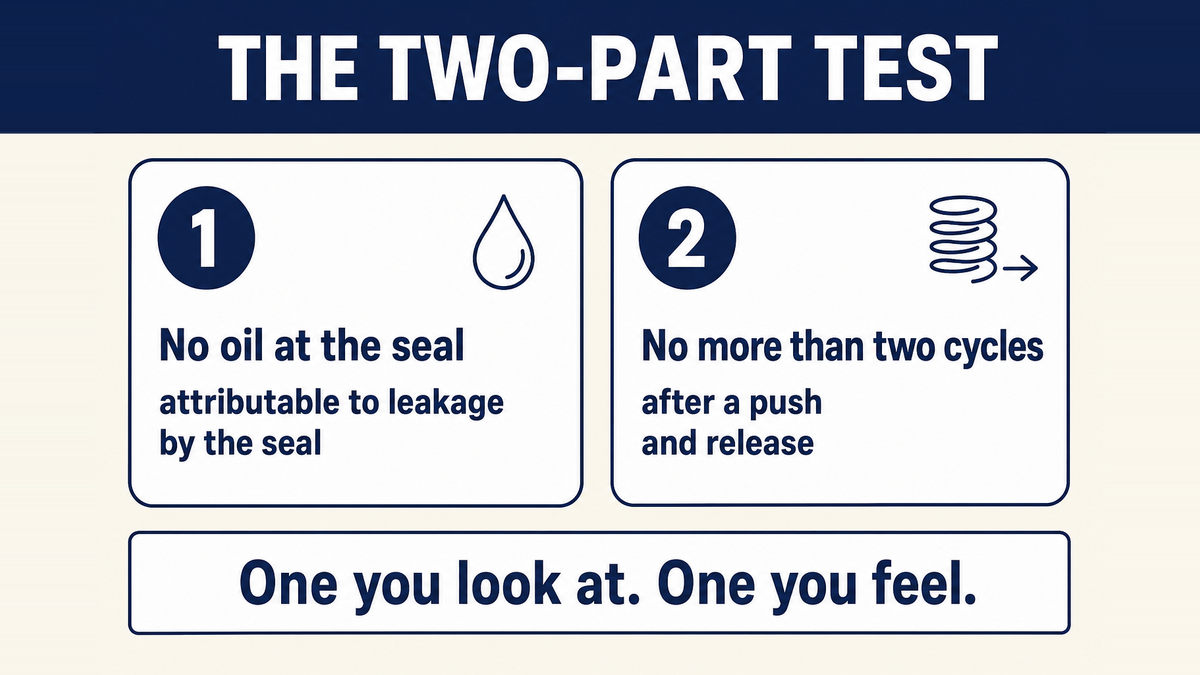
Most parts in this series are judged by a document. A pad has a code, a disc has an approval list, a caliper has a recall record. A shock absorber is judged by a person pushing down on the corner of a car. The federal inspection rule for the part sets out an entire pass-or-fail test, and it is two things: there shall be no oil on the housing from seal leakage, and the body shall not rock more than two cycles after you press it and let go. Both are visible. Both are physical. Neither is a certificate. And whether that test applies to your unit at all depends on one number — the vehicle's weight class — which changes the rule at ten thousand pounds.
1. What a Damper Is, and the Line That Separates It From a Strut
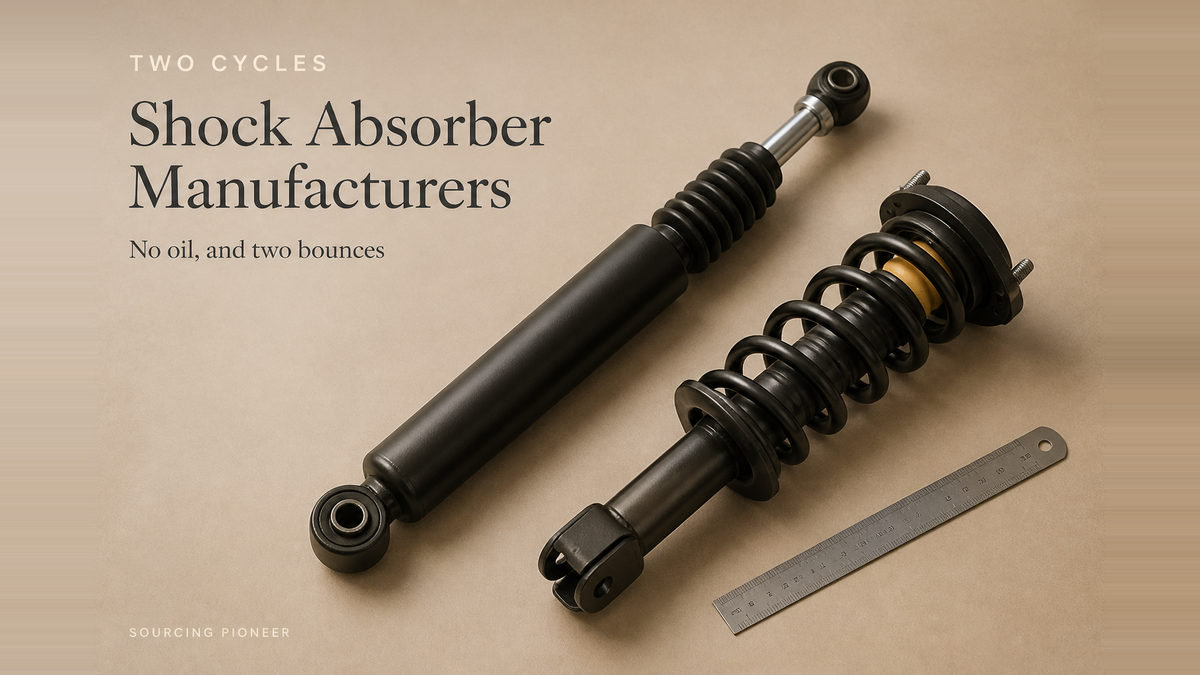
A shock absorber is a hydraulic damper. A piston moves through oil inside a tube, and oil is forced through valves that turn motion into heat. The spring carries the vehicle's weight and absorbs the bump; the damper's job is to control what the spring does afterwards, so the wheel stays on the road instead of bouncing.
That definition matters commercially, because the trade sells two different objects under one shopping category, and they are not interchangeable.
- A shock absorber damps. It carries no vehicle weight and does not locate the wheel. It can be unbolted and replaced without disturbing the vehicle's geometry.
- A strut damps and carries load. On a MacPherson-style front end the strut is a structural member: it holds the spring, and its position partly sets the wheel's alignment.
So the same enquiry can produce two products with different consequences. Fitting a damper is a straightforward job; fitting a strut can change the alignment, and a strut that is bent or assembled wrong is a structural fault rather than a comfort fault. The inspection rule for suspension draws exactly this line — it is written about structural parts as well as about damping, in separate paragraphs.
| The part | What it decides | What a vague quote hides |
|---|---|---|
| The valves and oil | How much damping, at which speeds | The force curve, and at what temperature |
| The rod and the seal | Whether it weeps oil as it wears | Rod finish and plating, seal material |
| The gas charge | Whether the oil foams when worked hard | Whether it is charged at all |
| The mounts and boots | Whether it stays attached and stays clean | Whether they ship in the box |
What this guide covers
- What a damper is, and the line that separates it from a strut
- The whole federal test is two things you can see
- The rule changes at ten thousand pounds
- The suspension rule that names everything except the damper
- What the UK adds: severity depends on the spring
- What a cheap damper quote leaves out
- The kit around the unit
- What to check on a sample
- Frequently asked questions
2. The Whole Federal Test Is Two Things You Can See
There is no product approval for a replacement damper, so the most concrete official statement about the part is the in-service inspection rule. For light vehicles it is unusually specific, because it gives both the criteria and the procedure a person follows to check them:
Shock absorber condition. There shall be no oil on the shock absorber housing attributable to leakage by the seal, and the vehicle shall not continue free rocking motion for more than two cycles.
National Highway Traffic Safety Administration, 49 CFR 570.8(b), Suspension systems (read 15 October 2026)
And the method, from the same paragraph:
Examine shock absorbers for oil leaking from within, then with vehicle on a level surface, push down on one end of vehicle and release. Note number of cycles of free rocking motion. Repeat procedure at other end of vehicle.
National Highway Traffic Safety Administration, 49 CFR 570.8(b)(1) (read 15 October 2026)
Read those as a supplier's brief rather than a workshop instruction and they name three specifications that never appear on a product page.
The rod surface and the seal are the pass-or-fail features. The rule does not ask a damper how much force it produces. It asks whether oil has escaped past the seal. Everything that decides that — how straight the rod is, how smooth and well plated its surface, what the seal is made of, and how well the tube bore was machined — is invisible from outside and is where a cheap unit is cheapest.
Two cycles is a damping criterion, and it is measured by hand. The number is small: after pushing the corner down and letting go, the body may not keep rocking for more than two cycles. A damper that has lost its oil, or its gas charge, will not pass that. A buyer can run the same test on a sample before ordering, with no equipment at all.
Leaks and wear are treated as the same failure. A weeping seal and a worn valve both end in a unit that cannot control the spring, so the rule catches both with two criteria rather than one. That is a useful reminder that a damper can be structurally intact and still be scrap.
3. The Rule Changes at Ten Thousand Pounds
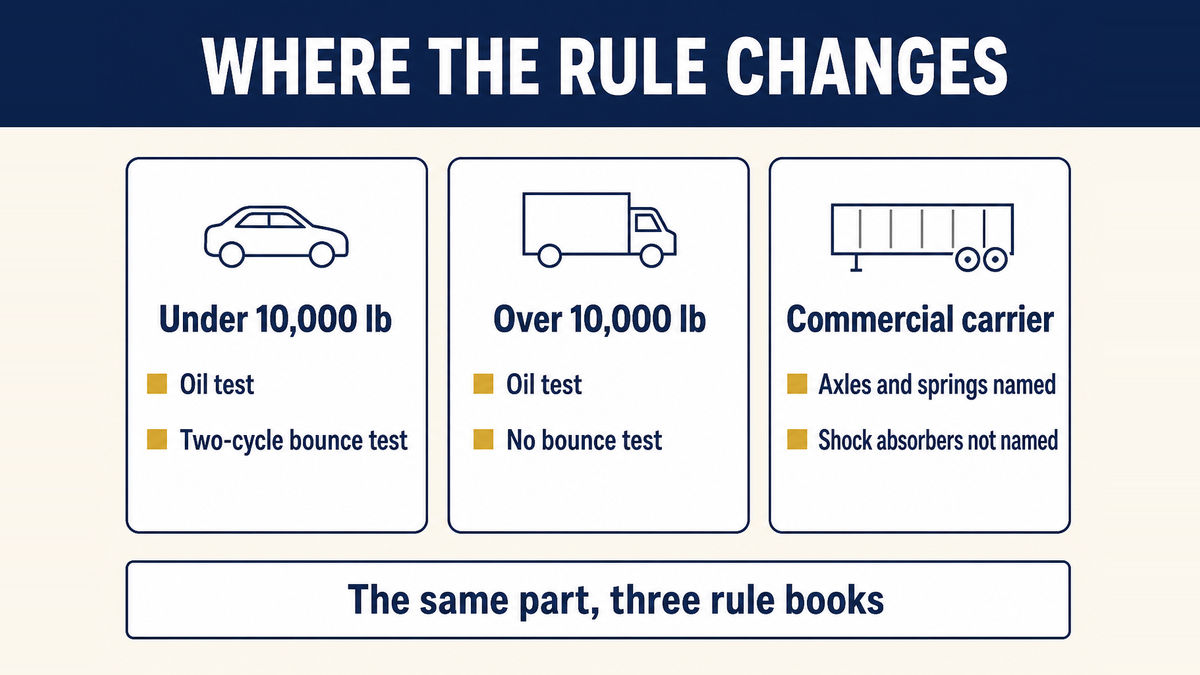
The same part is inspected under a different rule once the vehicle gets heavier. Below ten thousand pounds the suspension section sits in one subpart of the inspection standard; above it, in another. The test does not simply get stricter — it gets shorter.
The heavier rule keeps the oil criterion and drops the bounce test:
Shock absorber condition. There shall be no oil on the shock absorber housings attributable to leakage by the seal… Inspection procedure. Examine shock absorbers for oil leakage from within.
National Highway Traffic Safety Administration, 49 CFR 570.61(b), Suspension system (read 15 October 2026)
That makes sense once you picture the vehicle — nobody rocks a loaded truck by hand — but it has a commercial consequence that is easy to miss. On a heavy vehicle the only criterion left is the visible one. The rule no longer measures what the damper does; it only checks that nothing has escaped. A unit can therefore pass the inspection on a truck while doing very little damping.
The two rules also diverge on spacers, in a way that matters to anyone supplying lifted or levelled suspension:
- Light vehicles: spacers are permitted, but if fitted they must be "installed on both front springs, both rear springs, or on all four springs" — symmetric, never one corner.
- Heavy vehicles: the rule goes further and states that "coil springs shall not be extended by spacers."
So a kit that is lawful on a light vehicle is not automatically lawful on a heavy one, and the difference is not a matter of degree. For a buyer supplying levelling products, that boundary belongs on the specification sheet next to the part number.
4. The Suspension Rule That Names Everything Except the Damper
There is a third American rule in play, and it produces the most surprising result in this article. Commercial motor carriers operate under a separate suspension regulation, and it is thorough — it names every major suspension component except one.
Axles. No axle positioning part shall be cracked, broken, loose or missing. All axles must be in proper alignment… Leaf springs. No leaf spring shall be cracked, broken, or missing nor shifted out of position. Coil springs. No coil spring shall be cracked or broken. Torsion bar. No torsion bar or torsion bar suspension shall be cracked or broken. Air suspensions… Air leakage shall not be greater than 3 psi in a 5-minute time period when the vehicle's air pressure gauge shows normal operating pressure.
Federal Motor Carrier Safety Administration, 49 CFR 393.207, Suspension systems (read 15 October 2026)
Axles, leaf springs, coil springs, torsion bars, air suspensions. Shock absorbers are not mentioned. The rule even quantifies air loss to a pound per square inch over five minutes while leaving dampers out entirely.
Two conclusions follow, and they pull in opposite directions.
The first is that a damper is not the component that is expected to carry a commercial vehicle's suspension. The regulation is written around the parts that hold the vehicle up and locate the axles. A damper's failure is a handling problem, not a structural one, and the rule reflects that.
The second is that absence from the rule is not permission to sell anything. The commercial rule sits alongside general requirements that a vehicle be in safe operating condition, and a unit that fails the light-vehicle two-cycle criterion is still a unit that does not damp. What the absence changes is where the buyer's assurance comes from: since no regulation names the part, the specification and the sample are the only controls in the chain.
5. What the UK Adds: Severity Depends on the Spring
Outside the United States the inspection logic is similar but the framing is different. In the United Kingdom, a leaking damper is a listed defect, and the official categorisation document pairs the description of the fault with how serious it is:
Shock Absorbers. A shock absorber, pivot, linkage or mounting missing/insecure/fractured/malfunctioning/damaged… Shock absorber leaking.
Driver and Vehicle Standards Agency, Categorisation of vehicle defects (read 15 October 2026)
Note what the entry pairs together: the unit itself, its pivot and linkage, and its mounting. In one line the document treats the damper as an assembly rather than a cylinder — which is the same message as the United States rule, where the earlier paragraph requires that "shock absorber mountings, shackles, and U-bolts shall be securely attached".
The document then says something no product page will tell you, and it is the most useful single sentence in this article for a buyer deciding how much to spend:
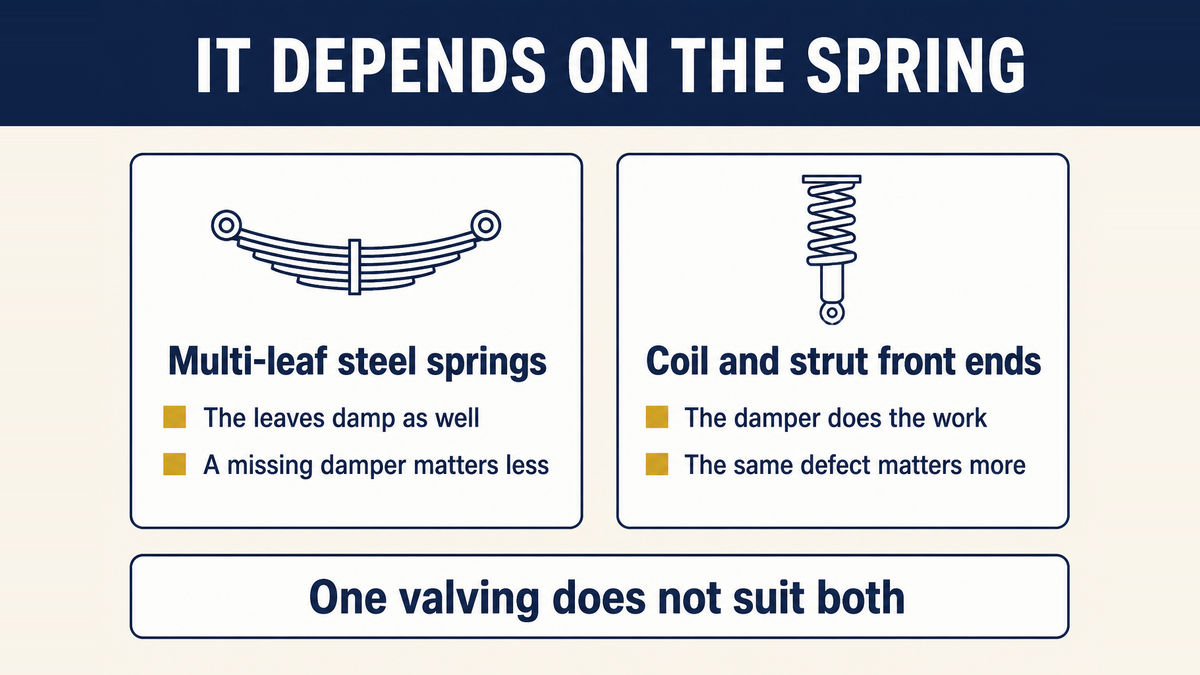
The significance of defective shock absorbers will vary according to the suspension type. Prohibition action will be appropriate only when it is clear that the handling of the vehicle will be severely affected. e.g. in the case of multi-leaf steel springs the effect of a missing shock absorber will be less significant than with other road spring types.
Driver and Vehicle Standards Agency, Categorisation of vehicle defects, note to the suspension section (read 15 October 2026)
Read it as a specification decision. The official position is that the same damper defect carries different weight depending on the suspension it sits in. On a multi-leaf steel spring axle, the spring leaves do a substantial part of the damping themselves, so losing the damper changes less. On a coil-sprung or MacPherson layout the damper is doing far more of the work, so the same defect matters far more.
That is the engineering reason a single damper specification cannot serve every application. If a supplier offers one valving for a whole range — a leaf-sprung light truck, a coil-sprung car and a strut-front crossover — they are not offering a compromise that suits all three. They are offering a part that matches at most one of them.
6. What a Cheap Damper Quote Leaves Out
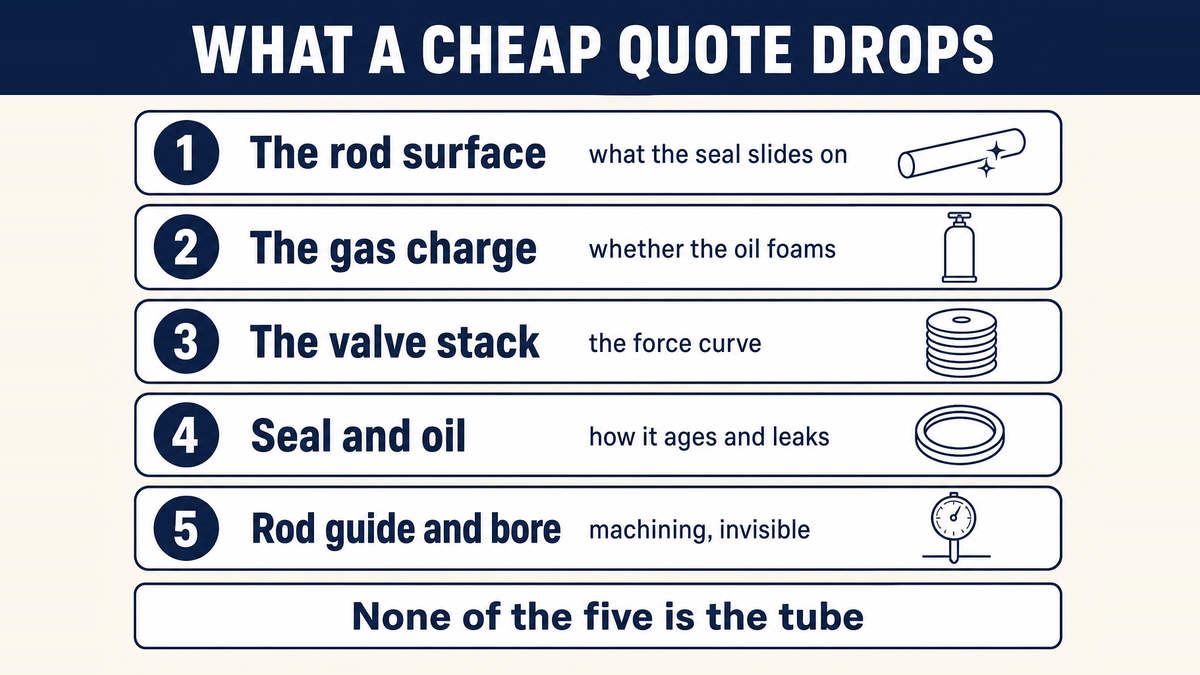
A damper is a tube, a rod, a piston, a valve stack and a seal. Five places a low quote tends to come from:
The rod surface. The seal slides on the rod thousands of times, so the rod's straightness, hardness and plating decide how long the seal holds. A rod that is soft or poorly finished wears the seal, and the oil escapes. This is the failure the inspection rule is written to catch, and it is a surface treatment — invisible in a photo and easy to trim.
The gas charge. Dampers are charged with gas above the oil so the oil does not foam when it is worked hard. Whether a unit is charged, and with what pressure, is a process step and a filling cost. A unit sold as charged that is not will still feel acceptable in a showroom and will change character after sustained use.
The valve stack and the force curve. Damping is not one number; it is a curve of force against piston speed, and the curve is what a suspension engineer selects. A buyer who never receives a curve is comparing units on price alone, and the seller who supplies no curve is usually the cheaper one.
The seal and the oil. Seal material and oil viscosity decide how the unit behaves when cold and how it ages. Both are line items that can be quietly downgraded without changing the outside of the part.
The rod guide and the tube bore. The guide keeps the rod running straight inside the tube, and the bore finish is what the piston seals against. Both are machining and both are invisible.
The same questions about who holds the drawing and who checks the first article apply here as to any other machined part, which we cover in metal stamping and machined parts.
7. The Kit Around the Unit
Both inspection regimes treat the damper as an assembly rather than a cylinder, so the parts around it belong in the quotation. The United States rule requires that "shock absorber mountings, shackles, and U-bolts shall be securely attached", and the same paragraph adds that "rubber bushings shall not be cracked, extruded out from or missing from suspension joints". Together those two sentences name the items that most often get left out of a box.
Four things to settle before ordering:
- Mounts and bushings. Whether a new upper mount and bushing are supplied, or whether the customer is expected to reuse a worn original.
- Dust boots and bump stops. The boot keeps grit off the rod — which is the same surface the seal depends on. A cheap kit omits it and shortens the life of the unit it protects.
- Spring seats and insulators, on any unit that ships as an assembly.
- Fasteners. Whether the mounting bolts are included and marked to a grade.
Where a supplier sells a complete strut assembly — damper, spring, mount and bearing in one unit — the specification has to cover the spring as well, because the spring carries the load. In that case the rule about springs is the one that governs: they may not be broken or "extended above the vehicle manufacturer's design height". A different spring is a different vehicle height, and vehicle height is the sort of thing that becomes a market-access question rather than a comfort question.
8. What to Check on a Sample
With no approval document anywhere covering the part, the sample is the whole assurance. Six checks do most of the work, and the first two are the same two criteria the federal rule uses.
- Run the two-cycle test. Compress and release the unit by hand and watch how many times it continues to move. It is a rough test, but it is the official one, and it needs no equipment.
- Look for oil after a short working cycle. Not on the outside of the shipping carton — on the housing, at the seal. A trace after a few dozen strokes is a finding, not a break-in effect.
- Inspect the rod. Straightness by eye and by rolling it, plating coverage, and freedom from scoring where the seal runs.
- Ask for the force curve. Force against piston speed, at more than one temperature if the factory can supply it. This is the document that says what the unit actually does, and whether a factory can produce one tells you as much as the numbers on it.
- Check the mounts and the kit. Bushings fitted and sound, boot present, and every fastener in the box.
- Match the specification to the spring. Ask what suspension type the valving was selected for — leaf spring, coil spring or strut — because section 5 is the official statement that it matters.
On the factory side the usual visit checks apply — who casts or draws the tube, who machines the bore, who fills the gas, and who signs off the first article. Our sequence for that is in the factory audit checklist, and where a supplier also claims social or ethical audits, the scheme matters as much as the certificate — see social audit schemes compared.
9. Where the Unit Price Comes From
A unit's price is built from the tube and rod, the internal valve stack, the seal and oil, the gas fill, and the kit in the box. The tube and rod set most of the material cost and, being steel, most of the weight. The valve stack sets the performance and is where the difference between a general-purpose damper and a specified one lives. The seal and oil are small line items that decide the leak record. The gas fill is a process step. The kit is the smallest line and the one that decides whether the part can be fitted.
Weight then decides how the goods move, because a damper is dense and long, so it is charged on what it weighs rather than on the volume it fills — the reverse of the calculation in how volume decides what a shipment is charged. That changes the arithmetic of a comparison: a heavier, thicker-walled unit is more expensive to ship, and two offers that look equal on a unit price can differ once the freight is added.
So a damper quotation should name the rod material and surface treatment, the valving and whether a force curve is available, the gas charge, the seal and oil, and every part that ships with the unit. How the goods are then described for entry determines what happens at the border, which is the subject of how an HTS code is assigned, and the origin paperwork behind it is set out in the certificate of origin guide.
10. Frequently Asked Questions
How is a shock absorber officially tested?
For light vehicles in the United States, by two criteria that need no equipment: there shall be no oil on the housing from seal leakage, and the vehicle shall not continue free rocking motion for more than two cycles after a corner is pushed down and released. The procedure is written into the same paragraph, which tells the inspector to push down on one end of the vehicle, release it, count the cycles, and repeat at the other end.
Does the same test apply to trucks and commercial vehicles?
No, and the difference is instructive. Above ten thousand pounds the heavy-vehicle rule keeps only the oil criterion and drops the bounce test entirely, so the only remaining measure is whether anything has escaped the seal. The commercial motor carrier suspension rule is stricter on air leaks — it limits loss to three pounds per square inch over five minutes — but does not mention shock absorbers at all.
Is there an approval number for a replacement shock absorber?
Nothing equivalent to the approval that covers friction parts in Europe. What governs a damper in service is the inspection regime, and that regime changes with the vehicle's weight class. Because no approval document attaches to the part, the specification you write and the sample you approve are the only controls standing between you and a shipment that does not damp.
Why does the same damper defect matter more on some vehicles?
Because the springs share the damping work. The official categorisation used for vehicle inspection in the United Kingdom states that the significance of a defective damper varies with the suspension type, and gives the example that on multi-leaf steel springs a missing shock absorber matters less than with other road spring types. On a coil-sprung or strut front end the damper is doing far more of the work, so the same defect is far more significant.
What should I ask for instead of a certificate?
A force curve: damping force against piston speed, ideally at more than one temperature. That is the document that describes what the unit actually does, and it lets you compare two factories on the same basis. Ask also which suspension type the valving was selected for, what the gas charge is, and what parts ship in the box — mounts, bushings, boots and fasteners.
Why the Spring Decides the Verdict
We return the seal inspection, the bounce count, and the spring rate that changes the pass mark in the UK test.
Note My Severity
Questions & Comments
We read every one and reply within 24 hoursA shock absorber is inspected for leakage and for mounting, not for damping. Send the part number and the vehicle, and we will specify the seal, the rod finish and the gas charge.