
Brake Caliper Suppliers: One Part, No Approval List, and a Twenty Percent Test
 ·
Updated October 15, 2026
·
13 min read
Every other part in a disc brake gets named somewhere. Pads have a friction code, discs have an approval list in Europe, drums have a trade order on them. The caliper does not. It sits outside Europe's compulsory list of approved replacement brake parts, and no American standard approves it as a product of its own. And yet a caliper defect is the one thing that can put a carmaker's vehicles out of line with the vehicle standard itself — which is exactly what happened in a 2018 recall over the coating on a caliper piston. That is the shape of this part: no certificate of its own, and the power to break the vehicle's.
1. What a Caliper Is, and the Two Jobs It Does
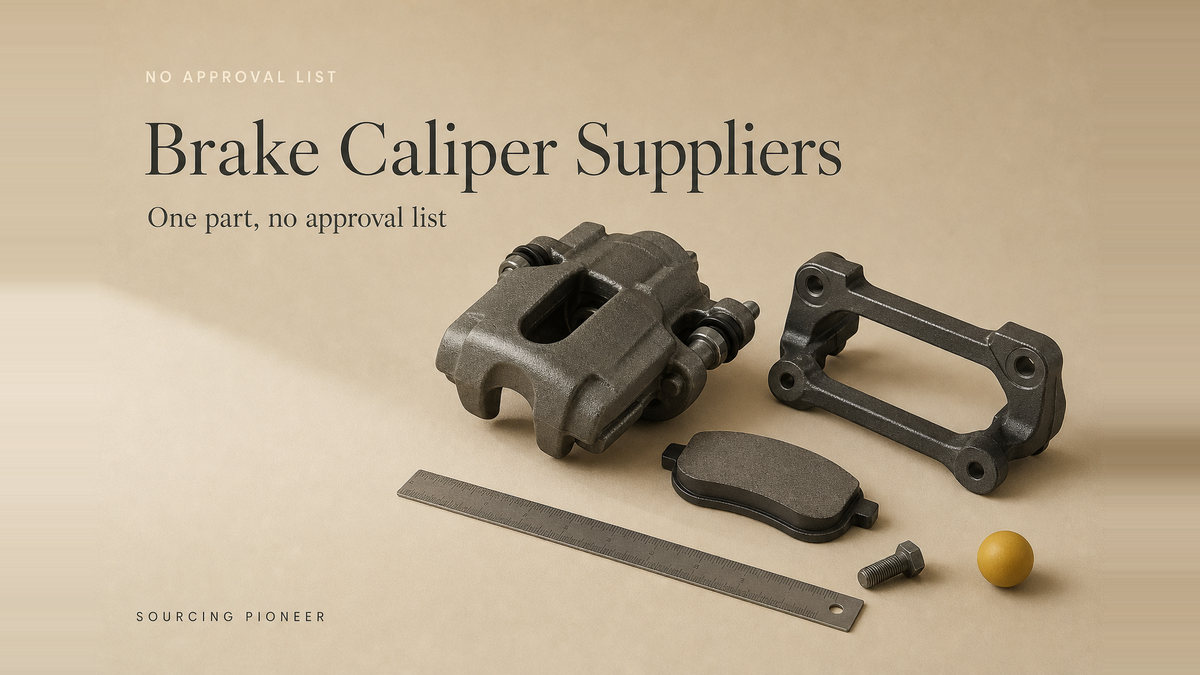
A disc brake caliper holds the pads and presses them against the disc. It is a casting or a forging, machined inside and out, with one or more pistons that move under hydraulic pressure. Reading it as "the clamp" is only half right, because a caliper does two separate jobs and they fail in different ways.
The first job is clamping: piston force turns fluid pressure into the force that squeezes the pads. The second is sliding or releasing: when the driver lifts off, the piston has to retract and the pads have to come off the disc, or the brake drags. On the common sliding caliper the second job is done by guide pins and sleeves that let the body move sideways, and by a piston seal that pulls the piston back as the pressure drops.
That is why a caliper can pass a "does it stop" test and still be bad. A caliper that drags stops the car, just not the way it should — it overheats one side, wears a pad unevenly, and pulls the car under braking.
| The part | What it decides | What a vague quote hides |
|---|---|---|
| Pistons and bore | Clamping force and heat path to the fluid | Piston material, count and bore size |
| Guide pins and sleeves | Whether the caliper slides back | Whether boots and grease are fitted |
| The piston seal | Whether the piston retracts | Seal profile and elastomer |
| Fasteners | Whether the caliper stays attached | Bolt grade, and whether they are in the box |
Notice that three of those four are not the casting. A caliper supplier who quotes on "aluminium body, powder coated" has priced the part most buyers look at, and left the parts that decide whether the unit works in service. Section 6 comes back to this.
What this guide covers
- What a caliper is, and the two jobs it does
- The three things an inspector is told to look for
- What the vehicle standard assumes about a leak
- The one part the European approval list leaves out
- Two recalls that show what actually fails
- What a cheap caliper quote leaves out
- New or rebuilt: a fork to settle in writing
- What to check on a sample
- Frequently asked questions
2. The Three Things an Inspector Is Told to Look For
Because no certificate covers a replacement caliper, the clearest official statement about the part is not about approving it — it is about what to look for when it has already been in service. The federal rule for vehicle inspection names calipers directly, and in a way that is narrower than most buyers expect:
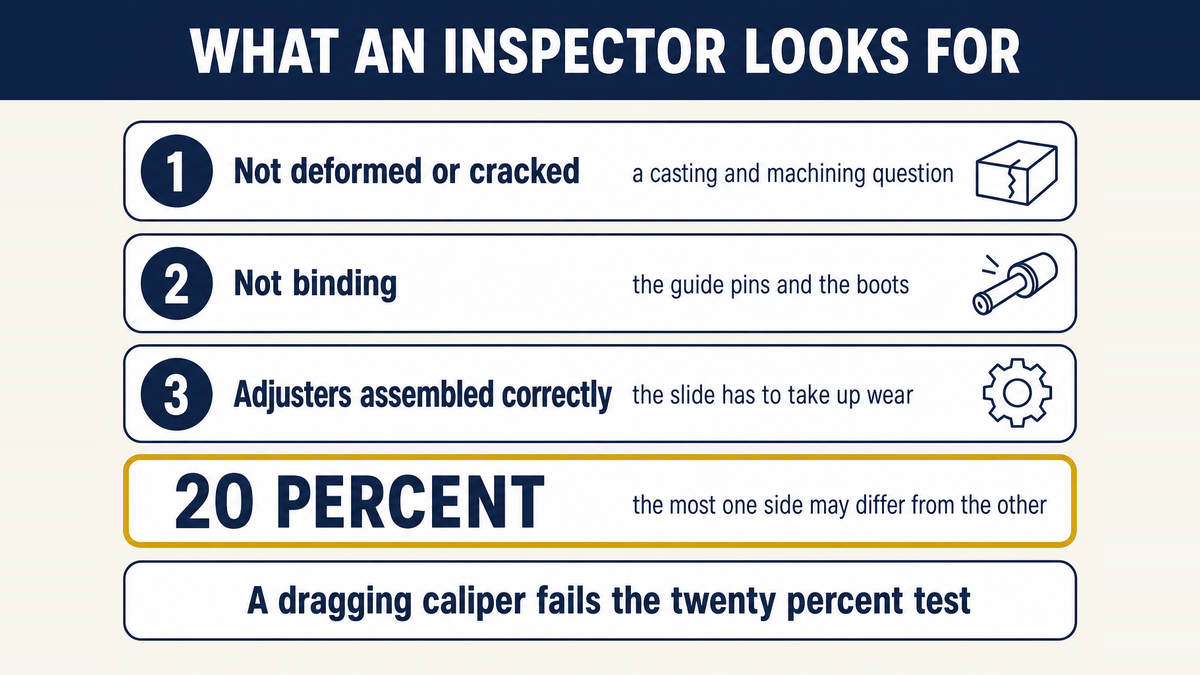
Backing plates and caliper assemblies shall not be deformed or cracked. System parts shall not be broken, misaligned, missing, binding, or show evidence of severe wear. Automatic adjusters and other parts shall be assembled and installed correctly.
National Highway Traffic Safety Administration, 49 CFR 570.5(h), Service brake system (read 15 October 2026)
Three things are worth pulling out of that sentence, because each one is a sourcing specification.
"Deformed or cracked" is a casting and machining question. The rule does not ask how much force the caliper can produce. It asks whether the body has gone out of shape or come apart. That points at wall thickness, at how the casting was cooled, and at whether the machining left stress behind — the things a lighter, cheaper casting compromises first.
"Binding" is the second sentence, and it is the slide. A caliper that binds has not failed structurally at all; it has stopped moving. That is the guide pin, the sleeve, the boot and the grease — the four cheapest items on the unit and the four most often left out of a quote.
"Automatic adjusters" is called out by name. The vehicle standard says the same thing from the other end: "Wear of the service brakes shall be compensated for by means of a system of automatic adjustment." A caliper that does not take up pad wear as it goes is not a maintenance inconvenience; it is the failure the rule exists to catch. On a sliding caliper that job belongs to the slide itself.
The same inspection section also gives the one number that catches a dragging brake on the spot. The brake force measured at one wheel may not differ from its opposite by too much:
The force applied by the brake on a front wheel or a rear wheel shall not differ by more than 20 percent from the force applied by the brake on the other front wheel or the other rear wheel respectively.
National Highway Traffic Safety Administration, 49 CFR 570.5(d)(1), Service brake performance (read 15 October 2026)
Twenty percent left to right. A caliper that slides freely sits comfortably inside that; a caliper that has seized on one side does not, and it fails the test without leaking a drop of fluid. This is the single most useful line in the article for anyone who has to explain to a supplier why the cheap slide matters. The same section covers the flexible side of the system too: brake hoses "shall not be cracked, chafed, or flattened", checked through the full steering swing.
3. What the Vehicle Standard Assumes About a Leak
The caliper is a pressure vessel sitting at the end of a hydraulic line, and the vehicle standard is written around the assumption that one will eventually give way. That assumption is what shapes the whole system, and it is worth reading because it tells a buyer what the part has to be able to do.
The standard defines a split brake system as one built so that a single failure in any part of it does not take down the rest — and it names the failure it means in the definition itself:
Split service brake system means a brake system consisting of two or more subsystems actuated by a single control, designed so that a single failure in any subsystem (such as a leakage-type failure of a pressure component of a hydraulic subsystem except structural failure of a housing that is common to two or more subsystems, or an electrical failure in an electric subsystem) does not impair the operation of any other subsystem.
National Highway Traffic Safety Administration, 49 CFR 571.135, Standard No. 135; Light vehicle brake systems (read 15 October 2026)
So the design question is not "will the caliper leak" — it is "what happens to the vehicle when it does". That feeds three requirements a buyer should know exist, because together they explain why the seal and the bore finish are not optional extras:
- The system must compensate for brake wear automatically, which on a disc brake means the piston and the slide must reset themselves as the pads thin.
- The driver must be warned about a "gross loss of fluid or fluid pressure" by an indicator — not about a seep, but about a real loss.
- The brakes must still work when hot, which is what the fifteen heating snubs and the hot stop in the same standard are there to test.
Read as a buyer, that list is a specification sheet in disguise. A caliper whose seal leaks slowly, whose bore is machined too rough to let the seal hold, or whose piston does not retract cleanly is not a slightly worse version of a good part. It is aimed at the exact three properties the standard is built to protect.
4. The One Part the European Approval List Leaves Out
Now the gap, and it is a clean one. Europe does require approval for replacement brake parts — but the Commission's own sentence names which parts, and the list stops before the caliper:
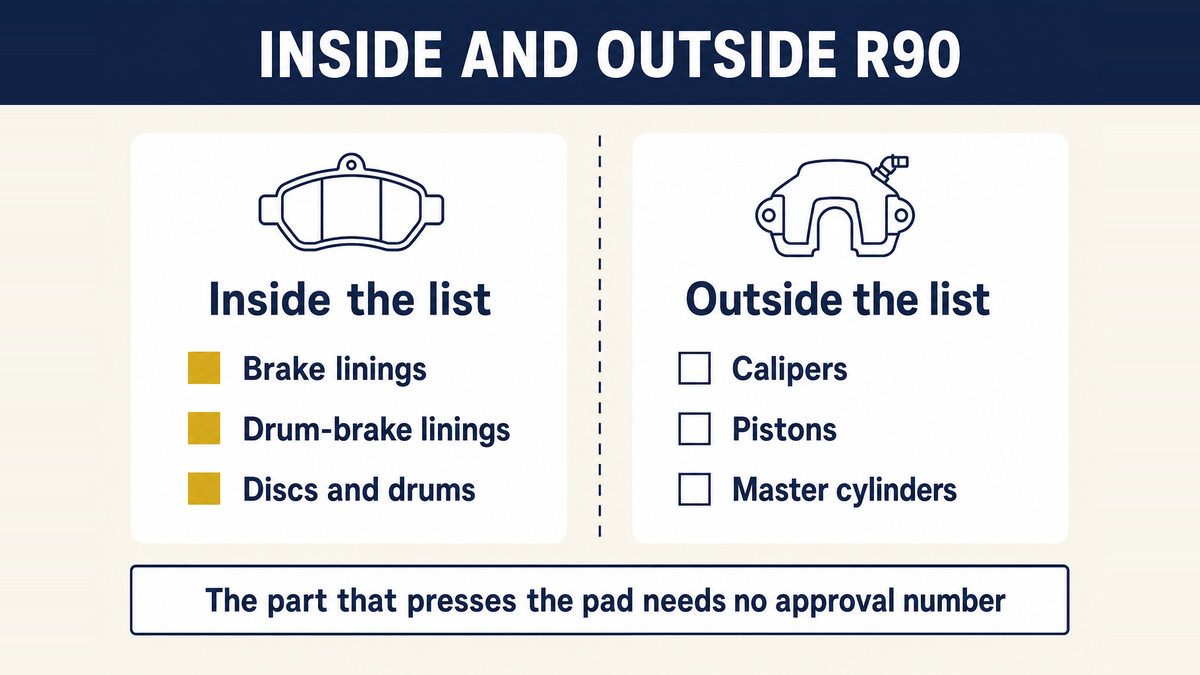
Compliance with UN Regulation No 90 is compulsory for replacement brake lining assemblies, drum-brake linings, discs and drums for power-driven vehicles and their trailers.
European Commission, amending Annexes I and II to Regulation (EU) 2019/2144 (read 15 October 2026)
Linings, drum-brake linings, discs and drums. No calipers, no pistons, no master cylinders. The regulation is titled around the same four items, and the machinery in it — braking performance tests against the vehicle's original behaviour — is written for friction parts and for the discs they run against.
That produces an odd position for a sourcing buyer, and it is worth stating plainly:
- The pad has an approval number. The caliper that presses it does not. If you sell both into Europe, only one of them needs the paperwork under that regulation, and a supplier with a long approval list may still have nothing for the caliper.
- "No approval number" is not the same as "no requirements". The caliper is still governed — by the vehicle standard when it leaves the line, and by the in-service inspection rule afterwards. What is missing is a product approval attached to the spare part.
- The absence is not a loophole to sell into. A caliper that drags or weeps creates the defects sections 2 and 3 describe, and those are the defects that generate recalls — which is the next section.
5. Two Recalls That Show What Actually Fails
The fastest way to see which features of a caliper matter is to read what manufacturers have had to recall them for. Two records from the federal recall database make the point better than any specification table, because both are about small features rather than the casting.
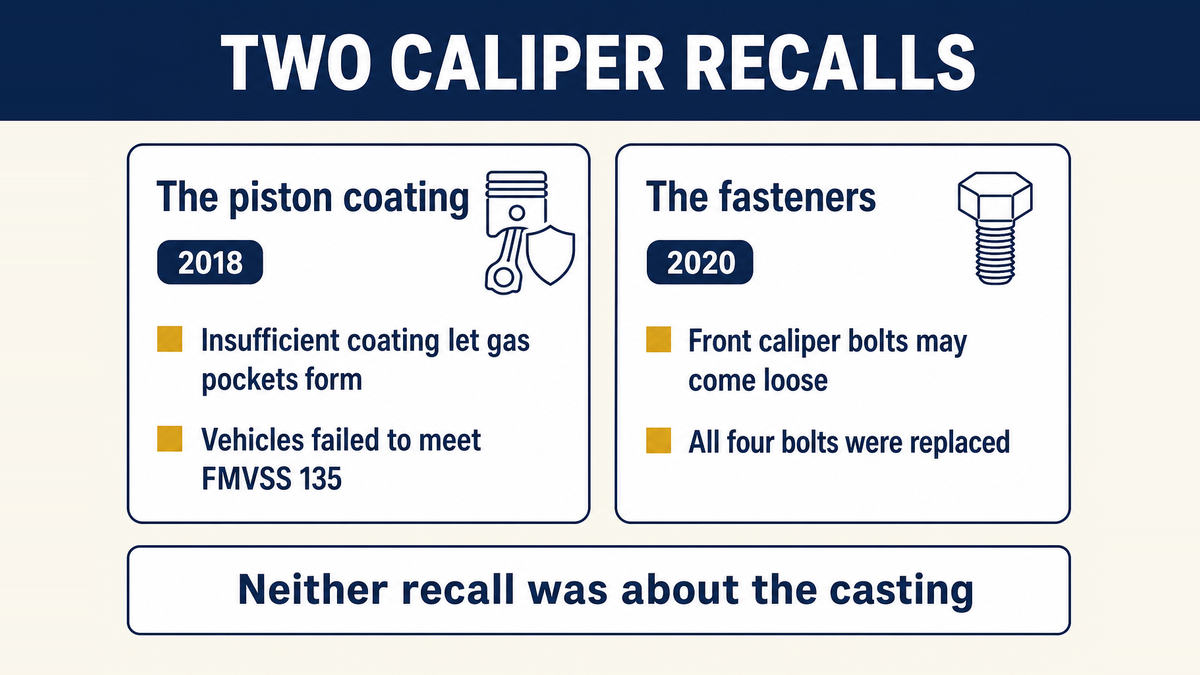
The piston coating. A campaign reported in January 2018 covered certain Acura and Honda vehicles, and the fault was described in a single line:
The rear brake caliper pistons may have an insufficient coating, causing gas pockets to form, reducing brake performance.
National Highway Traffic Safety Administration, recall campaign 18V777000 (read 15 October 2026)
The consequence was a reduction in braking performance, and the outcome was not a caliper swap — dealers bled the brakes. What makes the record unusually useful is the closing sentence, which states that these vehicles "fail to comply with the requirements of Federal Motor Vehicle Safety Standard (FMVSS) number 135, 'Light Vehicle Brake Systems.'"
Read that twice. A piston's surface treatment — invisible in a photograph, absent from most specification sheets, and never mentioned in a quote — was enough to put a fleet of vehicles outside the vehicle standard. This is the paradox from the lead made concrete: the caliper has no approval of its own, and it can still be the reason a vehicle does not comply.
The fasteners. A second campaign, reported in June 2020, covered one vehicle whose "front brake caliper bolts may come loose", with the stated consequence that a loose caliper bolt may affect brake performance and increase crash risk. The remedy was to replace all four front caliper bolts.
Bolts. Not the body, not the piston, not the seal. For a wholesale buyer this is the argument for insisting that mounting bolts, guide pins and boots are quoted as line items rather than assumed: they are the parts that appear in recall records, and they are the parts most likely to be left out when a quotation is trimmed.
6. What a Cheap Caliper Quote Leaves Out
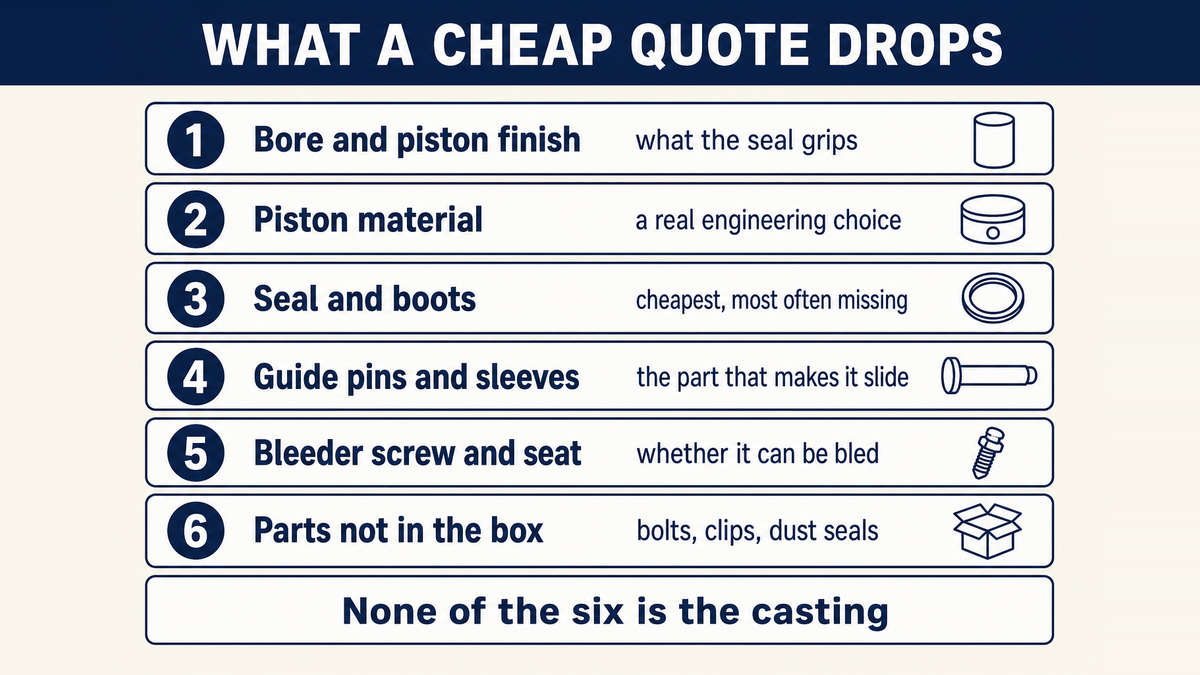
A caliper is a casting or forging plus a small kit of moving parts, and the kit is where the price is decided. Six places a low quote tends to come from:
The bore and the piston surface. The bore has to be machined to a finish the seal can hold against, and the piston surface has to resist corrosion without shedding its coating. As the recall above shows, a coating that is thin is not a cosmetic defect. Both are invisible in a product photo and both are machining-time costs.
The piston material. Pistons are made in more than one material, and the choice changes how much heat reaches the fluid as well as how the part wears. It is a real engineering decision, so it belongs on the specification sheet rather than in a supplier's discretion.
The seal and the boots. The piston seal is what retracts the piston; the guide-pin boots are what stop water and grit reaching the slide. A hard or wrong-profile seal drags, and a missing boot turns the guide pin into the "binding" the inspection rule names. These are the cheapest parts in the bill of materials and the most common omission.
The guide pins and sleeves. Whether they are stainless, plated or plain, and whether the sleeve is a proper sliding fit, decides the life of the slide. A supplier who cannot describe the pin material has not specified the part that makes the caliper slide back.
The bleeder screw and its seat. A minor part that decides whether the unit can be bled properly in the workshop, and a common complaint source for whoever fits it.
Everything that is not in the box. Mounting bolts, clips, anti-rattle hardware and the dust seals. Whether they travel with the caliper or have to be bought separately changes both the landed cost and the customer's experience of the part.
Machining is a category the site covers in more depth for adjacent parts, in metal stamping and machined parts, and the same questions about who holds the drawing and who signs off the first article apply here.
7. New or Rebuilt: a Fork to Settle in Writing
Caliper cores are valuable, and much of the aftermarket for this part is supplied by rebuilding used units rather than by casting new ones. A rebuilt caliper can be a perfectly good product — but it is a different product, and the difference has to be settled before the quotation, not after the pallet arrives.
Three questions separate the two clearly, and all three belong in the enquiry letter:
- What is replaced, and what is reused? A rebuilt unit has a defined replacement kit — seals, boots, piston, sometimes the bleeder. If the supplier cannot list what is new, the buyer cannot compare two offers on the same basis.
- What happens to the bore and the body? Is the bore re-machined, and is the body crack-checked? Section 2's rule about deformation and cracking is exactly what a rebuild has to answer for.
- Who carries the core? Rebuilding only works with a flow of returned units, so the logistics of cores belong in the deal rather than in a footnote.
Both paths are legitimate. What is not legitimate is a quotation that says "caliper" and leaves the buyer to discover which one they bought. Whether the goods are new or rebuilt also feeds directly into how they are described for entry, which is the subject of the classification in how an HTS code is assigned.
8. What to Check on a Sample
With no approval document to lean on, the sample carries the weight. Six checks cover most of the ground.
- The slide, by hand. Does the body move freely on its pins through the full travel, with the boot in place? This is the single most predictive check in the list, and it costs nothing to run.
- The bore and the piston surface. Finish, freedom from scoring, and — as the recall record shows — whether the coating is present and even.
- The seal fit and the boots. Correct profile for the bore, and boots that seat properly. Ask what elastomer is used and for which fluid.
- The fasteners. Grade marked on the bolts, and whether bolts, clips and anti-rattle hardware are in the box.
- The casting. Wall thickness at the bridge, and freedom from porosity around the fluid passages and the bleeder seat.
- The paperwork that travels with the part. The written description that will define the goods for entry, what is new versus reused if the unit is rebuilt, and the origin documents.
On the factory side, the usual visit checks apply: whether the casting is theirs or bought in, whether the bore is machined in house, and who signs off the first article. Our sequence for that is in the factory audit checklist, and the origin paperwork that Customs asks for when the marking on the carton is questioned is covered in the certificate of origin guide.
9. Where the Unit Price Comes From
Four things set a caliper's price, in roughly this order: the body, the small kit, the machining, and what is in the box. The body sets the material and most of the weight. The small kit — pistons, seals, boots, pins — is where a quote moves fastest, because those parts are cheap individually and easy to specify weakly. Machining sets the machine time per piece, and it is where volume changes the price. What is included in the box is the smallest line and the one that decides whether the customer can fit the part at all.
That ordering is why a caliper should never be quoted on the body alone. Two quotations for "aluminium caliper, powder coated" can differ by a third in their contents, and the cheaper of the two is usually the one whose guide pins, boots and bolts were never priced. A quote worth comparing names the piston material, the bore finish, the seal, the pins, and every part that ships with the unit.
10. Frequently Asked Questions
Do replacement brake calipers need an approval number?
Not under the European regulation that governs most replacement brake parts. The Commission's own statement makes approval to UN Regulation No 90 compulsory for replacement brake lining assemblies, drum-brake linings, discs and drums — calipers are not on that list, and the regulation is titled around the same four items. The caliper still faces requirements through the vehicle standard and through in-service inspection rules; what it lacks is a product approval attached to the spare part itself.
What does an inspection check on a brake caliper?
Structure and movement, not pressure. The federal in-service rule says backing plates and caliper assemblies shall not be deformed or cracked, that system parts shall not be broken, misaligned, missing or binding, and that automatic adjusters shall be correctly assembled. It does not ask the caliper to hold pressure. The same section limits the difference in brake force between the two sides of an axle to twenty percent, which is the check a dragging caliper fails.
Can a caliper defect make a vehicle non-compliant?
Yes, and there is a record of it. A 2018 campaign covering certain Acura and Honda vehicles stated that the rear caliper pistons may have an insufficient coating, causing gas pockets to form and reducing brake performance, and that the vehicles therefore fail to comply with Federal Motor Vehicle Safety Standard number 135. The remedy was to bleed the brakes. A part with no approval of its own can still be the reason a vehicle does not meet the standard.
Why does a cheap caliper drag, and why does it matter?
Drag usually comes from the slide rather than the hydraulics: guide pins that are not plated properly, sleeves that do not fit, or missing boots that let water and grit onto the pin. The result is a caliper that does not fully release, which overheats one side, wears a pad unevenly, and shows up as a left-to-right brake force difference above the twenty percent limit. It is also the failure the inspection rule names as binding.
How do I compare a new caliper with a rebuilt one?
Settle three things in writing before the quotation: what is replaced and what is reused, what is done to the bore and the body including any crack check, and who carries the cores. Both new and rebuilt units can be good products, but they are not interchangeable on a price list, and a quotation that just says "caliper" leaves the buyer to find out which one they bought after the pallet arrives.
Three Inspection Points, Plus the Leak Figure
We return the three items an inspector is told to look at, the leak rate on your order, and two recall patterns worth testing for.
Write My Caliper Spec
Questions & Comments
We read every one and reply within 24 hoursSourcing calipers for a market where nothing on the part needs an approval number, comparing a new unit against a rebuilt one on the same basis, or working out which small parts — pistons, seals, boots, guide pins, bolts — your supplier is actually quoting? Send us the application and the market, and our team will put the caliper specification in writing, item by item.