
ASTM F2413-24: How to Read the Label and Check Every Code
 ·
Updated October 19, 2026
·
13 min read
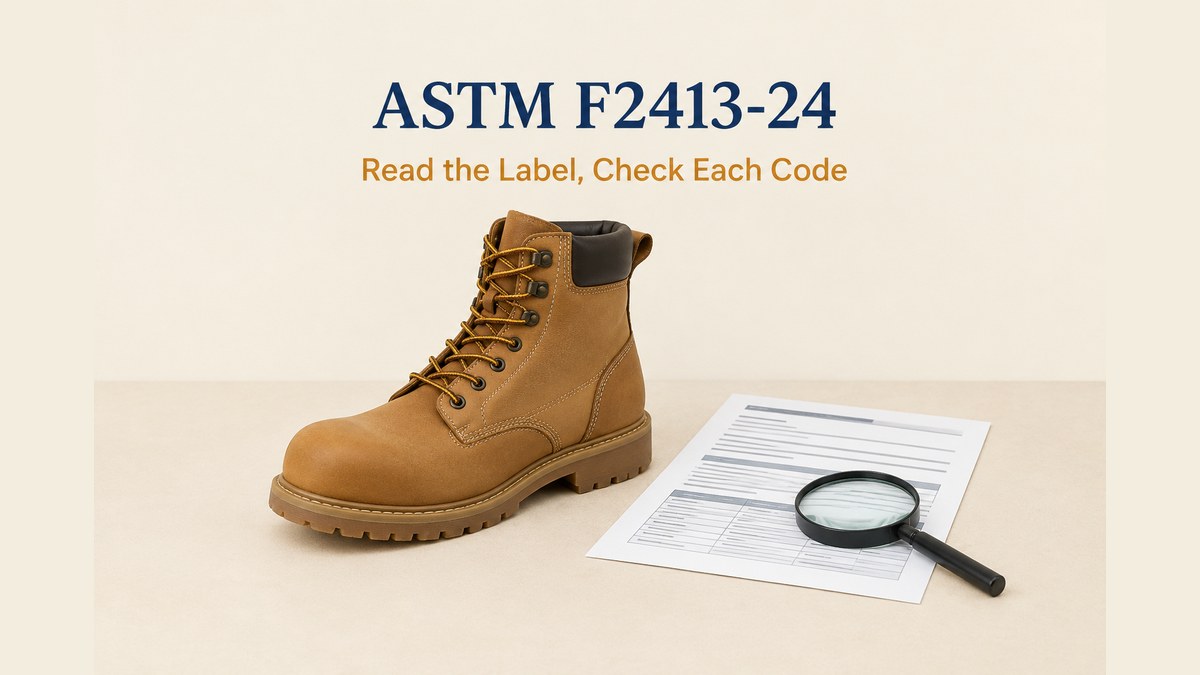
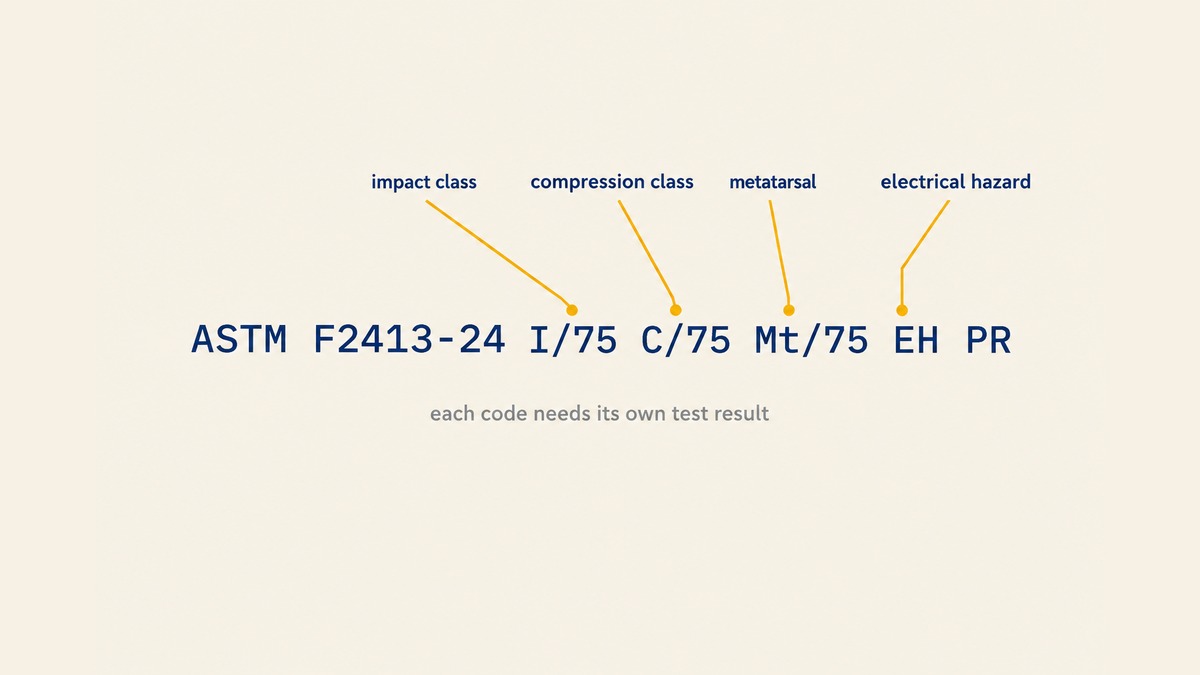
ASTM F2413-24 is the current version of the performance standard for safety footwear, and the string on the tongue is a list of claims. A boot marked I/75 C/75 EH PR claims four other things. Each one needs its own test result. This guide reads the label code by code. It then shows which paper proves each claim, and what to ask for when one is missing.
The Short Answer
F2413 sets the minimum rules for safety footwear. It tells you what a boot has to do to be sold as safety footwear in the United States. The number after the dash is the version, so F2413-24 is the 2024 version.
The companion standard is F2412, which describes the test methods. One standard says what the boot must do; the other says how the lab proves it. Confusing the two is common, and it matters when you read a test report.
For a buyer, the practical question is narrower than the standard. Is the marking on this boot supported by papers, and do those papers belong to this product? That is a checking job, not a reading job.
What the Marking Actually Says
The marking string is compact on purpose. It has to fit on a tongue, so each property became a short code. Reading it in order is the whole skill.
| Code on the label | What it claims | What proves it |
|---|---|---|
| I/75 | Impact rating, class 75 | Impact test result |
| C/75 | Compression rating, class 75 | Compression test result |
| Mt/75 | Metatarsal protection | Metatarsal impact test |
| EH | Electrical hazard cover | Electrical test result |
| PR | Puncture cover | Plate test result |
| SD | Static dissipative | Electrical resistance test |
The number in I/75 and C/75 is a class, not a measurement in your units. It comes from the test method in F2412. A boot cannot carry the class without a report that names the method.
Not every boot carries every code. A basic safety toe often shows I/75 and C/75 alone. Metatarsal protection adds Mt, and electrical properties add EH or SD. A boot that claims everything is claiming a lot of testing, and that is worth checking first.
Two codes rarely appear together: EH and SD. They pull in opposite directions electrically. A supplier claiming both on one style is describing two products, or a mistake in the label.
Three Documents, Very Different Value
Suppliers use one word for three different things, and the word is certificate. Knowing which one you have been sent is most of the checking job.
A test report comes from a lab. It names the sample, the test method, the result and the date. It is the only paper that shows a physical boot passing a physical test. Everything else is a summary of this one.
A letter of the rules is a letter, usually on the supplier's own paper, stating that the product meets the standard. It may quote a report number. It is a claim, and a claim is worth exactly as much as the report behind it.
Self-declaration is the weakest form: a line in a catalogue or an email saying the boots meet F2413. It is common, it is cheap, and it is not evidence. Some markets accept a supplier's declaration for some products. Safety footwear sold into the United States is not a comfortable place to rely on one.
| Document | Who issues it | What it proves |
|---|---|---|
| Test report | A lab | This sample passed this test |
| Statement | The supplier | That a report is said to exist |
| Self-declaration | The supplier | Nothing |
One detail decides whether a report is useful: the product named on it. A report for another style, sole or toe cap proves nothing about the boot in your carton. Read the model number and the construction on the first page. Do that before you read the result.
The second detail is the date. Standards have versions. A report against an older version may still be valid for a product already in the market. It is weaker evidence for a new run, because the spec has moved on.
The Edition Question
The year in the name is not a version number for the buyer to ignore. Production that claims the current version should be tested against it, and the label should say so.
In practice, three cases appear. The supplier tested against the current version and the label matches. The supplier tested against an older version, and the label shows the current one. That is a gap. Or the supplier tested against an older version and says so, which is honest but may not satisfy your buyer.
Ask which version the report covers, then compare it with the marking. If the two disagree, you are looking at a label written by a printer, not by a lab.
How to Check a Boot Before You Ship
Checking happens in four steps. Each one is cheap before the run and expensive after.
One: match the marking to the report. Every code on the label must appear as a tested property. A boot marked PR with no puncture result is a labelling problem, and it becomes your problem at the port.
Two: match the product to the report. Style number, material, construction. A report for a leather boot does not cover a mesh version of the same shape, even when the photo looks similar.
Three: check the lab. Reports carry a lab name and usually a report number. Ask for the contact on the letterhead and, on a large order, confirm the report exists. This is the step buyers skip, and it is the one that catches a copied report.
Four: test the production batch, not the sample. A sample can be hand-built. The marking on a mass-produced boot still has to match. This is where a pre-shipment check earns its fee, because it compares the run with the approved sample, not with the catalogue.
Two of these four steps need a paper from the factory. The other two need a person at the factory, which is what a an check at the factory before shipping is for. It counts, samples and photographs the actual marking on the boot.
Four Failures That Repeat
These are not rare. They are the same four problems in different cartons, and each one passes a quick look at the product photo.
The label is copied from another model. A factory makes a certified boot and an uncertified one in the same shape. The uncertified pair carries the same tongue marking because the label printer does not know the difference. The boot looks right, and the marking is a borrowed claim.
The report belongs to an older version. The supplier has a genuine report, dated years ago, against a previous version of the standard. The marking on new stock shows the current version. Nobody updated the test, and the paper no longer supports the label.
Puncture cover is claimed without the plate. PR needs a plate inside the sole. On a cheap pair the plate is thin, short, or absent. A buyer discovers it when a worker steps on a nail, which is the worst possible test.
Electrical protection meets metal. EH and SD depend on the whole boot being built the right way. Metal eyelets, a steel toe without insulation or a conductive insole can undo the property that the sole was designed for.
None of these is visible in a catalogue. Most of them come from the same weakness, and checking a supplier before the first order closes it earlier than an inspection can. All of them are visible in a factory, in about an hour, if you know which code to check and where to look.
Write It Into the Order
The marking is worth nothing in a chat and a lot in a spec. Write the codes you are buying, the version you expect, and the paper you will accept as proof.
A useful line reads: model X in black, marked ASTM F2413-24 with I/75 C/75 and PR. Add that it is backed by a test report naming this model and this material, from a named lab, within the last two years. That sentence is checkable. "CE certified" is not, and it is a different market anyway.
Say also what happens if the check fails. A clause that ties the balance to a passed check turns a paper problem into a commercial one the supplier has to solve. Without it, the argument happens after the goods land, when your leverage is gone. Our guide to writing a spec sheet a factory can price from shows where these lines sit.
Choosing the Factory
Safety footwear is made in several Chinese clusters, and the city name tells you less than the test file does. The same logic runs across footwear: Nike publishes a factory map, and most brands do not. Two factories in the same town can sit at opposite ends of the testing ladder.
Ask three questions before a sample. Which standard do you test to, and which version? Which lab issues your reports? Can I see a report for this exact model, with the model number visible?
A factory that answers all three has a testing process. A factory that answers the first two and avoids the third has a catalogue. The difference shows up in the first order, and it shows up whether or not the price was better.
Keep the answers on file with the report. When the second order comes, the file is what lets you compare the new run with the old one instead of starting again.
Keep the file small and current: the report, the model list it covers, the lab contact and the last check note. Four pages, one folder, and every later order starts from a known state instead of a photograph of a tongue.
Why the Standard Matters Beyond the Label
In the United States, workplace rules require employers to make sure safety footwear is worn where there is a hazard. The same rules require that footwear to meet a known standard. The requirement sits in 29 CFR 1910.136.
That chain is why a boot with an invented marking is worse than a boot with no marking. The buyer passes it on to an employer, the employer passes it to a worker, and the failure lands on someone with a legal duty. The paperwork problem becomes a safety record.
For an importer, the practical version is simple. If the boots are sold as safety footwear, the marking and the report have to survive a question from a buyer who knows the standard. Assume that question will be asked.
Country of origin is a other duty and it is not part of F2413. It applies to the boot, the box and the label, and a missing mark is a delay at the port. It sits in the marking rules at 19 CFR 134, and it applies to every imported article. A boot can be fully within the rules on protection and still fail on origin marking, which is a common and avoidable port problem.
Questions Buyers Ask About F2413
What is ASTM F2413-24?
It is the performance standard for safety footwear in the United States, in its 2024 version. It sets the minimum rules a boot must meet to be sold as safety footwear. It also defines the marking that goes on the product.
What is the difference between F2412 and F2413?
F2412 describes the test methods. F2413 describes the requirements. One tells the lab how to test, the other tells the product what it must achieve. A test report should name both.
What does I/75 C/75 mean on a boot?
They are impact and compression ratings. The number is the class taken from the test method, not a measurement in your own units. Both codes should appear as other results in the test report.
Is a statement enough?
Not on its own. A letter is a supplier letter summarising a test. Ask for the report it refers to, and check that the model, material and date on the report describe the boots you are buying.
Does F2413 cover electrical hazard protection?
Yes, as one of the properties a boot can claim, marked EH or SD. The two are electrically opposite, so a single style that claims both is worth a second look at the test report.
Is ASTM F2413 required by law?
The standard itself is voluntary. Workplace rules require employers to ensure safety footwear in hazardous areas meets a known standard, and F2413 is the one used in practice. That makes it effectively mandatory for safety footwear sold into the United States.
The Bottom Line
The marking on a boot tongue is a list of claims, and each claim has a test behind it. I/75, C/75, Mt, EH, PR and SD are not decoration; they are properties the maker says were measured.
Three papers get confused: the test report, the statement, and the self-declaration. Only the first one shows a physical boot passing a physical test, and only if the model on it matches the model in your carton.
So check the marking against the report, check the report against the product, and check the run before the balance is paid. That is an hour of work in a factory, and it is the difference between selling footwear that meets the standard and owning a safety record.
Have the Boots Verified Before Shipping
Send us the style and the marking you expect. We check the label against the test report, confirm the model and the version, and photograph the actual run at the factory. You get the papers and the gaps, before the balance leaves your account.
Verify My Safety Footwear
Questions & Comments
We read every one and reply within 24 hoursIf you are buying safety footwear, send us the marking on the tongue and the test report you were given. We will tell you which codes the report actually supports, and which ones the factory still has to prove.