
MOQ Meaning Alibaba Sellers Never Explain: It Is a Price, Not a Wall
 ·
Updated October 19, 2026
·
12 min read
MOQ means minimum order quantity, the smallest number a supplier will sell in one order. On the Alibaba.com marketplace site that number is rarely fixed. It is the point where the supplier stops losing money on a run, and it moves when the run gets cheaper to set up. This guide explains what the figure really measures. It also shows how to test whether it is firm, and the four levers that move it down.
The Short Answer
An MOQ is a price break written as a quantity. Below it, the supplier cannot cover the fixed part of a run. That means setup, the smallest batch of raw material, and the print or packing minimum. Above it, those costs spread out and the unit price falls.
That is why two suppliers quote wildly different numbers for the same bag. One buys fabric by the roll and prints in house. The other buys finished stock and adds a label. The second has a low floor and a high unit price. The first has a high floor and a low one.
So the useful question is not "what is your MOQ". It is "what makes your MOQ that number". A supplier who can answer that has shown you their cost structure. A supplier who cannot is quoting a habit.
Three Numbers Hide Behind One Label
The figure on a listing can mean three different things, and the listing rarely says which. Reading it wrong is how buyers plan an order that cannot ship.
| What the number counts | Example on a listing | What it means for you |
|---|---|---|
| Units in one order | MOQ 500 | 500 units of any mix |
| Units per colour | MOQ 500, 100 per colour | Five colours, or fewer with a surcharge |
| Units per carton size | MOQ 500, 50 per size | A size run, not five hundred of one |
The second row is the one that catches buyers. A supplier who says "500 pieces" may mean 500 in total, or 500 of each colour. Each colour change costs a setup. Ask before you build a plan around the number. The Alibaba.com seller blog makes the same split, in its own words.
The third row matters for anything sold in sizes. Shoes, shirts and gloves all carry a size curve, and a run of 500 pieces usually means 50 in each of ten sizes. Asking for 400 in one size and 25 in each of the rest is a different order, and often a different price.
Why the Number Exists
A factory does not lose money on small orders out of habit. It loses money because part of the cost does not shrink with the order. Four costs behave that way, and the MOQ is the point where they stop dominating the price.
Setup is the first. A machine has to be cleaned, threaded, filled or programmed before it makes anything. That work takes the same hour for 50 pieces or 5,000. On a short run it lands on fewer units, so the unit price jumps.
The smallest batch of raw material is the second, and it is the one buyers miss. Fabric comes by the roll, ink by the drum, film by the kilo. A supplier cannot buy a third of a roll. If your order needs 40 metres and the roll is 300, you either buy the roll or you buy somebody else's leftover.
The print or packing run is the third. A print plate, a die, a woven label and a carton all carry a minimum. Labels are often sold in batches of a thousand. That alone can lift the floor above what the product needs.
Colour changes are the fourth. Each colour means a clean-down. Five colours is five clean-downs, which is why a per-colour floor appears on listings that look like a single figure.
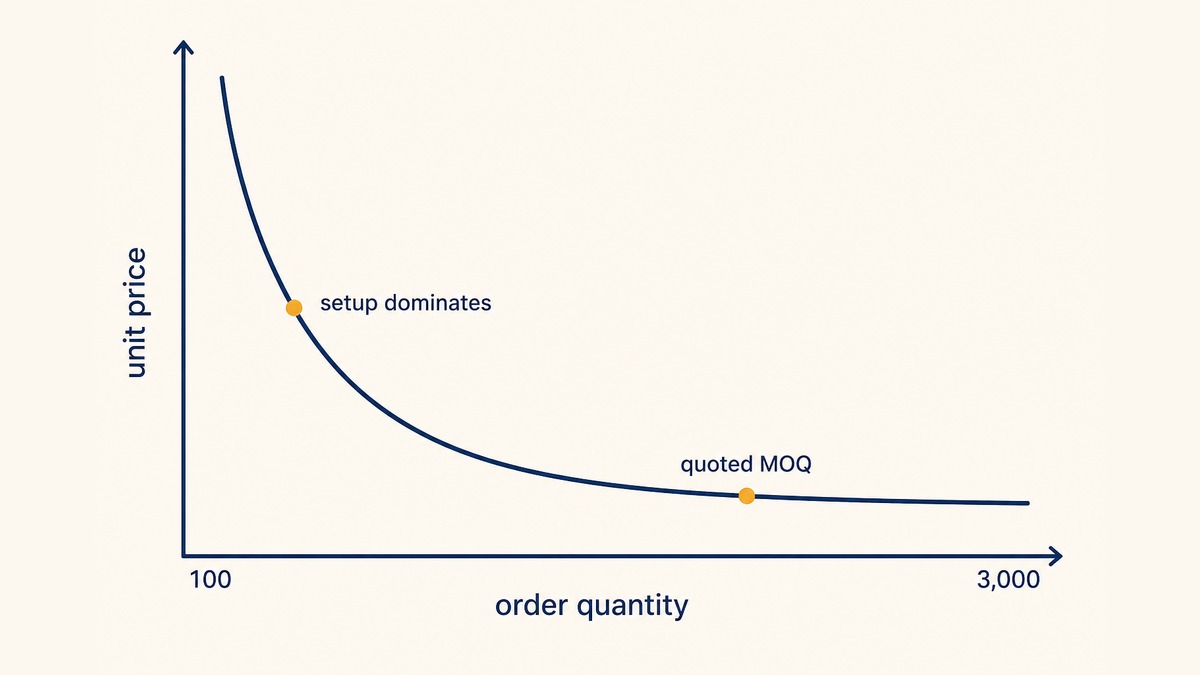
Add those four together and you get a curve, not a cliff. The unit price falls sharply at first, then flattens. The listed MOQ is usually the point where the curve is flat enough that the supplier is willing to quote.
How to Test Whether the Number Is Firm
Most listed minimums are soft. Testing one takes three questions, and none of them is "can you lower it". That request invites a yes with a worse unit price, which is not a win.
Ask for the same quote at three numbers. Use your target, half of it, and double it. A supplier with a real floor will refuse the low one and explain why. A supplier who quotes all three has told you the floor was a negotiating position.
Ask what changes at your number. If the answer is "we would need a smaller roll" or "we would add a setup fee", the number is real and movable. If the answer is silence, the number is a template.
Ask for the setup fee on its own line. A separate line is a cost you can choose to pay. A bundled fee is a number you cannot argue with.
One more check costs nothing. Search the same item on a retail site. If the supplier sells single pieces there, the production floor is not a capacity limit; it is a channel decision.
What a Realistic First Order Looks Like
Buyers ask for the floor and then plan as if it were a shelf. It is not. A first order usually has three jobs: prove the item, prove the supplier, and put something on sale while the second order is made.
That shapes the count. If you need a hundred units to test the market, the cheaper order is often a hundred at a higher unit price. A thousand only wins once you know the item sells. The thousand becomes cheaper only when you know the item sells.
So split the decision in two. Pay for the test, then pay for the scale. A supplier who sees a second order coming will often help with the first. The short order is the start of a long file.
Four Levers That Move the Number
Pay the setup yourself. A die, a plate or a mould is a one-time cost. Paying it separately often removes the need to hit a large count. The supplier no longer carries the risk of a tool it cannot reuse.
Take a stock colour. A colour already running needs no clean-down. The trade is a smaller choice, not a worse product, and it is often the cheapest way under a floor.
Join an existing run. Factories make the same item for several buyers. Ask to be added to a scheduled run with your label. You can sit below the listed count because someone else already paid the setup.
Split by colour, not by order. Two colours that share ink and thread change less often than two unrelated ones. Grouping your range around one palette can turn five clean-downs into two.
Each lever trades something: money, choice, timing or range. None of them is free, and a supplier who offers all four at once is probably quoting a price that will move later. Write whatever you agree into the order, because a floor agreed in chat is not a floor. Our guide to how to write a spec sheet a factory can price from shows where the number belongs.
What a Low MOQ Actually Costs
A low floor is not a discount. It is a smaller order with the same fixed costs on top, so the unit price carries more of them. The table below uses a cotton tote bag with a one-colour print, priced at four counts.
The numbers are illustrative, built from typical quotes for that item. Treat them as a shape, not a promise.
| Order count | Setup per order | Unit price | Total |
|---|---|---|---|
| 100 | $80 | $2.40 | $320 |
| 300 | $80 | $1.65 | $575 |
| 1,000 | $80 | $1.20 | $1,280 |
| 3,000 | $80 | $1.02 | $3,140 |
Read the first two rows together. Going from 100 to 300 pieces doubles the goods and adds $255, so the second order is far cheaper per unit. The setup did not change; it just landed on three times as many bags.
That is the trade a low floor offers. You pay more per piece to commit less money. For a test batch that is rational. For a product you already sell, it is a tax you chose.
The same logic runs through freight and duty, which do not care how few pieces you bought. Our breakdown of the fixed charges that sit above the unit price shows where those fixed charges sit.
When to Refuse the Floor
A floor that will not move is not always a bad sign. Some suppliers run one machine flat out and genuinely cannot take a short run. The question is whether the reason is capacity or policy.
Refuse when the floor moves only in exchange for a worse product. A lower count with thinner fabric or a simpler print is not a negotiation. It is a different item at a similar price.
Refuse when the number changes after you agree it. A floor that rises after the sample is approved ends the way most disputes start. Our guide to the five patterns behind most Alibaba losses explains why that is a stop sign, not a red flag.
Stay when the supplier names the constraint and offers a path. "The roll is 300 metres, so 400 pieces is our floor, or we can use the grey roll and start at 150" is a good answer. It names the cost, the limit and the option in one sentence.
Capacity is the one reason worth accepting. A plant running one line for a seasonal customer may have no room between March and June. A short order would mean stopping a bigger one. That is a real cost, and it explains a floor that will not move.
The test is simple. Ask when the line is free. A supplier with a genuine capacity limit will name a month. A supplier using capacity as a story will stay vague, because a date is something you can hold them to.
Use a Quote Request, Not One Chat
The fastest way to learn what a floor really is: send the same requirement to five suppliers at once. The replies form a market, and the spread tells you more than any single answer.
Send the count you want, the count you could accept, and the target unit price. Suppliers who come back with a path are worth a sample. Suppliers who only repeat the listed number have read the same listing you did.
One request also settles the colour and size questions early, because each supplier describes their own split. Reading five answers side by side is how buyers learn which numbers are structural and which are habits. Sending one request through the RFQ tool takes about ten minutes and replaces five separate chats.
Questions Buyers Ask About MOQ
What does MOQ mean on Alibaba?
It is the minimum order quantity, the smallest number of units a supplier will sell in one order. The figure can mean units in total, units per colour or units per size. Ask which one before you plan around it.
Is the MOQ on Alibaba negotiable?
Often, yes. The number sits where the fixed costs of a run stop dominating the unit price, and those costs can be moved. You can pay the setup fee yourself, take a stock colour, or join a run the supplier is already making.
Why is the MOQ so high for my product?
Usually one of four costs: setup time, the smallest batch of raw material, a print or label minimum, or a colour change. Ask which one applies. The answer tells you whether the floor is capacity or policy, and only one of those can be argued with.
Can I order below the MOQ and pay a surcharge?
Sometimes, and it is worth pricing. You are asking the supplier to carry the fixed cost of a full run on a short one, so the surcharge is real. Compare the total you would spend against the total at the full floor before deciding which is cheaper per unit.
Does a lower MOQ always mean a higher unit price?
Nearly always, because the same fixed costs land on fewer pieces. The exception is a supplier with spare capacity who wants your order to fill a run. That is worth asking about, and it is the best moment to negotiate.
Is a sample order the same as an order below MOQ?
No. A sample is usually made by hand or pulled from stock, and it is priced as a favour, not a run. It proves the item can be made, not that the factory will run your count. Do not read a sample price as a bulk price.
The Bottom Line
MOQ is a price written as a number. Underneath it sit four costs that do not shrink with the order, and the figure is where those costs stop dominating the unit price.
That makes the number a starting point, not a rule. Ask what makes it that number, test it with three quotes, and choose which lever you are willing to trade: money, choice, timing or range.
Then write the answer into the order. A floor agreed in a chat is a memory, and memory is what buyers argue with when a shipment is short.
Tell Us the Count You Can Commit
Send us the product and the number you can actually order. We will quote it against the factory floor and name which of the four costs is driving it. Then we tell you whether a setup fee or a stock colour gets you under it.
Test My Order Count
Questions & Comments
We read every one and reply within 24 hoursTell us the count you can actually commit and what you are trying to make. We will tell you which of the four costs is setting the floor, and whether a setup fee or a stock colour gets you under it without paying more per piece.