
Alibaba Scams: The Five Patterns That Cost Buyers Real Money
 ·
Updated October 19, 2026
·
15 min read
Most Alibaba scams are not clever. They are ordinary order failures that happen because the buyer never wrote down what they were buying. Five patterns cover almost all the cases we see, and each one is stopped by a document, not by suspicion. This guide walks through the five, shows where the money actually moves, and gives the check that closes each gap before you pay a deposit.
The Short Answer
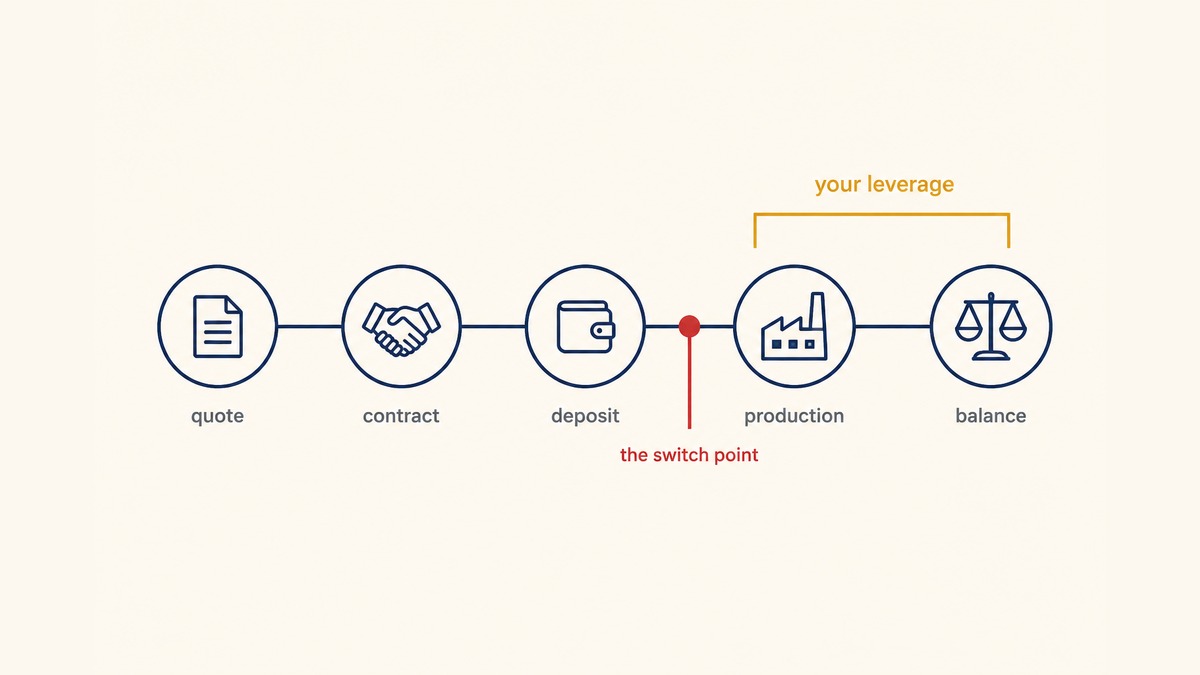
A scam on a trade platform often works by separating two things that should stay together: the money and the written terms. Whoever controls the gap between them controls the outcome. That is why the same five failures repeat across thousands of disputes.
This matters because the word scam points at the wrong target. It suggests a criminal hunting you. In practice the more common case is a supplier who takes the easiest path through a vague order, then defends it with the platform's rules. The result feels like fraud. The cause is a missing document.
Pattern One: The Payment Account Changes
You agree a price, receive a contract, and pay the deposit to the company account. Then a message arrives: use this other account instead, because of a tax change, a new bank, or a family account that clears faster.
This is the single most expensive pattern, because once the money lands in a personal account, the order and the payment are no longer connected. The platform sees a payment to a third party. That payment sits outside the order it was meant to fund.
The check is a name match. The account holder, the firm on the business licence and the seller on the contract must be the same legal name. Not a similar name, and not a trading name. If any of the three differs, the payment stops until they match.
Bank details do sometimes change for real reasons, such as a merger or a genuine account migration. That does not make the request safe. It means the change has to be confirmed through a second channel, with a new contract naming the new account.
Pattern Two: The Goods Match the Order, Not Your Expectation
This one is not fraud at all, which is why it wins so often. The supplier ships exactly what the contract says. The contract says stainless steel, and the goods are stainless steel. Your complaint is about thickness, finish or grade, and none of those words appear anywhere in the order.
Dispute teams measure the goods against the document. If the document is silent, there is nothing to measure. A buyer who writes "high quality" has written a sentence that cannot be tested, and the platform will not invent a standard for them.
The check is a specification sheet with numbers. Grade, thickness in millimetres, tolerance, finish, packing count, carton size. Each line should be something an inspector can put a gauge against. Our guide to writing a product specification sheet for Chinese factories shows the fields that decide disputes.
A sample helps only if it is signed and dated. An unsigned photo of a sample proves nothing six weeks later. A sealed sample that both sides have dated turns an opinion into a reference object.
Pattern Three: The Quote Is Real, the Second Batch Is Not
A supplier quotes a price, you approve a sample, you place a large order. The sample was made on a good line with a good grade. The bulk order is made somewhere cheaper, to a lower internal standard, at the same price.
The tell is timing. When a quote at 5,000 pieces is barely above the quote at 500, one of two things is happening. Either the first quote was padded, or the grade changes between the two runs. Ask which material the price covers at each quantity, in writing, and the answer often resolves it.
This is where inspection earns its fee. A check before the balance is paid measures the bulk run against the signed sample. If the two do not match, the balance is the leverage, and it is still in your hands.
The check is a material clause tied to quantity. Name the grade and the supplier for the material, at each break point. Then hold the balance until a pre-shipment inspection in China reports against that clause.
Pattern Four: The Factory That Does Not Exist
This is the pattern buyers fear most, and it is the easiest to test. A trading company presents itself as a manufacturer. It has no line, no machine and no workers, but it has a listing, a catalogue and a confident answer for each question.
Paying a trader is not automatically bad. A good trader consolidates small orders, handles export papers and answers faster than a busy plant. The problem is paying a factory price for a trader's product, then discovering the trader cannot control quality because it does not make anything.
| Signal | Leans factory | Leans trader |
|---|---|---|
| Licence scope | Production listed. | Sales only. |
| Product range | One material family. | Unrelated types. |
| Minimum order | Follows a production run. | Flexible, moves with the chat. |
| Tooling question | Names the mould and its owner. | Changes the subject. |
| Video call | Walks to the line, noise included. | Offers a showroom or a meeting room. |
The check is a live call on the line. Ask to see the machine that makes your part, running, with your grade on it. Badges do not answer this question. The Verified and Gold badges on a listing describe what a supplier paid for and what an inspector once saw. Neither badge shows what sits on the floor this week.
Pattern Five: Move the Payment Off the Platform
The supplier offers a discount for paying outside the order: a bank transfer, a wallet, a personal account, a other company. The discount is real in the sense that it exists. So is the loss of cover.
Platform protection is attached to an order and to a payment made through that order. Take the payment out and the protection does not follow. You keep a chat log and a hope.
Some buyers accept this trade because they have worked with the supplier for years. That is a business decision, and it can be rational. What is not rational is doing it on a first order while also expecting the platform to step in later.
The check is a written refusal. State in the order that payment will only go to the named company account, through the platform. Add that any later request to change this is void. A supplier with a real order to fill will not argue.
The Five Checks, in the Order That Matters
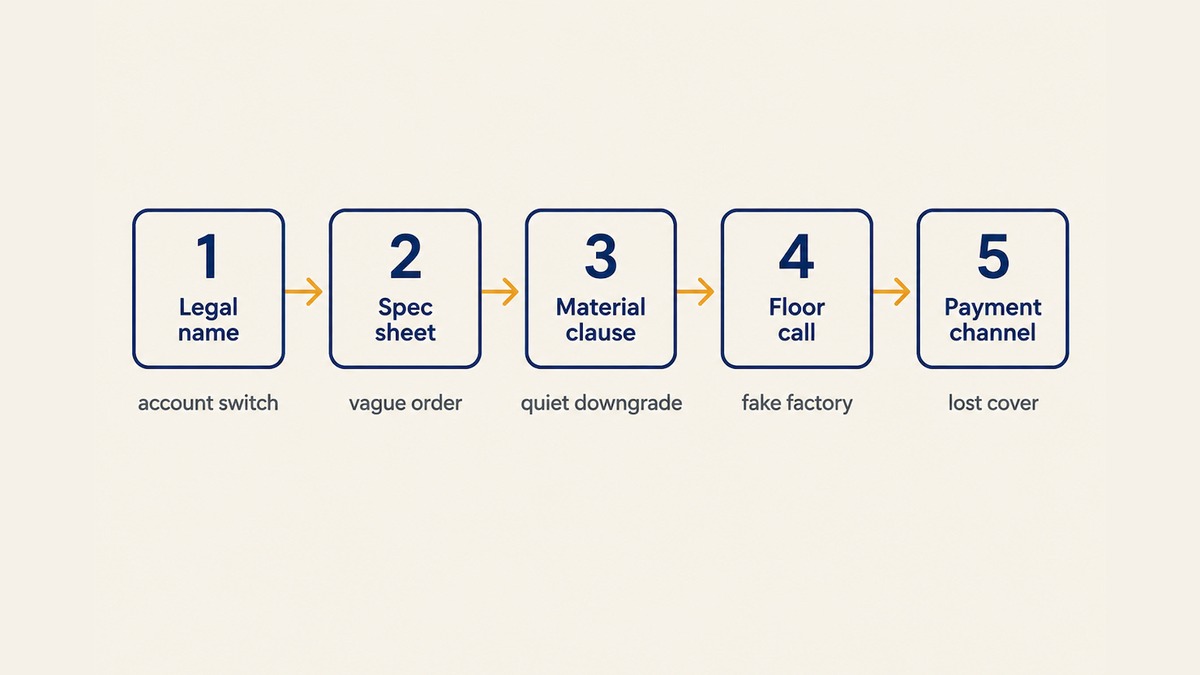
These checks are cheap before the deposit and expensive after it. Run them in this order, because each one depends on the answer to the one before.
| Check | What you ask for | What it blocks |
|---|---|---|
| 1. Legal name | Business licence and the account name. | Account switch. |
| 2. Spec sheet | Numbers, not adjectives. | Goods that match the order but not your aim. |
| 3. Material clause | Grade named at each quantity break. | Quiet swap in the bulk run. |
| 4. Floor call | Live video of the line, running. | A trader posing as a factory. |
| 5. Payment channel | Platform order, named account only. | Loss of cover once money leaves. |
Four of the five happen before production starts. That is the point. A buyer who runs them once has a supplier file for each later order. That file is what makes the second order faster than the first.
When the Supplier Pushes Back
A honest supplier answers these questions in a day. A supplier with something to hide answers them with delay, and the delay itself is information. The useful skill is telling the two apart without turning the order into an argument.
Start with the cheapest request. Ask for the licence photograph and the exact account name in the same message. A supplier who sends both, without a story, has passed the first check. It also tells you how the rest of the order will run.
If a request is refused, ask what would make it possible. Sellers sometimes block a video call because the line is a subcontractor's, or because the factory is a partner they do not control. That answer is worth more than the call, because it tells you who will answer for quality when the batch is wrong.
Never trade a check for a discount. A price cut offered in exchange for skipping the inspection is a price cut that removes your only evidence. The two are not comparable, and treating them as a bargain is how buyers end up in a dispute with nothing to show.
What Trade Assurance Decides, and What It Does Not
Trade Assurance ties payment to the terms written into the order, and it can hold funds until shipping is confirmed. On its own page the platform describes cover from payment through shipping. That is a real safeguard, and it is the reason to keep the payment inside the order.
What it does not do is invent a standard. It measures the goods against the contract. If the contract is silent on finish, thickness or grade, the dispute turns on words nobody wrote down. The what Trade Assurance actually covers is worth reading once, next to the order you are about to sign.
This is why the earlier patterns all resolve to papers. The protection is not weak. It is precise, and precision works in both directions. A buyer with a detailed order gets a usable tool. A buyer with a two-line order gets a two-line outcome.
The same logic explains why the platform choice matters less than the paperwork. Whether you buy through the wholesale door or a retail listing, the question of what was promised is identical. Our comparison of the AliExpress and Alibaba sourcing routes shows where that promise sits in each case.
If It Has Already Happened
Act in the order that preserves proof, not the order that feels urgent. The first hour is often spent on messages that create no record. The record is what decides the outcome.
Collect the four papers. The order page, the payment proof, the chat where the terms were agreed, and photographs of what arrived. Dispute teams work from these, and each one has to point at the same product and the same amount.
Open the dispute inside the window. Windows are short and they close without warning. If the goods are still in transit, a dispute about quality is hard to win; a dispute about non-shipping has a clear clock. Choose the claim that matches the proof you hold today.
Keep a copy of each one. Keep the balance. If any payment is still unpaid, it is your strongest lever, and it stays strong only while unpaid. Paying the balance to show good faith removes the only thing the other side needs from you.
Escalate to the payment route, not only the platform. A card payment can carry a chargeback window. A bank transfer generally cannot be reversed. Knowing which route you used tells you which clock is running.
If the money is gone and the supplier has stopped replying, file it. In the United States, a fraud report with the FBI's IC3 creates a dated record. Attach it to a bank claim or a chargeback.
Write the file even if you lose. The licence name, the spec sheet and the inspection notes become the checklist for the next supplier. Buyers who lose once and document it rarely lose the same way twice.
What These Failures Actually Cost
The visible loss is the deposit. The larger loss is the schedule. A disputed order often costs a season, because the next run comes after the dispute, not beside it.
That is why the checks are worth an hour each. An check costs a few hundred dollars. A lost quarter costs the margin on everything the product was meant to sell. The arithmetic is not close.
Questions Buyers Ask After a Bad Order
Are Alibaba scams common?
Fraud exists, but the more common failure is a weak order, not a criminal. The platform holds millions of suppliers, and most disputes we see turn on a term nobody wrote down. Both problems are real. Only one is solved by a checklist.
How can I tell whether a supplier is a real factory?
Ask for a live video call and walk it to the machine that makes your part, with your material running. Check that the business licence scope lists production, not only sales. A catalogue, a badge and a fast reply prove none of this.
Can I get my money back if I have been cheated?
Inside the Alibaba.com marketplace it depends on what the order promised and how fast you open the dispute. If the payment left the platform, the platform cannot reach it; your remaining routes are the bank and, for card payments, the chargeback window. Act while the balance is still unpaid.
Is a bank transfer safe for a first order?
It is normal trade practice, and it puts the risk on you between deposit and shipping. Keep the deposit small, match the account name to the company, and tie the balance to a check result not to a shipping date.
Do I need an inspection for a small order?
Not always. Below a few hundred dollars the inspection can cost more than the risk. The cut-off is your margin, not the order size. Once a bad batch would cost more than the inspection fee, the inspection is the cheaper line item.
What is the single strongest warning sign?
A change of payment account after the order is agreed. It appears in the most expensive cases and it has no innocent version that cannot wait for a new contract. Treat it as a stop sign, not a question.
The Bottom Line
Five patterns, five documents. A name that matches on three records. A specification with numbers in it. A material clause tied to quantity. A live look at the line. A payment that stays inside the order.
None of these requires experience or a contact in China. They require an hour before the deposit, which is exactly when nobody wants to spend it. The buyers who skip that hour are the ones who fund the next article about scams.
Have Us Vet the Supplier First
Send us the supplier and the product. We check the licence, the production floor, the spec sheet and the payment route before your deposit leaves. You get a short written report with the gaps marked, so the decision is yours and the risk is visible.
Request a Supplier Check
Questions & Comments
We read every one and reply within 24 hoursIf an order has already gone wrong, tell us what you paid and what the order said. We will read the contract against the goods and tell you which claim can actually be won, before you spend money on a lawyer or a flight.