
AliExpress vs Alibaba: The Three Layers Behind the Price You Pay
 ·
Updated October 19, 2026
·
16 min read
AliExpress and Alibaba are not two versions of one shop. They are two doors into the same supply chain, and the goods behind both doors often start on a third site called 1688. That is why the same mug costs $2.10, $4.80 and $9.90 depending on where you click. This guide maps the three layers. It then runs the landed cost at 10, 100 and 1,000 units, so you can see which door is cheaper for the order you really have.
The Short Answer, Before the Detail
Buy on AliExpress when you need one piece, fast, at a price you can see. Buy on Alibaba.com when you need a batch, a custom logo, or a price you can negotiate. Use 1688, through an agent, when the batch is small enough that the export markup still hurts.
The dividing line is not which platform is better. It is how much money sits between your order size and the factory gate. A single unit carries the most markup per piece. A container carries the least. Everything else in this guide explains why that gap exists, and how to shrink it.
Three Layers, One Owner
Alibaba Group runs all three sites. That single fact explains most of the confusion in this comparison. 1688, Alibaba.com and AliExpress are not competitors fighting for the same buyer. They are three storefronts pointed at three different buyers, and the group earns either way.
1688 is the domestic wholesaler. It is in Chinese, priced in RMB, and built for Chinese shopkeepers who resell inside the country. Sellers there rarely quote export prices, and most will not ship abroad. There is no English order flow and no export document service. You reach it through an agent or a forwarder who buys on your behalf.
Alibaba.com is the export wholesaler. Same factories, but the listing is written for a foreign buyer. Prices are quoted in dollars, often as FOB or EXW. Order minimums appear on the page. You can request a quote, ask for a sample, and pay through an escrow product called Trade Assurance.
AliExpress is the retail shop. One unit, fixed price, no negotiation, and shipping straight to a doorstep. The seller handles the export side for small parcels. What you give up is price, choice and control over what is inside the box.
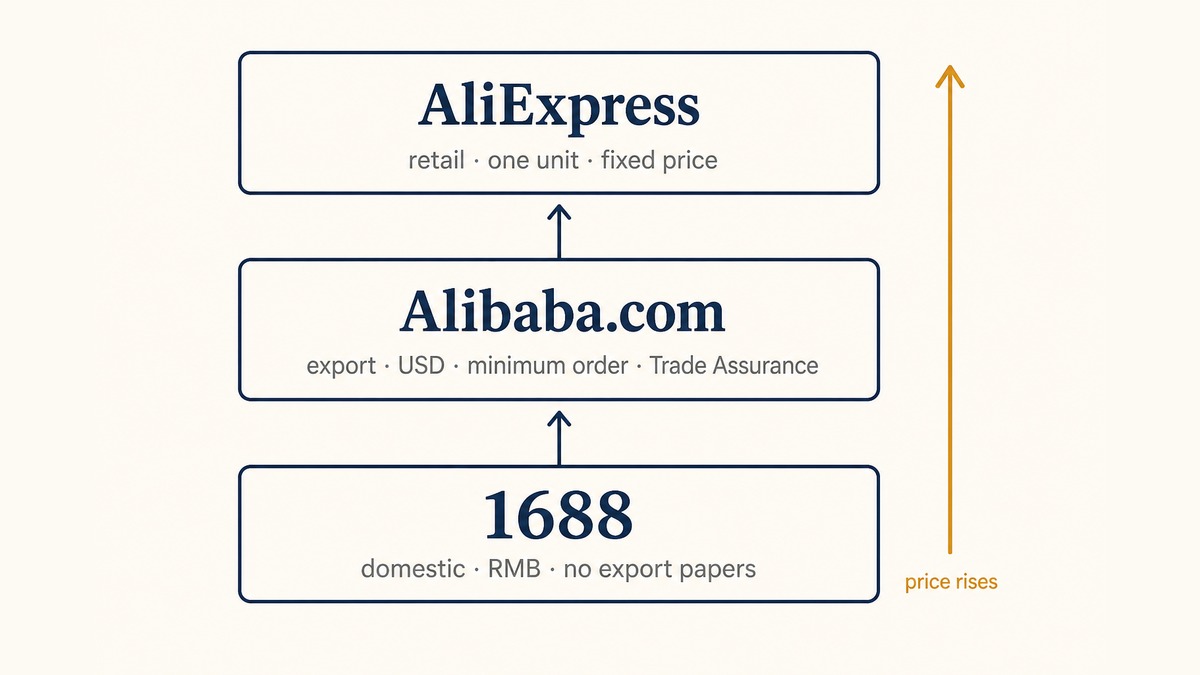
A factory can appear on all three layers at once, under three account names. This is common and not dishonest. The home listing sells to Chinese shops, the export listing sells to importers, and the retail listing sells to whoever finds the photo first. Same mould, three price lists.
This is also why a supplier search can feel like a hall of mirrors. The photo you saved from AliExpress may be on Alibaba.com at a lower price, and on 1688 at a lower price again. You are not looking at three products. You are looking at three margins.
| What changes | 1688 | Alibaba.com | AliExpress |
|---|---|---|---|
| Language | Chinese only | English listing | Local language |
| Currency | RMB | USD quote | Your card currency |
| Smallest order | A few pieces | Supplier minimum | One piece |
| Price | Fixed or chat | Negotiable | Fixed |
| Export papers | You arrange | Supplier assists | Seller handles |
| Custom work | Possible | Full range | Logo at most |
The Price Ladder: Where the Markup Actually Sits
Most comparisons stop at unit price. That hides the useful part, because the unit price is only the first number in a longer sum. The ladder below uses one product, a 350 ml stainless steel travel mug, and shows what changes between the three layers.
The numbers are illustrative, built from typical quotes for that product class. They are not a quote for your item. Treat them as a shape, not a promise.
| Layer and seller | Unit price | Minimum | What you still pay for |
|---|---|---|---|
| 1688 Domestic wholesaler | $2.10 | Often 2 to 10 pieces | Agent fee, domestic freight, export packing |
| Alibaba.com Factory or trading firm | $3.40 at 500 pieces | Often 100 to 1,000 | Freight, duty, inspection, bank charges |
| AliExpress Retail seller | $9.90 for one | 1 piece | Nothing visible, because it is inside the price |
The jump from $2.10 to $9.90 is not theft. It pays for four jobs. Someone holds the stock. Someone packs one unit instead of a carton. Someone carries the risk of a parcel going missing. Someone pays the platform commission, and Shopify puts the AliExpress seller commission at 5% to 8% depending on type.
That commission figure matters more than it looks. It is a cost you never see as a line item, and it is already inside the retail price before the seller adds a margin. Two markups stack before the parcel is even sealed.
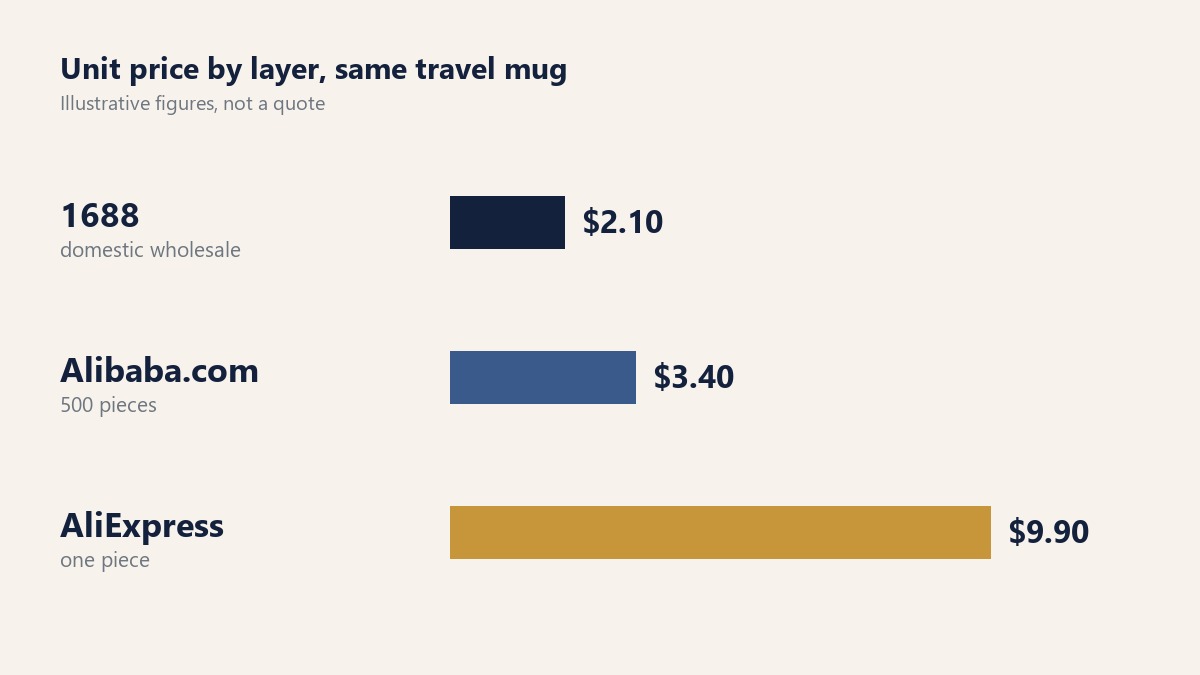
The shape repeats across types. Small, light, non-fragile goods show the widest gap, because retail packing and parcel post are cheap and the percentage markup is free to grow. Bulky goods show a narrower gap, because the freight is a large, visible number that both sides must pay.
Before you compare two quotes, it helps to see each line between them. Our breakdown of what an Alibaba order really costs from unit price to landed cost lists each charge and where it appears.
Landed Cost at 10, 100 and 1,000 Units
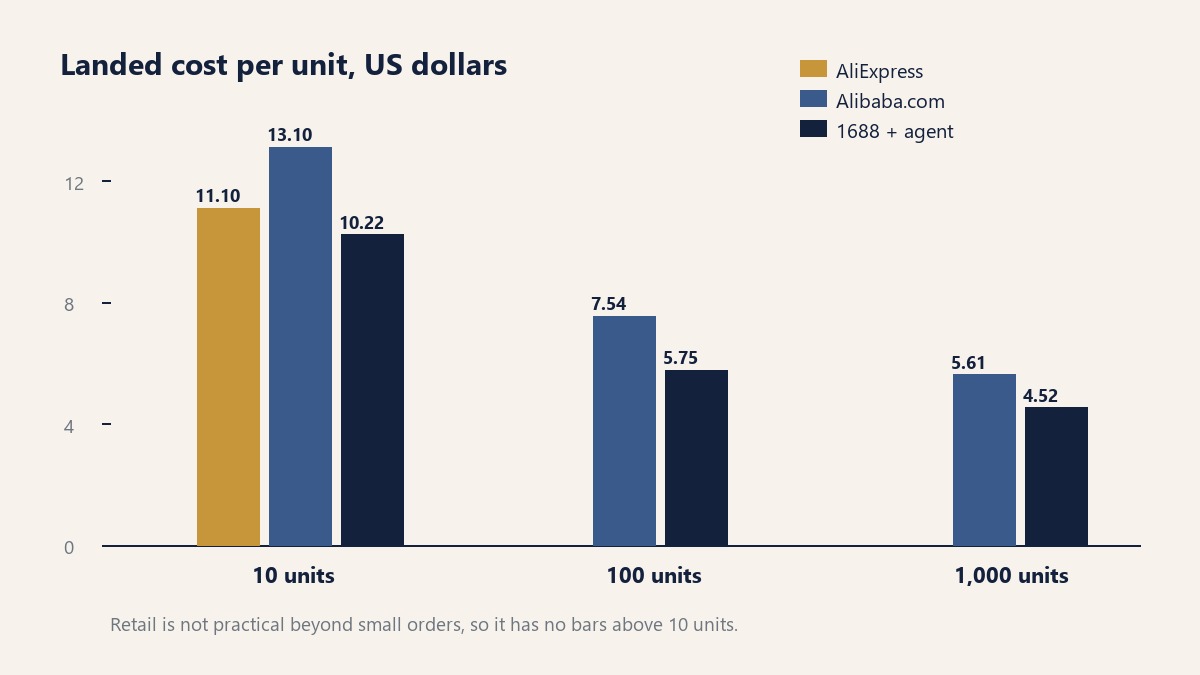
Unit price is a quote. Landed cost is what the goods really cost once they sit in your warehouse. The gap decides most of these arguments, so run the sum instead of comparing two stickers.
Below is the same travel mug across three order sizes. Each line is an assumption you can replace with your own quote. Air freight sits at $5.50 per kg, duty at 7.5%, clearance at $120, inspection at $300. The agent fee is 5%, and a tiny order carries a $30 handling charge. Freight moves most, so compare comparing air freight against sea freight from China before you lock a route.
| Order size | AliExpress | Alibaba.com | 1688 through an agent |
|---|---|---|---|
| 10 units | $11.10 | $13.10 | $10.22 |
| 100 units | Not used | $7.54 | $5.75 |
| 1,000 units | Not used | $5.61 | $4.52 |
Read the first row slowly. At ten units, the retail door is often the cheapest, and this is the exact complaint that sends buyers to a forum. Someone adds their first order to an AliExpress basket, compares it with a sample quote from a factory, and finds the retail price lower.
They are not wrong. A factory quoting ten pieces charges almost a retail price per unit, then adds express freight on a small parcel. The minimum order, the sample fee and the courier all land on ten pieces instead of a thousand. The bulk advantage has not started yet.
Now read the last row. At a thousand units the gap is wide and it does not close. The retail door cannot follow you there, because no AliExpress seller will pack a thousand units at a retail price. The bulk door, and the domestic door behind it, take over.
Where AliExpress Wins, and What Changed in 2026
AliExpress wins on three things: speed of decision, size of commitment, and certainty of price. You can test a product this afternoon without a supplier talk. For a first order, that is real value, and dismissing it as amateur buying misses the point.
It also wins on range. If you need twenty items from twenty types, the retail layer is the only place where that is one checkout instead of twenty negotiations. Consolidating small mixed orders is a genuine service, and it is priced into the unit cost.
What changed is the duty. For years, small parcels into the United States could enter under a value limit called de minimis. That limit kept most retail orders free from duty and papers. For goods from China the route closed on 29 August 2025, when the suspension took effect. A CBP rule published on 24 June 2026 made the suspension indefinite for every mode except the international postal network.
The same rule replaced the temporary measure with an indefinite one. The One Big Beautiful Bill Act then set a full end date of 1 July 2027. In practice, a low-value parcel now needs an entry, and the entry is filed by the importer or by a licensed broker.
That removes the oldest argument for buying retail. The retail price used to include shipping and often duty, because duty did not apply. Now the parcel can arrive with a bill attached, and the buyer who assumed the price was final is the one who pays it.
Two results follow. First, ask the seller who files the entry and who pays the duty. Second, compare the landed figure, not the basket total. A seller who cannot answer the first question is telling you something useful about the second.
Duty is not the only legal cost that arrives with the parcel. Each imported article also has to carry its country of origin, legibly and permanently, unless a specific exception applies. The marking rules in 19 CFR 134 set out what counts, and a retail seller who ships from a warehouse rarely controls it.
Where Alibaba.com Wins, and the Fees Nobody Quotes
Alibaba.com wins where the order has to be changed. A logo, a colour, a box, another plug, a moulded part. Retail sellers resell finished goods, so the only custom work they can offer is a sticker. A factory can change the thing itself, and that is a different talk at a different price.
It also wins on number breaks. A quote at 500 pieces and a quote at 2,000 pieces are not the same price list. The second one is where the factory starts amortising tooling, and it is the point where buyers stop paying for the retail layer at all.
Buyers do not pay a platform commission on Alibaba.com. The supplier pays for the listing, through a membership and through ads, and that cost is already inside the quote you receive. This is a real structural difference from AliExpress, where the platform takes a cut of each sale. On the bulk side the fee is fixed and baked in, so a bigger order dilutes it. On the retail side it moves with the price, so it never dilutes.
What the buyer does pay on the bulk side is the cost of being exact. A vague request gets a vague quote. A spec sheet gets a price you can compare, because two suppliers are then quoting the same product. That is why a written spec saves more money than a clever email.
The request-for-quote tool is the part most first-time buyers skip. Instead of messaging one supplier from a listing, you post the requirement once and let several reply. The replies are not just prices. They are a quick read on which suppliers understood the request and which ones copied a template.
Payment and Protection: What Is Covered
The two platforms move money in other ways, and the gap matters more than the fee table. On AliExpress the money sits with the platform until you confirm delivery. On Alibaba.com the common route is a bank transfer, and the cover comes from an order contract, not a shopping cart.
Trade Assurance is the escrow product on the bulk side. It ties payment to the terms written into the order, and it can hold funds until arrival is confirmed. That is a real safeguard. It is narrower than most buyers assume, and the gaps in Trade Assurance cover are where most disputes are lost.
It settles a dispute against what the order says. If the order says stainless steel and the goods are stainless steel, a complaint about the finish will struggle. If the order says nothing about the finish, there is nothing to measure. The protection is only as precise as the contract behind it.
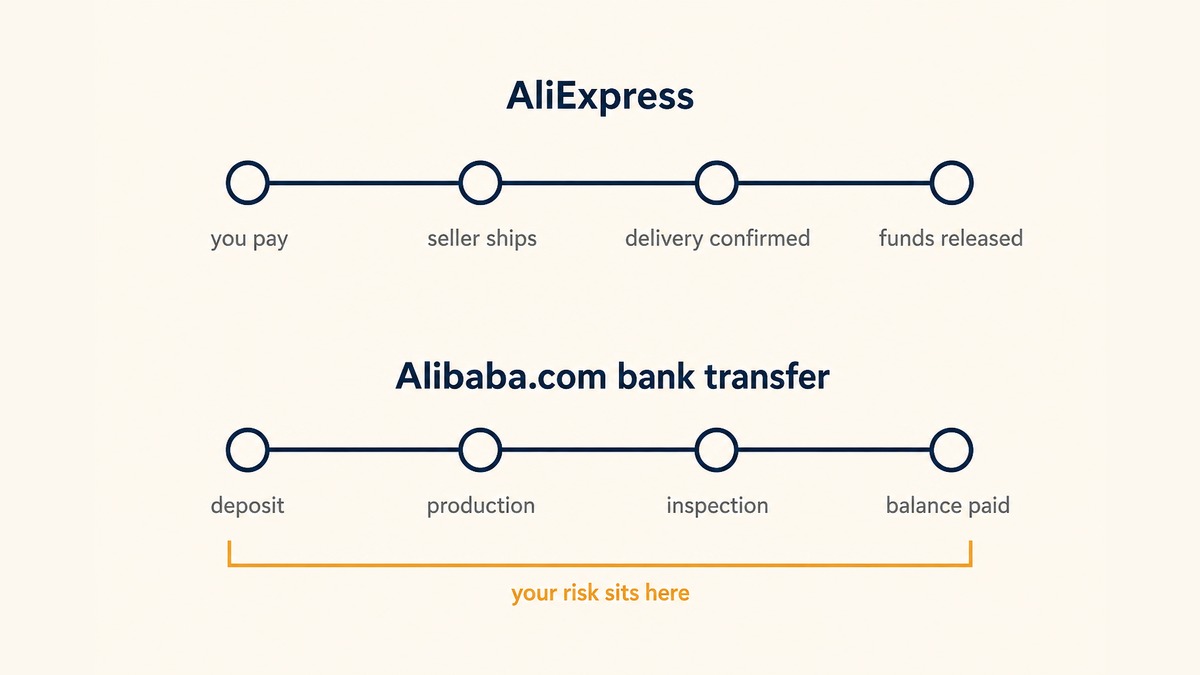
A bank transfer is the opposite arrangement. The supplier receives funds before production, and your leverage after that point is the relationship and the remaining balance. This is normal trade practice, not a scam signal, but it does mean the deposit is where the risk concentrates.
Two habits reduce that risk without changing the price. Keep the deposit small enough that a bad outcome does not end the business. Tie the balance to a check result, not a shipping date, so the second payment buys proof instead of hope.
| Question | AliExpress protection | Trade Assurance |
|---|---|---|
| Money held? | Until you confirm delivery | Yes, under the order terms |
| What is measured? | The listing and the parcel | The written order contract |
| Quality standard | As described in the listing | What your spec says |
| Who decides? | Platform dispute team | Platform against the contract |
| Weak point | Small refund ceiling | A vague contract |
Factory or Trading Firm: How to Tell on Either Platform
This is the question that decides your real cost, and neither platform answers it for you. A trading firm adds a margin and, at times, real value: consolidated orders, export papers, faster samples. A factory adds nothing between you and the price, but it may refuse small orders.
Start with the business licence. The registered scope names what the firm is allowed to make or sell. A supplier whose scope says sales, not production, is a trader. That is not a reason to refuse, but it changes how you read the quote.
Badges help only after that check, not before it. Verified and Gold Supplier status describe what a supplier paid for and what an inspector saw, and neither one guarantees a production line.
Then look at the product range. A factory tends to sell a narrow family of items made on the same machines. A trader lists whatever moves, across types that share no tooling. Twenty unrelated products under one account is a signal, not a crime.
Then test the minimum order. A real factory's minimum often follows its production run: the number of pieces it must make to start a machine. A minimum that appears and disappears depending on how you ask suggests a stock position, not a production line.
The strongest check is a live video call on the floor. Ask to see the machine that makes your part, running, with your material. A trader will offer a showroom, a warehouse or a meeting room. A factory will walk to the line, and the background noise will tell you the rest.
None of this requires a special tool. It requires asking the same three questions in the same order, and noticing which answer takes longest. The supplier who hesitates on the licence scope is often the one who is not making the goods.
The Middle Gap Nobody Talks About
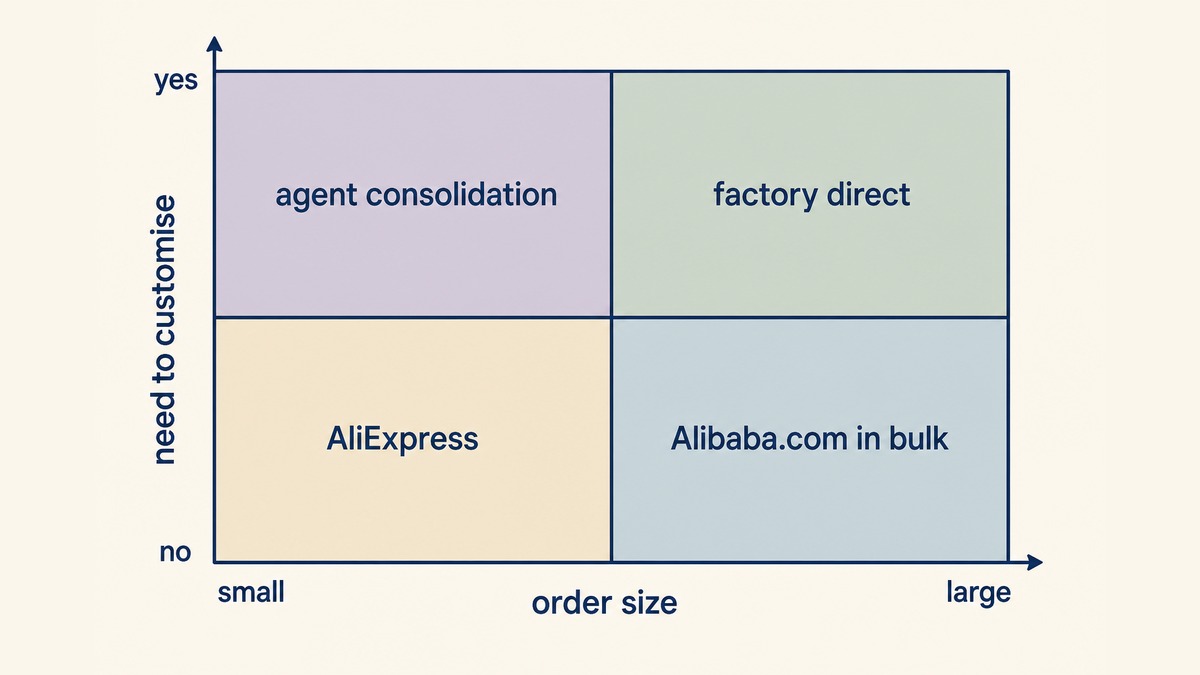
Between one unit and a container there is a stretch where both platforms feel wrong. Retail is too expensive per piece. Wholesale asks for a minimum you cannot use yet. Orders of 20 to 200 units live in that gap, and most first-time buyers hit it exactly once.
Three routes fit there. A mid-tier market with tiered prices is one, though the base price is still retail. That is why it is worth knowing whether DHgate is a safe place to spend money before you use it. An agent who buys on 1688 and combines several suppliers into one shipment is another. The third is to negotiate the minimum down on Alibaba.com and accept a slightly higher unit price.
The agent route often wins on mixed orders. Your plan may need mugs from one supplier, labels from another and boxes from a third. Three separate export shipments cost more than one combined carton. Consolidation is the service, and the fee buys the saving.
It loses on simple orders. If all of it comes from one supplier, the agent fee is a cost with no offset, and Alibaba.com already handles the export side. Paying twice for the same work is the mistake here, and it is a common one.
How to Choose in Three Questions
Forget the feature lists. Three questions settle most cases, and each one has a clear answer.
One: how many units, really? Under ten, the retail door is often cheaper once freight and duty are counted. Over a few hundred, the bulk door wins and keeps winning. In between, run the landed cost before you commit.
Two: does the product have to change? A logo, a material, a size or a box means a factory talk. If the answer is no, you are buying a commodity and the cheapest reliable source wins.
Three: who carries the risk if it goes wrong? Retail shifts small losses onto a platform that refunds quickly. Wholesale puts a larger sum at risk and gives you tools to manage it, but only if you use them in writing.
One more rule sits above the three questions. Buy the sample from the route you intend to use for the bulk order. A retail sample proves the product exists. It does not prove the factory can repeat it, because it was not made by that factory on that line.
Questions Buyers Ask Before They Choose
Is AliExpress really cheaper than Alibaba?
At ten units, often yes, once freight and duty are counted. At a few hundred units, no. The crossover often falls between ten and one hundred pieces, and it depends on the product's weight and duty rate. Run the landed cost at your real number before you decide.
Can I order a single unit on Alibaba.com to test?
You can often buy a paid sample, but the platform is not built for one-off retail buying. Expect a sample price above the bulk price, a courier charge, and a slower talk. For a fast cheap test, a retail order is the easier route.
Does AliExpress have a bulk price?
Some sellers offer tiered discounts at higher numbers, but the range is narrow and the starting point is retail. Treat it as a discount on twenty units, not as a substitute for a factory quote at two thousand.
Can I buy from 1688 without an agent?
Sometimes, but it is not designed for you. The site is in Chinese, prices are in RMB, payment often needs a Chinese account, and many sellers do not ship abroad. An agent handles the language, the payment and the export packing in one step.
Is Alibaba safe for a first order?
It is as safe as the order terms you write. Payment can be held under Trade Assurance until arrival is confirmed, but the cover measures the goods against the contract. A precise specification and a check before the balance is the part that protects you.
Do I pay duty on AliExpress orders now?
Assume yes. The low-value exemption for Chinese goods was suspended in August 2025, and a parcel now needs an entry. Duty depends on the product and the value, not on the platform, so check the current rule before you assume a retail order arrives duty-free.
The Bottom Line
AliExpress is a shop. Alibaba.com is a market. 1688 is the market behind the market. The price you pay tracks which of those three you walked into, and how much service you asked someone else to carry.
Buy retail to test. Buy wholesale to scale. Use the domestic layer when the export markup is bigger than the work an agent would do. None of these is a moral choice, and switching between them as your order grows is the normal path.
What does not change is the arithmetic. Count freight, duty, fees and inspection into one number per unit. Then compare that number, at your real number, and the argument about which platform is better answers itself.
Send Us the Product and the Quantity
Tell us what you want to buy and how many pieces you need. We will quote the domestic price, the export price and the landed cost side by side. Then you can see which route is cheaper for your order, instead of guessing from two stickers.
Compare My Three Routes
Questions & Comments
We read every one and reply within 24 hoursTell us which platform you are thinking of using and how many pieces you need. We will price the domestic and the export route on the same product, so the cheaper door is visible before you order.