
Brake Pads Wholesale: Two Identifiers, One Edge Code, and No Certificate
 ·
Updated October 14, 2026
·
14 min read
Brake pads are the easiest auto part to buy badly. A supplier can quote a plausible pad, in a plausible box, at a good price, and the quote can be perfectly usable or completely unsellable in your market — with nothing in the paperwork to tell the two apart. The reason is unusual and worth stating at the start: a replacement brake pad carries no federal certificate of its own. The United States brake standards bind the vehicle, not the box of pads you are buying. What a wholesale buyer has instead is two industry identifiers and one edge code, and this guide is about how to ask for them, what they do and do not prove, and where a cheap quote quietly leaves the difference out.
1. What a Brake Pad Is, and Which Part Decides What
A disc brake pad is a steel backing plate with a friction material bonded to one face. It looks like a single object and behaves like a stack of four decisions, and each one is separately quotable and separately cheapenable.
The friction material decides how the pad grips and how it behaves when it gets hot. The backing plate decides whether the pad stays flat under load — a thin plate flexes, wears unevenly and can crack. The bond between them decides whether the friction material stays attached, which is the failure that matters most. The hardware and shims decide noise, vibration and whether the pad rattles in the caliper bracket. A quote that names only "ceramic brake pad, good quality" has priced exactly one of the four.
There is a fifth decision that is not part of the pad at all, and it is the one buyers get wrong first: the pad is only half of a friction pair. It runs against a disc, and the pair was designed together. A pad material intended for a smooth, hard disc behaves differently against a worn or soft one, and no amount of material quality fixes a mismatch. This is why a pad specification is never a standalone quantity, and why the useful question to a supplier is not "what is your best pad" but "which pad shape, with which friction code, for which disc".
| The decision | What it decides | What a vague quote hides |
|---|---|---|
| Friction material | Grip, fade, dust, noise | Which formula, and at what cost |
| Backing plate | Flatness under load, cracking | Steel gauge and whether it is coated |
| The bond | Whether the material stays on | Cure cycle and shear test results |
| Shims and hardware | Noise and rattle | Whether they are included at all |
| The disc pairing | Whether the pair works | Which disc the pad was matched to |
What this guide covers
- What a brake pad is, and which part decides what
- The two identifiers a buyer has to ask for
- What the standard covers, and what it leaves to you
- Reading the edge code properly
- Materials: what the label does not decide for you
- The copper constraint
- What a cheap quote leaves out
- What to test on a sample
- Frequently asked questions
2. The Two Identifiers a Buyer Has to Ask For
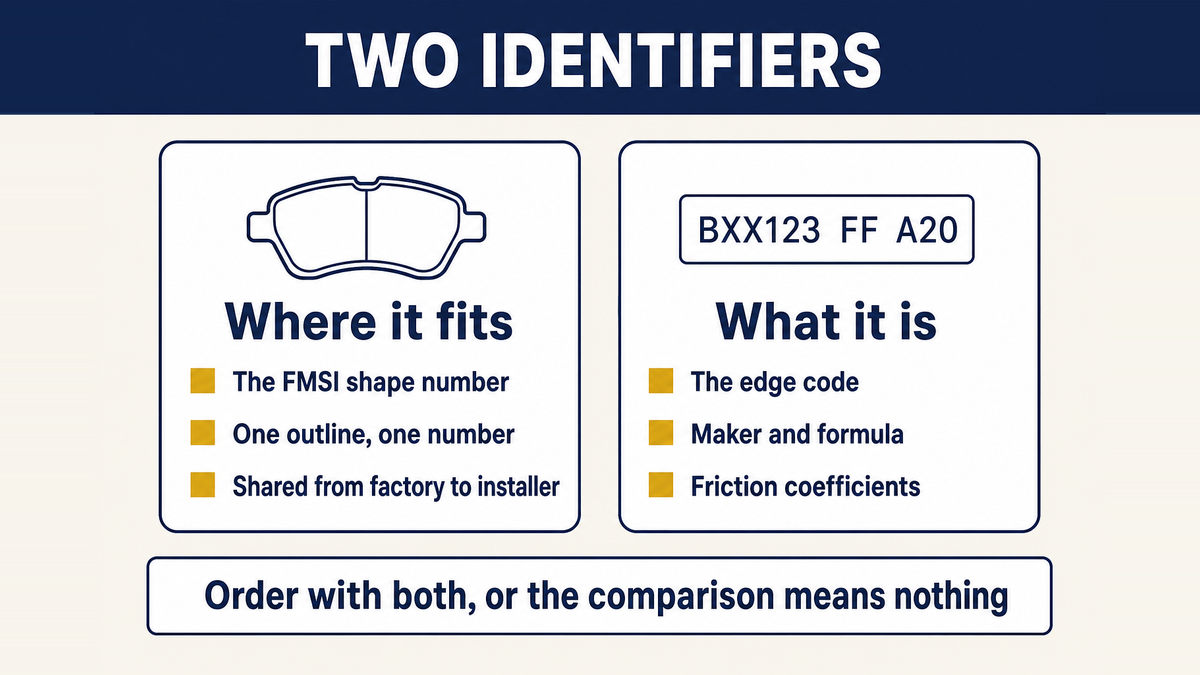
Because the pad itself is not certified as a product, the aftermarket uses two identifiers to say what a pad is. One says where it fits. The other says what it is made of and how it behaves. Ordering without both is how buyers end up with pads that fit the caliper and fail the application.
The shape number: where it fits
The first identifier is the shape number, and in North America that is the FMSI number. It is not a manufacturer's internal code; it is a shared language maintained by the trade association that created it, so that one number means the same pad outline from the factory to the retailer to the workshop.
In 1948 the Friction Materials Standards Institute was founded as a trade association of automotive aftermarket friction manufacturers… the creation of a standardized part numbering system for brakes and clutch facings… From manufacturer through retailer / installer one part number is used as the standard and as a common language.
Friction Materials Standards Institute, fmsi.org — About FMSI (read 14 October 2026)
The practical value of a shared shape number is that it removes the fitment argument from the conversation. A supplier who quotes by FMSI number is quoting a physical outline that a catalogue can be checked against, and a buyer who asks for one can compare two factories on the same object. A supplier who quotes only "for a 2018 sedan" has given you a description, not a specification, and the difference does not show up until the pallet arrives.
The edge code: what it is
The second identifier is stamped or printed on the pad, usually on the edge of the backing plate, and it is called the edge code. It carries the manufacturer identifier, the friction formula identifier, the friction coefficients, and environmental and date markings. Its structure comes from an industry standard rather than from a federal rule — which is the point of the next section.
3. What the Standard Covers, and What It Leaves to You
This is the part of the subject that wholesale buyers most often assume backwards, and it is worth reading precisely because it changes what a supplier's assurance is worth.
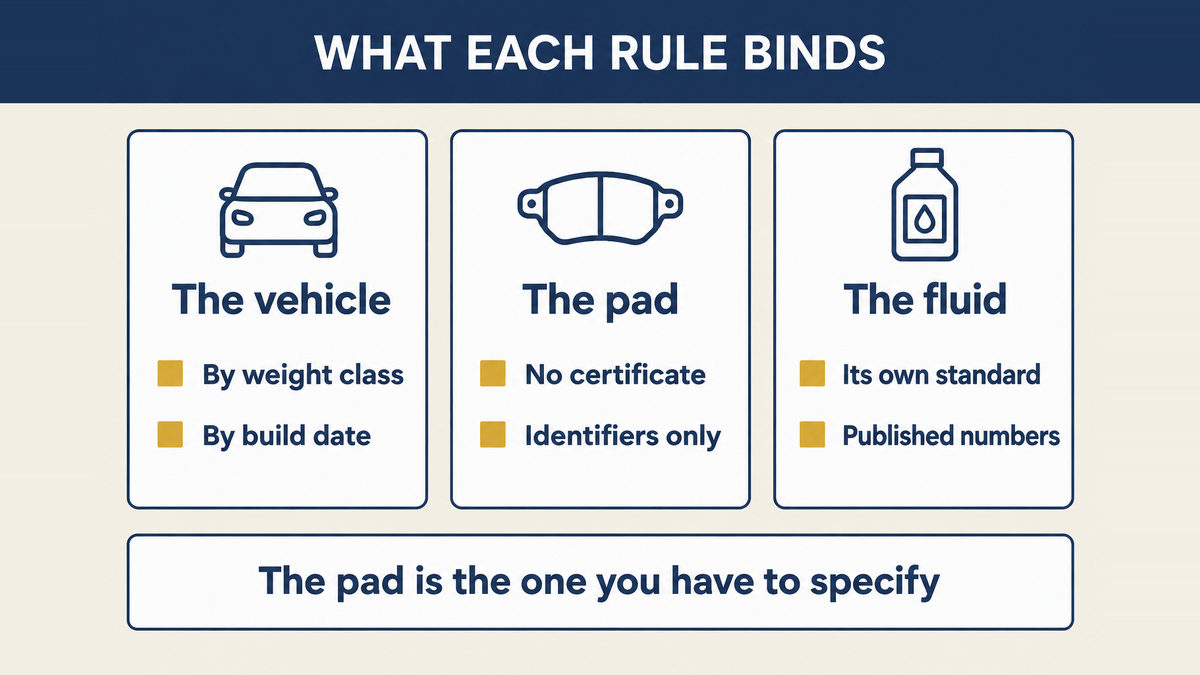
The United States has a federal brake standard. It has two of them, and which one a vehicle falls under depends on its weight class. For lighter vehicles the application reads:
This standard applies to passenger cars manufactured on or after September 1, 2000 and to multi-purpose passenger vehicles, trucks and buses with a gross vehicle weight rating (GVWR) of 3,500 kilograms (7,716 pounds) or less, manufactured on or after September 1, 2002.
National Highway Traffic Safety Administration, 49 CFR 571.135, Standard No. 135; Light vehicle brake systems (read 14 October 2026)
And for the heavier class, the other one:
This standard applies to multi-purpose passenger vehicles, trucks, and buses with a GVWR greater than 3,500 kilograms (7,716 pounds) that are equipped with hydraulic or electric brake systems.
National Highway Traffic Safety Administration, 49 CFR 571.105, Standard No. 105; Hydraulic and electric brake systems (read 14 October 2026)
Read those two together and the boundary is a single number: 3,500 kilograms. Below it the lighter standard governs, above it the heavier one. Both are written about vehicles, defined by weight class and by the date the vehicle was built.
The consequence for a wholesale buyer is simple and easy to miss. A box of replacement pads is not a vehicle, and no federal standard certifies it as a product. When a factory or a trading company says their pads "comply with FMVSS", ask what document they are pointing at, because the standard they are naming is addressed to the vehicle manufacturer and to the braking system as built. What the aftermarket uses instead is the pair of identifiers above, plus the buyer's own sample testing.
There is a useful contrast sitting one part number away. Brake fluid, which is sold beside the pads, does have its own federal standard, with its own numbers on the drum:
This standard specifies requirements for fluids for use in hydraulic brake systems of motor vehicles, containers for these fluids, and labeling of the containers… the ERBP shall not be less than the following value for the grade indicated: (a) DOT 3: 205 °C. (401 °F.). (b) DOT 4: 230 °C. (446 °F.). (c) DOT 5: 260 °C. (500 °F.).
National Highway Traffic Safety Administration, 49 CFR 571.116, Standard No. 116; Motor vehicle brake fluids (read 14 October 2026)
The same standard fixes the wet boiling point, the viscosity at minus forty and the container's colour coding — DOT 3, DOT 4 and DOT 5.1 non-silicone are colourless to amber, DOT 5 silicone is purple, and mineral oil is green — and it requires a resealable, tamper-evident closure on any container of 177 millilitres or more. A fluid is a product you can hold to a published number. A pad is a product you have to specify and test. Treating the two as equally certifiable is where a sourcing plan goes wrong.
4. Reading the Edge Code Properly
The edge code is where a buyer can do a real check, because its contents are defined in order and in public. One of the clearest published descriptions is a state environmental agency's guidance to manufacturers, written to explain what a marking that meets the rule looks like.
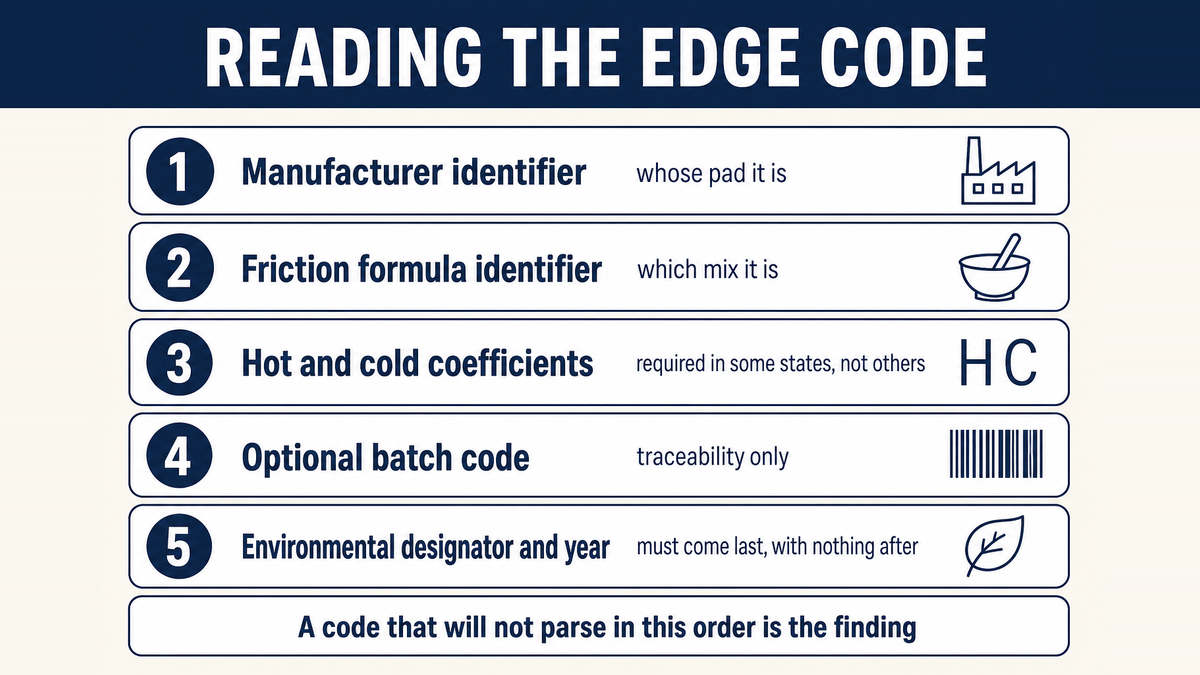
To summarize SAE J866, brakes must be marked with the following information, in the following order: 1. Manufacturer identifier 2. Friction formula identifier 3. Hot and cold coefficients of friction (Not required in Washington – but are required by several other states.) 4. Optional batch code or other optional information 5. Environmental designator and year of manufacture… The environmental markings are to be the last characters in the edge code string with no additional alpha or numeric characters following.
Washington State Department of Ecology, Guidance for Marking Brake Friction Material (read 14 October 2026)
Three things in that passage are directly useful at the sourcing stage.
The first is the ordering rule. Because the elements are fixed in sequence and the environmental markings must come last with nothing after them, a buyer can read a pad's markings and tell whether what is there belongs where it is. A code that cannot be parsed in that order is not a pad with a strange code; it is a pad whose markings were not produced to the standard.
The second is the coefficient element, and the parenthesis attached to it. The hot and cold friction coefficients are the two letters most buyers recognise — the pairs such as FF or GG — and the guidance says outright that Washington does not require them but several other states do. That is a small sentence with a large consequence for anyone selling across state lines: the marking obligations are not uniform nationally, and a pad marked for one market may be under-marked for another.
The third is that the same rule reaches the packaging. Brake packaging must carry a registered certification mark showing that the packaging meets the rule, which means the box is a second place a buyer can look, and a second place a cheap quote can be thin.
The guidance is also candid about why the rule exists, and the reason is a material constraint rather than a labelling one: as pads wear, copper and other metals are deposited on roadways, and in urban areas brake pads are identified as accounting for up to half of the copper entering waterways, with young salmon named as especially susceptible. That is the origin of the copper limits discussed in section 6, and it explains why friction formulation is now a regulatory subject and not only an engineering one.
5. Materials: What the Label Does Not Decide for You
The trade divides pads into three families, and the division is a shorthand for a set of trade-offs rather than a ranking.
Non-asbestos organic pads are quiet and kind to discs, and they produce more dust. They suit light cars, moderate driving and buyers who value a quiet brake. Semi-metallic pads carry steel and other metals in the mix; they hold friction better when hot and last longer, at the cost of more disc wear and more noise. Ceramic pads sit between the two on most measures, with less dust and a higher material cost.
The sourcing point is not which is better. It is that the family name does not carry a coefficient, and the coefficient is what the application actually needs. Two pads both described as ceramic can differ enough in behaviour that one is right for a light sedan and the other is wrong for it. That is why the useful specification is not the family alone but the family plus the friction code — and why a supplier who offers to "choose the right formula for your market" has taken a decision that belongs to the buyer and to the sample test.
Something similar applies to the parts of the pad that are not friction material. The backing plate gauge, whether the plate is coated, whether the shim is attached or loose in the box, and whether the abutment clips are included are all separately quotable. None of them appears in a family name, and all of them decide whether the pad you sell behaves like the sample you approved.
6. The Copper Constraint
Friction formulation is no longer only a performance question in every market. Several states have moved to restrict copper in brake friction material because of the waterway impact described above, and the practical result for a wholesale buyer is a set of market-specific requirements rather than one global specification.
Two consequences follow for a sourcing plan. The first is that the destination market now belongs in the pad specification rather than in the shipping paperwork: a formulation acceptable in one state may not be acceptable in another, so the question is not "what is your standard pad" but "which of your formulations is intended for this market, and how is it marked". The second is that a supplier's assurance is again not the evidence. The visible evidence is the marking on the pad and on the packaging together with the certification the manufacturer has registered, which is why the sample stage matters more in this category than in most.
For a buyer who sells nationally or exports onward, the clean answer is usually to standardise on a formulation that satisfies the strictest market you intend to serve, and to record that decision on the specification sheet. It costs a little more per unit and removes a class of problem that is very expensive to discover after a pallet has been distributed.
7. What a Cheap Quote Leaves Out
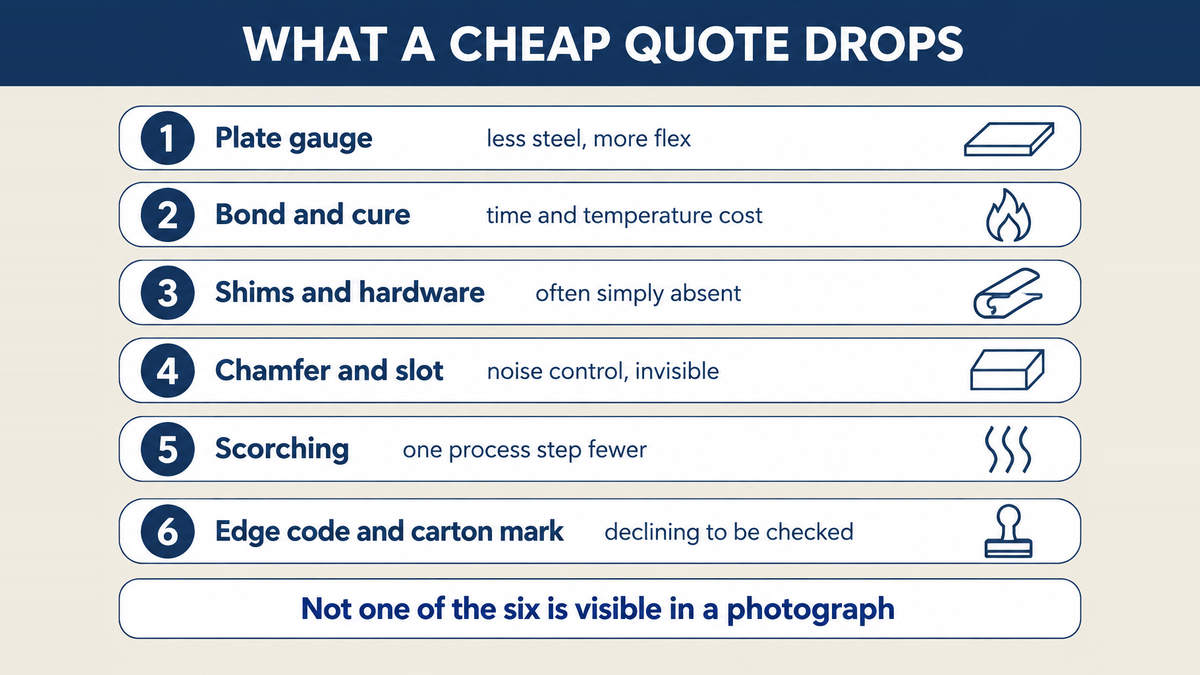
Pads are a commodity in appearance and not in substance, which is exactly the condition under which a low quote wins a comparison it should lose. Six things are commonly absent, and every one of them is invisible in a photograph.
Plate gauge. A thinner backing plate saves steel on every pad. It also flexes more, and a flexing plate wears the friction material unevenly and can crack at the abutment.
Bond quality and cure. The friction material is attached either by a bonding process with a controlled cure cycle or, on some cheaper lines, by rivets or a mechanical attachment method. The cure is a time-and-temperature cost, which makes it a natural place for a quote to be trimmed, and bond failure is the failure mode that turns a warranty claim into a safety event.
Shims and hardware. Whether a noise shim is fitted, and whether the abutment clips and retaining hardware are in the box, changes both the bill of materials and the customer's experience. A pad that fits but squeals is a return, and returns are the cost this whole category is judged on.
Chamfer and slot. The angled edges and the groove across the friction face are there for noise control and for debris clearance. They are easy to omit and impossible to see in a marketing photograph.
Scorching and finishing. Some lines are heat-treated on the surface to seat the material. It is another process step, so it is another place to save money.
Marking itself. Because the edge code and the packaging mark are the two pieces of visible evidence a buyer has, a supplier who is vague about both is not being modest; they are declining to be checked.
8. What to Test on a Sample
Because no certificate attaches to the pad, the sample stage carries the weight that certification would otherwise carry. Four checks do most of the work.
- Read the markings against the order. The shape number should match the catalogue entry, and the edge code should parse in the standard's order with the environmental designator last. If the pad and the packaging tell different stories, stop there.
- Measure the plate and the friction thickness. Stated dimensions with a stated tolerance, checked on more than one piece from the same box. Variation inside a box is a manufacturing control question and is more informative than the average.
- Ask for the bond and shear test record. This is a document you can request, and whether a factory can produce one says as much as the number printed on it. For a wider view of what supplier documentation should look like before an order, the sequence in our factory audit checklist is the same one that applies here.
- Fit the pad to the application. Physical fit in the caliper bracket and against the disc, checked against the disc the pair is intended for. A pad that sits correctly but was specified for a different disc is the failure that passes every paperwork check.
Alongside the sample, two documents belong in the order rather than in a drawer. The first is the classification the pads will be imported under, since a friction material is classified differently from the steel hardware in the same box — how that is decided is set out in how an HTS code is assigned. The second is the origin documentation, which for this category is not a formality: the certificate of origin is what a customs authority will ask for when the marking on the carton is questioned. Pads are dense for their size, so freight is charged on weight rather than volume, and the calculation is the reverse of the one in how volume decides what a parcel is charged.
9. Where the Unit Price Comes From
A pad's price is built from the friction formula, the plate, the process steps and the packaging, in roughly that order of influence. The formula sets the material cost and is the largest single line. The plate sets the steel cost and the weight, which pulls freight with it. The process steps — bonding and cure, scorching, shim fitting, marking — are labour and machine time, which is where volume changes the price. The packaging is the smallest line and the one most often over-specified by buyers who want a premium box around a commodity pad.
The consequence for a wholesale buyer is that the quote should be requested with the formula and the plate gauge named, so that two factories are quoting the same object. A quotation built on "ceramic pad" alone compares sellers who may be shipping different products at different weights, and the cheaper one is frequently cheaper because one of the four decisions in section 1 was never made.
10. Frequently Asked Questions
Are brake pads FMVSS certified?
No, and this is the most important point in the article. The federal brake standards are addressed to vehicles, defined by weight class and build date, so a replacement pad sold on its own does not carry a certificate under them. What the aftermarket uses instead is the FMSI shape number for fitment and the edge code for identity and friction behaviour, together with the buyer's own sample testing.
What is the FMSI number on a brake pad?
It is a shared shape number for the pad outline, maintained by the Friction Materials Standards Institute, which has operated the numbering system since 1948. Its value at the sourcing stage is that it lets two factories quote the same physical object rather than describing the same car, which is what makes a price comparison mean anything.
What does the edge code on a brake pad tell me?
It carries the manufacturer identifier, the friction formula identifier, the hot and cold friction coefficients, optional batch information, and the environmental designator with the year of manufacture. The elements appear in a fixed order and the environmental markings must come last with nothing after them, so a code that will not parse in that order is itself the finding.
Do brake pads have to be marked the same way in every state?
No. Washington's rule requires the manufacturer and friction formula identifiers, while the hot and cold friction coefficients are not required there but are required by several other states, and the packaging carries its own marking requirement. For a buyer selling across state lines, the workable approach is to specify for the strictest market you serve and record that on the specification sheet.
Why does copper content matter in brake pads?
Because as pads wear, copper and other metals are deposited on roadways and washed into waterways, where copper is toxic to fish. Several states have moved to restrict it for that reason. The practical effect for a buyer is that the destination market belongs in the formulation specification, not in the shipping paperwork, and that the visible evidence is the marking on the pad and packaging rather than a supplier's assurance.
Both Numbers Written Into the Order
We put the friction identifier and the edge code into the order, with the temperature range each one implies.
Add Both to My Order
Questions & Comments
We read every one and reply within 24 hoursBrake pad buyers receive two identifiers and no certificate, which is normal for this part. Send the FMSI shape number or the application, and we will put the edge code, formula and box markings into one specification.