
Influencer Marketing for Ecommerce: The Cost Ladder and the Disclosure Rule
 ·
Updated October 14, 2026
·
16 min read
Influencer marketing is usually presented as a budget decision: gift the product if you are small, pay per post when you can afford it, move to commission when you have data. The ordering is right and the reasoning underneath it is wrong in one specific way. The first rung is not free, because the product you give away has a cost and half of it never produces a published post. And the duty to disclose is not something that begins when money appears, because the rule that governs it is triggered by the connection rather than by the payment. This guide sets out the four rungs with their real costs, then looks at the disclosure rule that applies from the first one.
1. The Ladder Has Four Rungs, Not Three
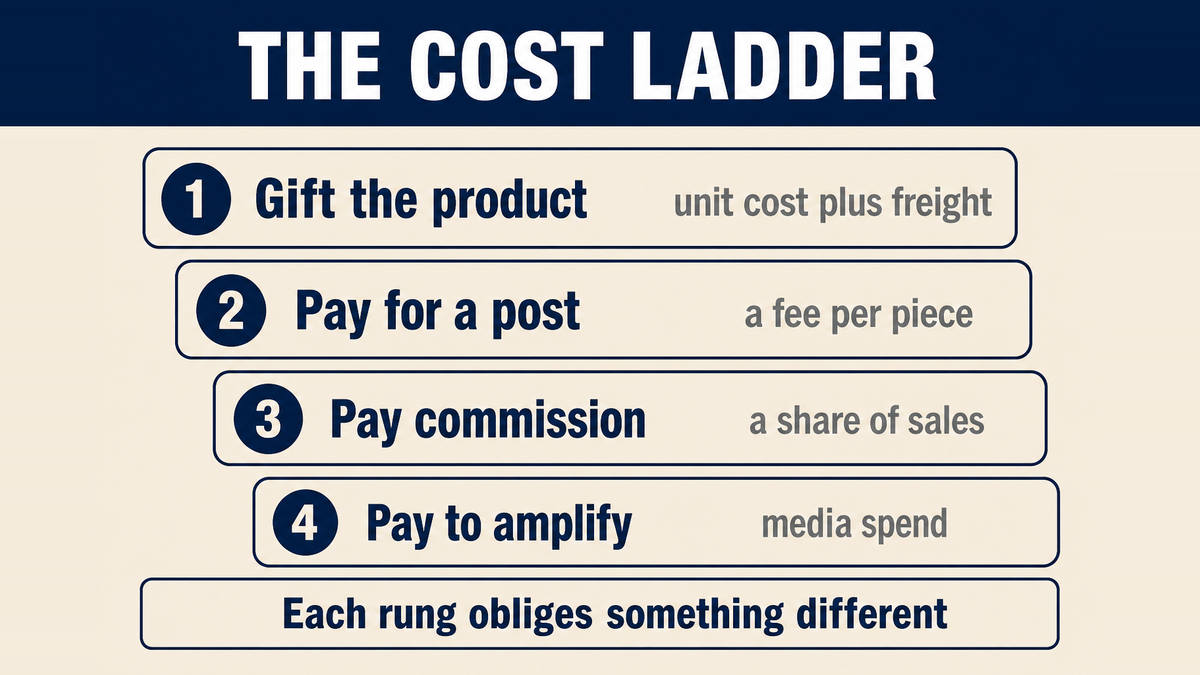
Most descriptions of influencer marketing for a small store set out three stages: send free products, then pay for posts, then pay commission on sales. That is a reasonable shape, and it leaves out the rung that most sellers reach fourth and understand least, which is paying to put a creator's content in front of more people than would have seen it organically. That fourth rung behaves differently from the other three, because the cost is not the content, it is the reach.
The reason the ladder matters is not that one rung is better than another. It is that each rung obliges you to something different, and the obligations do not arrive in the same order as the costs. A seller who plans only the budget discovers the rest by accident, usually at the point where a post has already gone out.
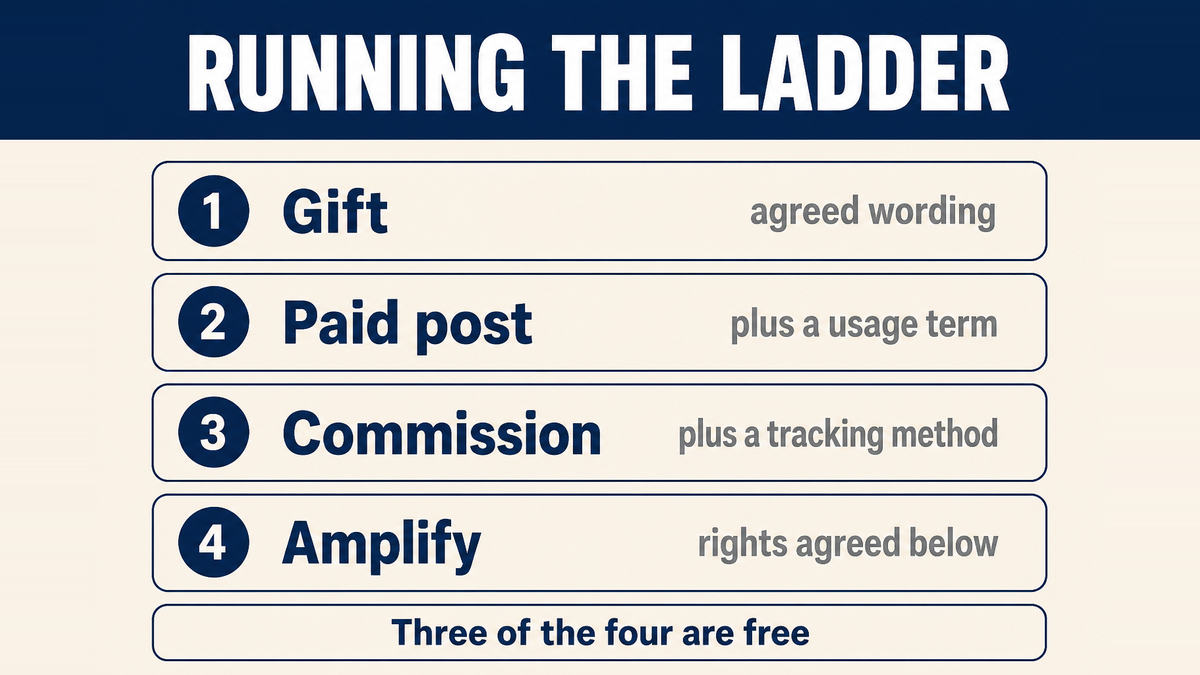
Under the ordering, the first rung is the one that feels safest and is the one most likely to be misunderstood. Sending a product to somebody with no fee and no agreement is not a transaction in most sellers' minds, so it is not treated as one. It has a cost, it has a rate of return, and it carries a duty that is explained in section four. The table below shows what each rung actually commits you to.
| Rung | What you pay | What it commits you to |
|---|---|---|
| Gift the product | Unit cost plus freight, over a base that partly never posts | A duty that starts here, not later |
| Pay for a post | A fee per piece of content | A duty, plus agreed usage and timing |
| Pay commission | A share of sales you can attribute | A duty, plus tracking that has to work |
| Pay to amplify | Media spend behind content that already exists | A duty, plus rights to reuse the content |
The fourth rung deserves its own note because it is the one that changes hands most often without anyone noticing. Paying to put a creator's post in front of more people is not a new collaboration; it is a new use of content that already exists. That distinction decides whether you own anything at the end of it, and it is also the rung where the money is easiest to spend because the platforms make it a button rather than a negotiation. A seller who has agreed nothing about reuse reaches this rung and finds that the only material available is material they have no right to promote.
What this guide covers
2. Rung One: What Gifting Actually Costs
The arithmetic of gifting is simple once the denominator is stated correctly. The cost is not the price of one product. It is everything you spend sending products out, divided by the number of pieces of content that actually get published. That denominator is the part sellers leave out, and it is the part that decides whether the rung is cheap or expensive.
The numerator is easy to understate. A gifted product costs you what you paid for it rather than what you sell it for, which is the correct figure for a cost calculation and the wrong one for a decision, because a unit given away is also a unit you could have sold. Added to the unit cost is the freight, and on a platform where you are shipping one parcel to one person the freight can be a large share of a small order. Packaging, returns of samples that arrive damaged and replacements all belong in the same figure. The exercise of building a truthful unit cost is the same one described in how a landed cost is assembled, with the price line removed.
The denominator is harder, because you cannot know it in advance. Some people you send a product to will post something substantial, some will post a story that disappears in a day, and some will post nothing at all and not mention it. None of that is bad faith; it is what an unpaid arrangement produces when it meets a busy person. The practical consequence is that the cost per published post is a running average rather than a fixed figure, and it usually starts higher than expected and settles as you learn which kinds of creators actually publish.
Two details make the rung work better, and both are about the denominator rather than the cost. Asking in advance what the person intends to do, without requiring it, raises the share who do something, because the request itself is a mild commitment. And sending a product that arrives in good condition raises the share who are willing to show it, which sounds obvious until you consider how often a sample arrives dented or in packaging that looks nothing like the listing photograph. Checking that the unit you send is representative is the same discipline as checking a batch before it ships, and a supplier who describes a sample inaccurately is the subject of what the usual assurances really mean.
Choosing who receives a parcel is therefore the real lever, and it is a selection problem rather than a spending one. A person whose audience already asks them what to buy will publish something; a person with a large following but no habit of recommending products will not, however well matched the product looks. The practical test is not the size of the audience but whether the account already contains unpaid recommendations of things the person bought, because that is evidence of the habit you are relying on. Choosing the product at the same time is the subject of how a product trend actually reaches a seller, and the two decisions belong together rather than in sequence.
3. Rungs Two and Three: Paid Posts and Commission
Paying a fee for a post changes the arithmetic in a way that is easy to miss. The fee is not only buying the content. It is also the moment at which the rights question appears, because by default you have none. A creator who is paid to post something has been paid to publish it on their own account, and that is where the permission normally ends. Reusing that video in your own advertising, or pinning it to a product page, or running it as paid media, are three separate uses that need to be agreed rather than assumed.
That is why the second rung is where a usage term belongs. The term can be short, and it does need to exist, because the fourth rung on the ladder depends on it entirely. Running paid media behind content you have no right to reuse is the most common way a small seller turns a successful collaboration into a problem. Agreeing, in plain words, where the content may appear and for how long costs nothing at the time and is the whole basis of the rung above.
Commission inverts the risk and introduces a different problem. There is no fee, so nothing is owed if nothing sells, and in exchange you have to be able to show what sold. Attribution in social media is approximate at the best of times: a viewer may watch a video, close the app and search for the product by name a day later, and no tracking system will connect those two events. Codes and tracked links both undercount, which is tolerable if you decide in advance to accept it and compare creators on the same basis rather than pretending the figure is a sales total.
It is worth saying plainly that the ladder is not a ranking of sophistication, because commission-only offers are frequently declined. A creator with an audience is being asked to carry the risk of a product they did not choose, in exchange for a share of a number they cannot check, and many simply say no. The rungs describe increasing commitment on your side, not increasing respect for the other party, and treating a commission offer as the grown-up version of gifting misunderstands why the earlier rungs work.
4. The Rule That Starts on Rung One
This is the part that catches sellers who planned their budget carefully and never considered anything else. The obligation to disclose is not triggered by payment. It is triggered by a connection between the person making the recommendation and the seller, and a gifted product is named in the rule as one of the connections that counts. The provision is short enough to read in full:
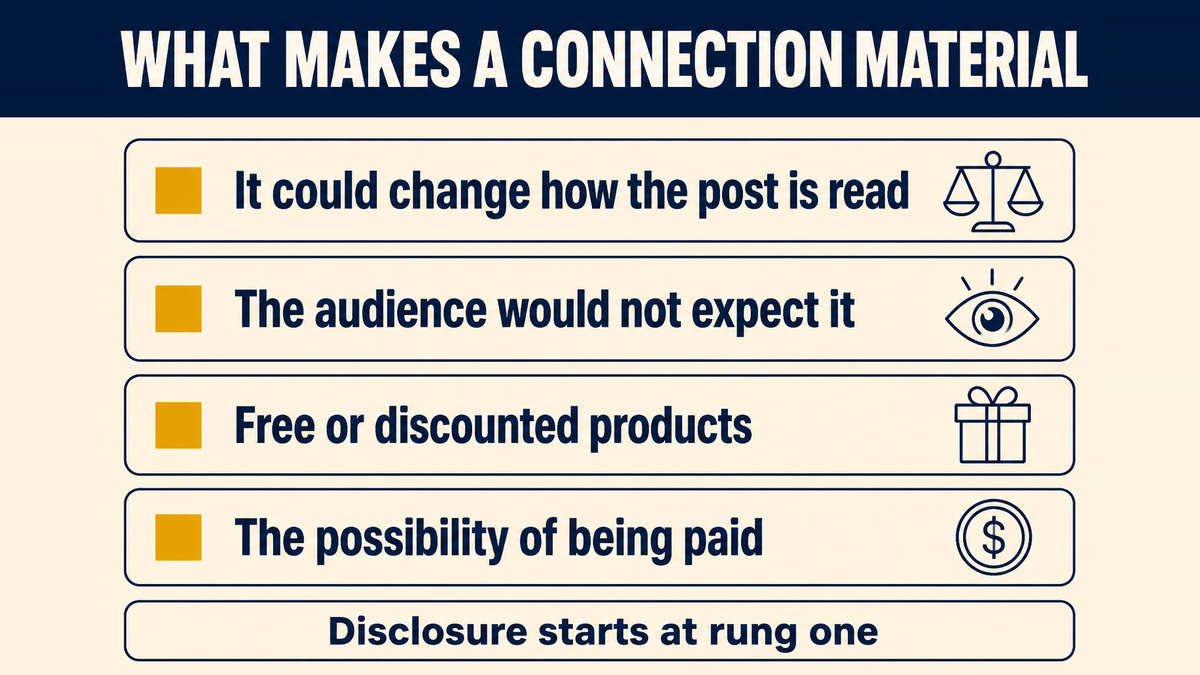
When there exists a connection between the endorser and the seller of the advertised product that might materially affect the weight or credibility of the endorsement, and that connection is not reasonably expected by the audience, such connection must be disclosed clearly and conspicuously. Material connections can include a business, family, or personal relationship. They can include monetary payment or the provision of free or discounted products (including products unrelated to the endorsed product) to an endorser, regardless of whether the advertiser requires an endorsement in return. Material connections can also include other benefits to the endorser, such as early access to a product or the possibility of being paid, of winning a prize, or of appearing on television or in other media promotions.
Federal Trade Commission, 16 CFR 255.5, Disclosure of material connections (read 14 October 2026)
Four phrases in that paragraph decide most of the arguments. The first is “might materially affect the weight or credibility”, which is the test of whether the connection matters at all: a relationship that would change how a viewer reads the recommendation is inside the rule, and one that would not is outside it. The second is “not reasonably expected by the audience”, which asks what a viewer assumes when they see the post. An audience does not generally assume that a creator was given the product by a store they have no visible relationship with, which is why the disclosure is required rather than optional.
The third, and the one that ends the commonest misunderstanding, is the sentence stating that the connection covers the provision of free or discounted products “regardless of whether the advertiser requires an endorsement in return”. A seller who sends a product with no conditions attached has not avoided the rule; the rule was written for exactly that case. The fourth is “the possibility of being paid”, which reaches the arrangement that has not been agreed yet, including the one where a seller sends a product hoping to discuss a paid collaboration later.
The final requirement is where the disclosure goes. “Clearly and conspicuously” describes a placement, and it means the audience must encounter it in the same place they encounter the recommendation. A line in a profile description, a hashtag buried under twenty others, or a note on the store's own page is not the same as a statement in the post itself. Since the obligation is to disclose rather than to avoid the connection, the workable habit is small: agree the wording in advance, ask for it to appear in the post, and treat a missing disclosure as a reason to ask again rather than a reason to end the arrangement.
5. Who the Rule Reaches
The obligation sits on top of a broader prohibition, and the wording of that prohibition is worth knowing because it is what a complaint would actually be built on. The statute declares the practice unlawful in one sentence:
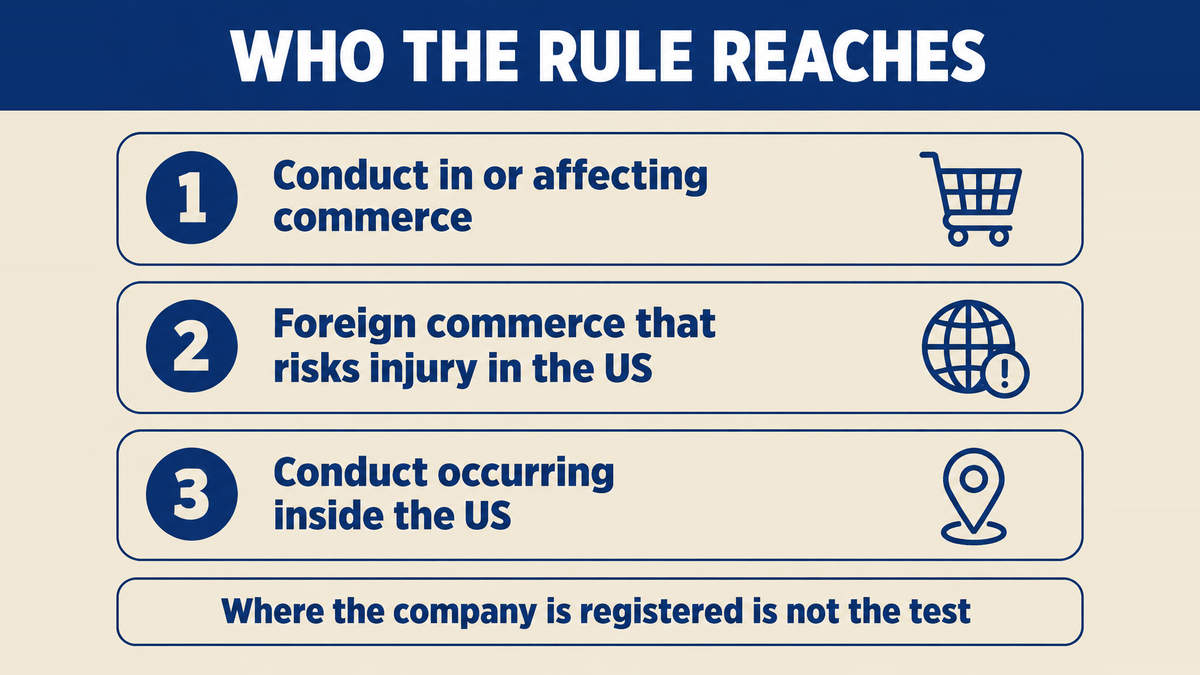
Unfair methods of competition in or affecting commerce, and unfair or deceptive acts or practices in or affecting commerce, are hereby declared unlawful.
15 U.S.C. § 45(a)(1), via Cornell Law School, Legal Information Institute (read 14 October 2026)
The reason this matters to a store that buys from China and sells into the United States is a second provision in the same section, which extends the phrase to cover acts involving foreign commerce where they either cause or are likely to cause reasonably foreseeable injury inside the United States, or involve material conduct occurring there. A seller operating from elsewhere, shipping to American buyers and running campaigns that reach American audiences, is not outside the rule by virtue of where the company is registered. The conduct, the audience and the foreseeable effect are what the provision looks at.
Within a collaboration there are two parties, and the seller is the one with the commercial interest and the administrative ability to fix the problem. A creator can be answerable for a post that misleads, and the practical reality is that the seller is the party who organised the arrangement, who chose what to send and who benefits from the recommendation. Planning on the basis that the creator will handle the wording is the same as planning on the basis that nobody will.
For a small store the useful consequence is that the disclosure step belongs in the same list as choosing the product and packing the parcel, not in a legal folder nobody opens. It takes one sentence agreed in advance and placed in the post. Nothing about it is difficult, and everything about it is easy to skip, which is precisely why it is the step that a well-run collaboration and a careless one differ on.
6. What This Does to a Small Seller's Plan
Read together, the ladder and the rule suggest a running order that is different from the one sellers usually follow. The instinct is to start with the product and the money, and deal with the formalities once something works. The sequence that costs least does the opposite, because three of the four rungs need something that is free and must exist before the rung is used.
| Before you start a rung | What has to exist | What it costs |
|---|---|---|
| Gifting | Agreed disclosure wording | One sentence |
| Paid post | The same, plus where the content may be used and for how long | One conversation |
| Commission | The same, plus a tracking method both sides accept | A link or a code |
| Amplify | Rights that were agreed on the rung below | Nothing, if it was done in order |
The budget question then becomes answerable in a way it was not before. A gifting programme has a cost per published post, which is a number you can compare with what the same money would buy in advertising, and it only becomes comparable once you are counting the parcels that produced nothing. A paid post has a fee that buys content and, if you agreed it, a licence to reuse that content, which changes its value considerably and is the reason the usage term is not a formality. Commission has no fee and an attribution problem, and the honest version of it is a comparison between creators using the same method rather than a claim about total sales.
The disclosure rule then sits across all four rungs as the one constant, because it is triggered by the connection rather than by the payment, and the connection exists from the moment the parcel is in the post. The sellers who do this well are not the ones with the largest budget. They are the ones who decided, once, what their collaborations would always say, and then stopped thinking about it because it had become the way they work. A store that sorts out the wording on the first rung never has to fix it on the fourth, and the fourth is the rung where fixing it is expensive.
What gets measured is the last piece, and it is what separates a programme that improves from one that simply continues. The figure worth tracking is the cost of each published post set against what the same money bought in advertising, and the basis for that comparison comes from an ordinary margin calculation, which is set out in how a margin is actually built. A gifting programme whose cost per published post sits above the advertising equivalent is not a branding exercise, it is an expensive one, and the same arithmetic applied to a channel that behaves differently from a store needs its own baseline, which is the argument in how a short-video channel differs from a store.
7. Frequently Asked Questions
Is influencer marketing worth it for a small store?
It can be, and the rung that suits a small store is the first one, provided you measure it properly. Gifting costs the landed cost of each unit plus the freight, divided by the number of posts that actually get published, and that figure is comparable with what the same money would buy in advertising. The rung it is not comparable with is a fee, because a fee buys content plus whatever usage rights you agreed, and gifting buys neither.
Do I have to disclose if I only sent a free product?
Yes, if the connection could affect how the audience reads the recommendation and the audience would not expect it. Free or discounted products are named in the rule as a material connection, and the rule applies regardless of whether you required an endorsement in return. The possibility of being paid later is also named, so an informal gifting arrangement that may lead to paid work is inside it as well.
What should the disclosure actually say?
It has to be clear and conspicuous, which is a question of placement before wording. The audience should meet it in the same place they meet the recommendation, so a line in a profile description, a hashtag lost among many, or a note on your own site is not a substitute for a statement in the post. Agree the words in advance with the creator and ask for them to appear in the post rather than in the caption metadata.
Can I use an influencer's video in my own ads?
Only if you agreed that you may. Paying for a post normally buys publication on the creator's account and nothing more, so reusing the content on your product page, in your own advertising, or as paid media are separate uses requiring their own permission. That permission is also what makes the final rung possible, so agreeing it in plain words at the start is what keeps the option open.
Should I pay per post or per sale?
They carry different risks rather than different levels of sophistication. A fee is owed whatever happens and buys content you may also be able to reuse, while commission costs nothing unless something sells and depends on attribution that social platforms make approximate. Many creators with a real audience decline commission-only offers, so treat the two as choices for different situations rather than as a progression.
The Sentence Every Collaborator Must Publish
We return the disclosure wording, where it has to sit in the post, and the four rungs priced per unit delivered.
Kit My Disclosures
Questions & Comments
We read every one and reply within 24 hoursWorking out what a gifting programme has actually cost you per post that went live, unsure how to word a disclosure so it sits where the audience will see it, or trying to decide between paying a fee and offering commission? Tell us the product and the markets you ship to, and our team will help you cost the ladder and get the wording right from the first rung.