
Fire Extinguisher Manufacturer: A Label That Is a Test Result
 ·
Updated October 22, 2026
·
12 min read
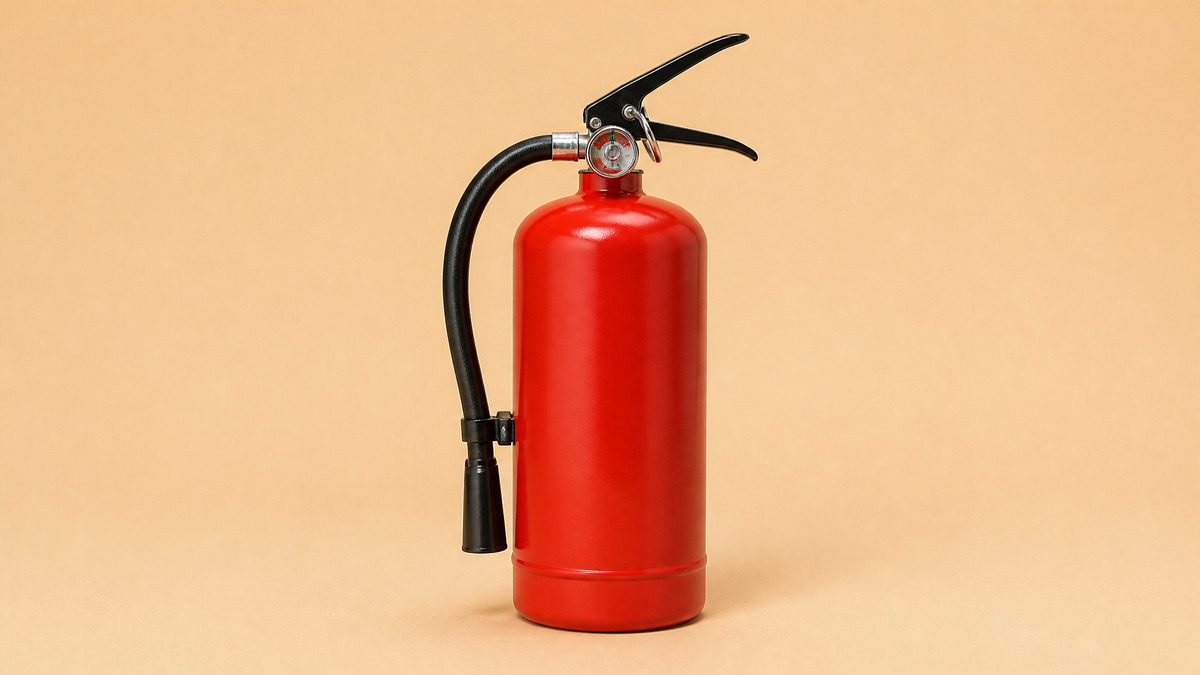
Every product in this series has carried a number that somebody else supplied. A rim carried a size from a tyre maker's listing, a blade carried a fitment from a vehicle, a jack carried a rating it stamped itself, a tire changer carried a laboratory's scope. A fire extinguisher carries something different again: a label that is a test result. The letters say which fires the unit passed a test against, the numbers say how much fire, and both come from a fire test rather than from a catalogue decision. That makes this the first product in the series whose headline number cannot be invented, and the first whose service interval is decided by how it is built — twelve years or five, depending on the shell and the agent inside it. This article reads the rating, the workplace rule that consumes it, and the table that turns a material choice into a decade of obligations.
1. The Label Is a Test Result
The rating comes from a standard that tests extinguishers against real fires: UL 711, Rating and Fire Testing of Fire Extinguishers. The letter names the class of fire the unit passed against, and the number, where there is one, describes how much of that fire it put out. The classes themselves are worth a line each, because a buyer quoting a mixed order needs to know that the letters are not interchangeable:
- Class A — ordinary combustibles: wood, cloth, paper, rubber and many plastics.
- Class B — flammable and combustible liquids: oils, tars, oil-based paints, solvents, lacquers, alcohols and flammable gases.
- Class C — fires involving energized electrical equipment.
- Class D — combustible metals such as magnesium, titanium, zirconium, sodium, lithium and potassium.
- Class K — cooking appliances involving combustible cooking media, vegetable or animal oils and fats.
What the numbers mean is more interesting than the letters, and it is the part a buyer should be able to repeat to a customer. On Class A, the test burns a crib of dry wood — pieces of 1½ inch by 1½ inch (38 mm by 38 mm), or 1½ inch by 3½ inch (38 mm by 89 mm), stacked and lit — and the rating depends on the size of crib the unit can put out. A 3-A rated extinguisher has to extinguish a fire made of 144 pieces of 1½ by 1½ by 29 inch wood, and Class A ratings run from 1-A to 40-A.
On Class B the fuel is heptane, one of the main components of gasoline, burned in a square steel pan. A 10-B rated unit has to put out 31 gallons of heptane in a 25 square foot pan. The number is therefore an area and a volume at the same time, which is why a 10-B on one label and a 10-B on another should mean the same fire.
Class C has no number at all. The test asks a different question: whether current flows through the extinguisher while it is discharged onto energized equipment. That is why a C rating never appears alone — a unit is rated A, or B, or both, and the C is added by passing a conductivity test. Class D has no number either; it is rated by the amount of agent and the method of application. Class K is tested against a single size of cooking fire, extinguished without splashing the oil or letting it reignite.
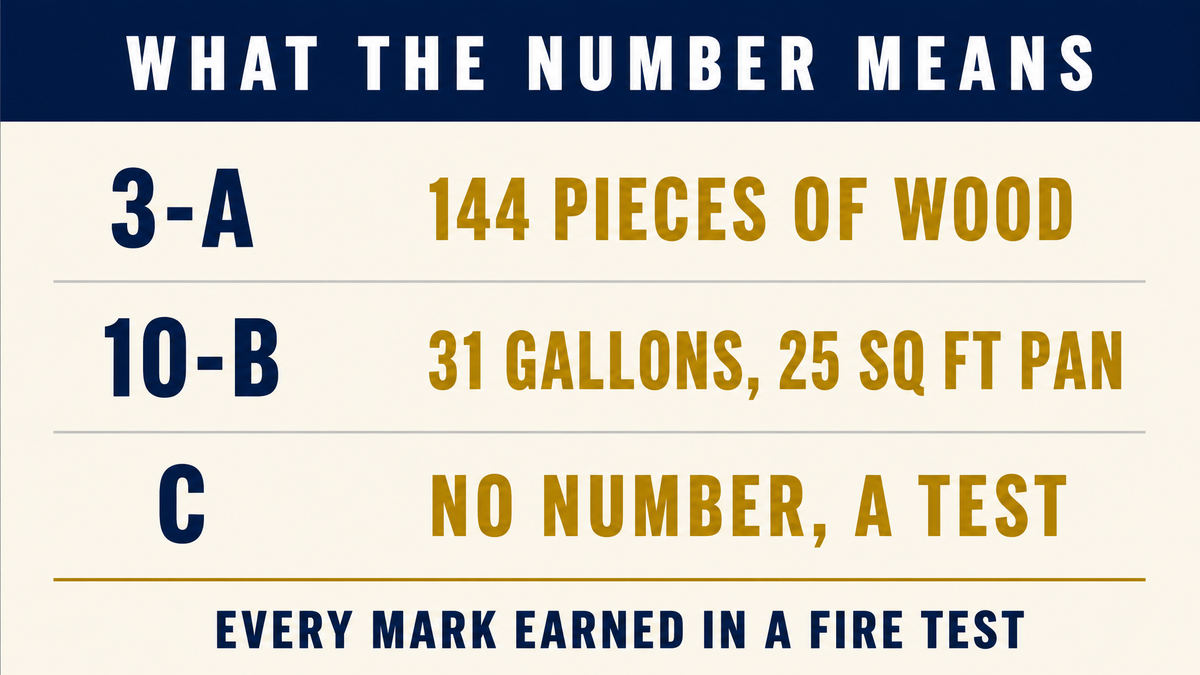
Put that together and a label such as 2A:10B:C reads as three separate results joined by colons: a wood crib of a certain size, a heptane pan of a certain area, and a conductivity test passed. None of the three can be chosen by a catalogue, and none of them can be printed without the test. That is the whole reason the label matters downstream, because the workplace rule that governs what the customer buys opens with a short sentence about it.
“(c)(2) Only approved portable fire extinguishers shall be used to meet the requirements of this section.” — 29 CFR § 1910.157(c)(2)
One word in that sentence does the work. Approved is not a description of quality; it is a status, and the subpart's own definitions decide what fills it. So the rating on the label is the entry ticket to a workplace, and everything else in this article follows from that.
2. What the Workplace Rule Fixes
The rest of 29 CFR 1910.157 is a set of duties on the employer, and four of them land directly in a wholesale order. The first is a count. Extinguishers must be distributed so that the travel distance to the nearest unit is 75 feet (22.9 m) or less for Class A hazards and 50 feet (15.2 m) or less for Class B. Class C is distributed on the pattern of the A or B hazard it sits with, and Class D follows the same 75 foot rule, with units required where combustible metal powders, flakes or shavings are generated at least once every two weeks.
Read those numbers as a buyer and they change what a quotation is. The customer's quantity is not a preference; it comes from the floor plan and the hazard class, and a supplier who quotes a pallet without asking about the building is quoting a number that may be half what the site needs. That is also why a mixed order is normal in this category — one site can need an A unit in an office area, a B unit at a solvent store and a D unit in a machine shop.
The second duty is condition: units must be maintained fully charged and operable, and kept in their designated places except during use. The third is what a buyer rarely hears about, and it is a prohibition: no carbon tetrachloride or chlorobromomethane agents, and soldered or riveted shell self-generating soda acid, foam or gas cartridge water types that work by inverting the unit must be removed from service.
The fourth is the clock, and it is where this product separates itself from every other one in the series.
“(e)(2) Portable extinguishers … shall be visually inspected monthly. (e)(3) The employer shall assure that portable fire extinguishers are subjected to an annual maintenance check … The employer shall record the annual maintenance date and retain this record for one year after the last entry or the life of the shell, whichever is less.” — 29 CFR § 1910.157(e)
Monthly, annually, and then two longer intervals that depend on the unit: a stored pressure dry chemical extinguisher that requires a twelve-year hydrostatic test must be emptied and maintained every six years, and dry chemical units with non-refillable disposable containers are exempt from that requirement. When a unit is recharged or tested, the six-year clock starts again from that date. The employer also has to provide alternate equivalent protection whenever a unit is taken out of service for maintenance.
3. The Interval Is a Material Fact
Here is the sentence that makes this product different from everything else in the series. The hydrostatic test interval is not a number the supplier chooses or the customer negotiates. It is a value read off a table by the type of extinguisher, and the type is a fact about the shell and the agent:
“(f)(2) The employer shall assure that portable extinguishers are hydrostatically tested at the intervals listed in Table L-1 … (i) When the unit has been repaired by soldering, welding, brazing, or use of patching compounds; (ii) When the cylinder or shell threads are damaged; (iii) When there is corrosion that has caused pitting, including corrosion under removable name plate assemblies; (iv) When the extinguisher has been burned in a fire; or (v) When a calcium chloride extinguishing agent has been used in a stainless steel shell.” — 29 CFR § 1910.157(f)(2)
Table L-1 splits the trade cleanly in two. On one side sit the units tested every five years: soda acid in a stainless shell, cartridge and stored pressure water or antifreeze, wetting agent, foam in a stainless shell, aqueous film forming foam, loaded stream, dry chemical with a stainless steel shell, and carbon dioxide. On the other sit the units tested every twelve years: dry chemical stored pressure in a mild steel, brazed brass or aluminium shell, dry chemical cartridge or cylinder operated in mild steel, Halon 1211 and Halon 1301, and dry powder cartridge or cylinder operated in mild steel.
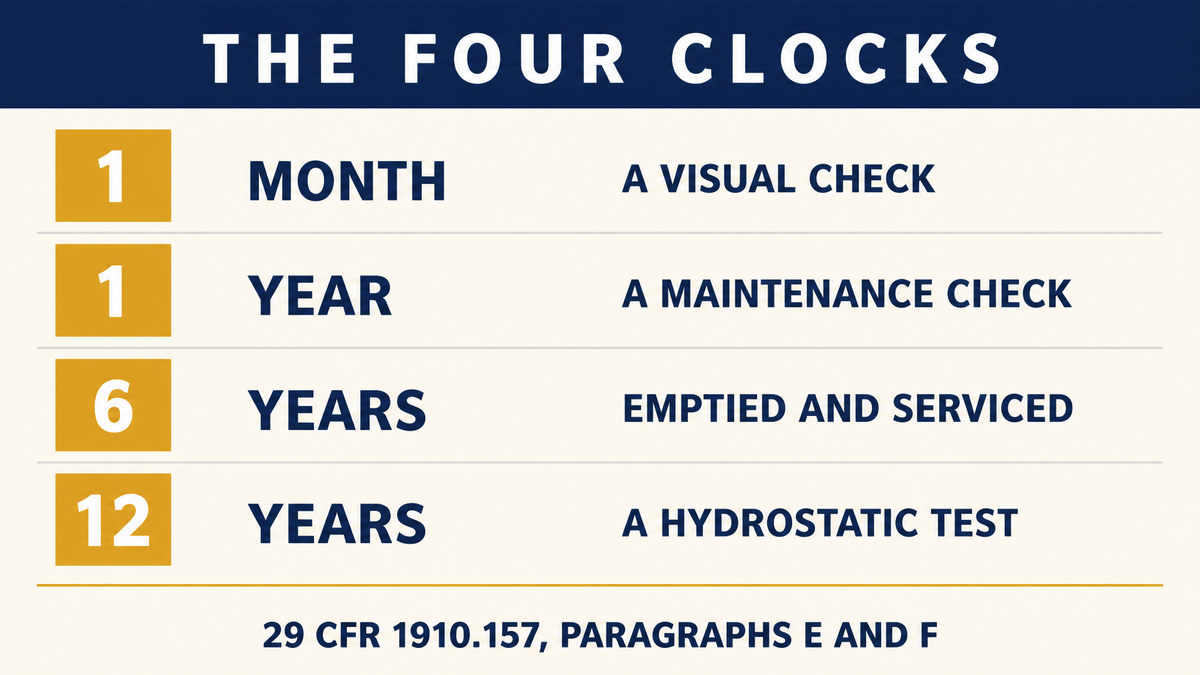
The commercial consequence is blunt, and it is the reason this article exists. Two units that look identical on a pallet can carry different decades. A mild steel dry chemical unit is tested every twelve years and emptied every six. The same agent in a stainless shell is tested every five. A carbon dioxide unit is tested every five. A non-refillable disposable unit is exempt from the six-year emptying rule entirely, which sounds like a saving until the customer works out that the unit cannot be recharged either.
The table also carries two smaller numbers that a buyer can put straight into a specification. Hose assemblies with a shut-off nozzle are tested with the unit, and at their own pressures: 1,250 psi (8,620 kPa) for carbon dioxide and 300 psi (2,070 kPa) for dry chemical and dry powder. Carbon dioxide hoses are tested inside a protective cage, air or gas pressure may not be used for any hydrostatic test, and a shell that fails is removed from service rather than repaired.
Two consequences for the order document follow from those paragraphs. The first is that the shell material belongs in the model name, not in a footnote, because the customer's maintenance schedule and a decade of records depend on it. The second is that the unit needs a serial number that survives its own service life: the certification record required by the section has to carry the date, the signature of the tester and the serial number or other identifier of the unit that was tested. A name plate that corrodes, or a number stamped where the paint sits, is a record that cannot be completed.
4. Two Units That Look Alike
The three-way split in table L-1 turns into three questions a buyer can ask about any model. Each answer changes something the customer will live with for years, and none of them is visible in a product photograph.
Three choices, and what each one changes
| The choice | What it changes | What the order states |
|---|---|---|
| Shell | Five years or twelve | Mild steel or stainless |
| Refill | The six-year rule applies or not | Refillable, by model |
| Agent | The interval and the hose pressure | Dry chemical, CO2, water |
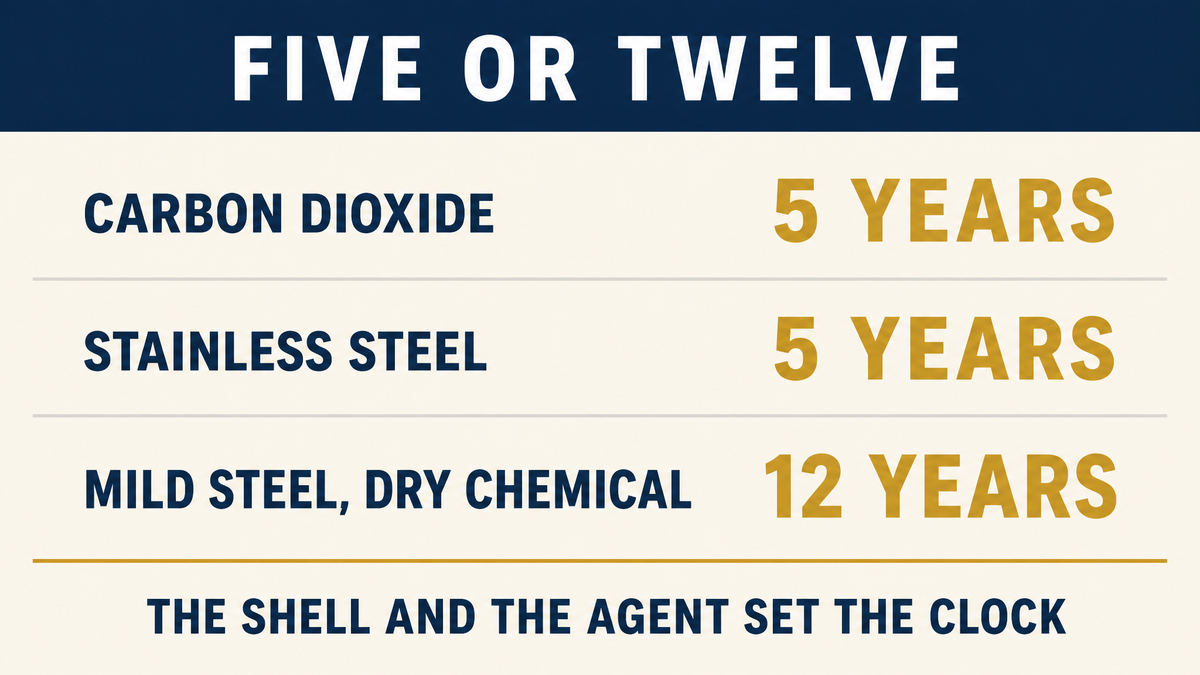
Work through the three answers on one order and the shape of the category appears. A customer buying for a workshop wants a mild steel dry chemical unit, because it is the cheapest way to cover A, B and C hazards, and the twelve-year interval is a bonus of that choice. The same customer buying for a clean room or a food plant may want stainless, and has just halved the interval to five years while paying more for the shell. A customer buying for a server room wants carbon dioxide, which is five years and comes with its own test pressure, and which is a poor choice for a Class A hazard because a gas leaves no blanket behind. None of those are preferences a supplier should override; they are consequences a supplier should price and document.
There is one more consequence that belongs on the drawing, and it comes from a phrase inside the exception list. The section names corrosion that has caused pitting, including corrosion under removable name plate assemblies, as a reason a unit must be tested early or pulled. That is a design statement without saying so: a removable plate that traps moisture is a place where a shell fails first. A buyer who wants a unit to reach its twelve-year test should look at how the name plate is fixed, not only at what it says.
5. Who Trains the Customer's People
The last paragraph of the section is the one a supplier is least likely to read and most likely to be asked about. Employers who provide extinguishers for employee use must run an educational program to familiarise employees with the general principles of extinguisher use and the hazards of fighting a fire in its incipient stage, at initial employment and at least annually after that. Employees designated to use fire fighting equipment as part of an emergency action plan get training on the appropriate equipment, again at initial assignment and at least annually.
None of that is a supplier's legal duty. It is, however, a supplier's opportunity, and it has a hard edge. A unit whose label cannot be read in a hurry, whose gauge sits where a wall bracket hides it, or whose manual is a single sheet in a language the workforce does not read, is a unit that makes the customer's annual education harder than it needs to be. The strongest suppliers in this category ship three things with the pallet: a label that states the rating at a glance, a bracket that puts the gauge at eye level, and a manual that describes the model, the agent and the interval in plain words.
6. What the Record Says
Method first. The federal recall file holds 245,845 records, has no header row, and every field is scanned. Controls: brake 28,639, air bag 16,162. Twenty-five terms were counted, and three came back at zero.
| Term | Records | Campaigns |
|---|---|---|
extinguisher | 3,831 | 53 |
extinguishers | 3,805 | 50 |
fire | 38,181 | 3,229 |
dry | 225 | 62 |
chemical | 103 | 18 |
foam | 548 | 47 |
halon | 0 | 0 |
co2 | 0 | 0 |
dioxide | 0 | 0 |
nitrogen | 2 | 1 |
agent | 335 | 40 |
charge | 239,004 | 14,348 |
recharge | 67 | 9 |
gauge | 544 | 85 |
valve | 8,247 | 527 |
pin | 2,318 | 253 |
seal | 1,457 | 213 |
bracket | 5,865 | 647 |
cylinder | 2,593 | 252 |
shell | 333 | 52 |
rating | 1,929 | 274 |
label | 4,268 | 585 |
pressure | 15,665 | 979 |
hydrostatic | 8 | 1 |
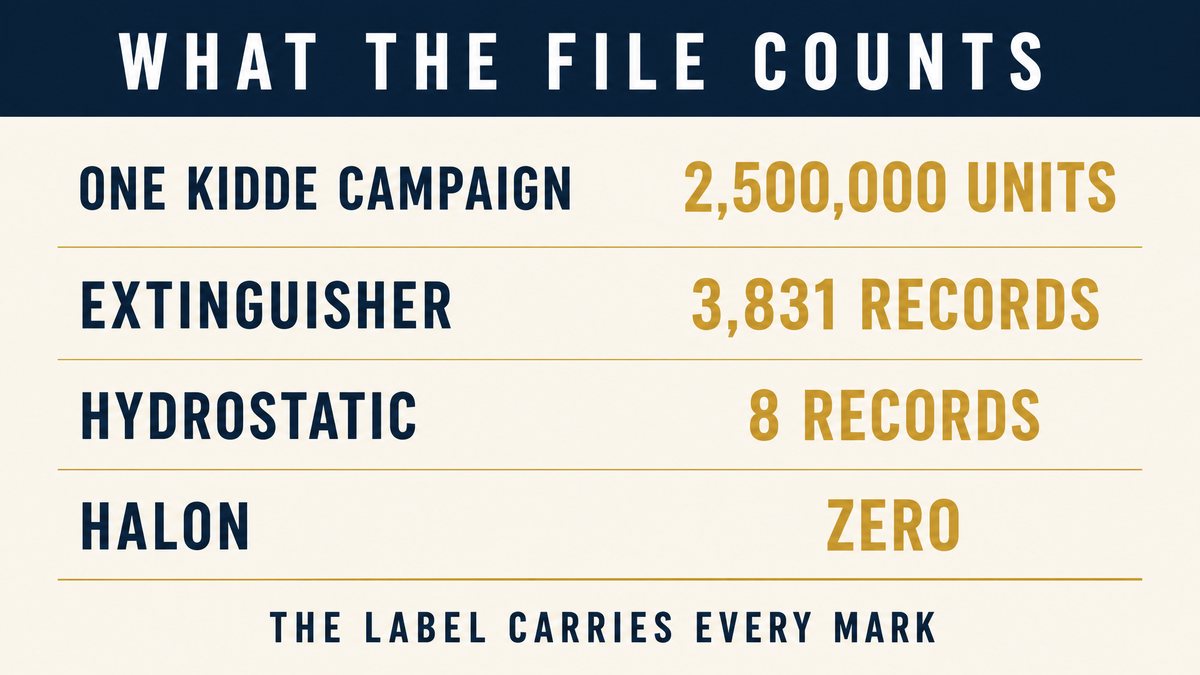
The extinguisher is in the file, and mostly as vehicle equipment. The largest row is a Kidde campaign at 2,500,000 units filed under the equipment heading, and it is the only large stand-alone extinguisher campaign in the set. The five that follow are all vehicles: a Dutchmen Denali at 1,205,997, a Continental Cargo at 365,885, a KZRV Spree at 134,046, a Thor Ventura at 110,400 and an Isuzu NRR at 69,138, every one of them filed under EQUIPMENT because the extinguisher is installed in the vehicle. So in this record the product appears twice over: once as an article in its own right, and once as a part of somebody else's vehicle.
The agents that decide the interval are missing. halon, co2 and dioxide return nothing at all across a quarter of a million records, while dry and chemical appear 225 and 103 times and mostly mean something else — the largest dry rows are brake master cylinders and a trailer described as a dry van. The three-way split that table L-1 turns on is invisible in the record.
The word that sets the decade appears eight times. hydrostatic reaches 8 records in a single campaign, and that campaign is an Elgin Sweeper street sweeper with 56 units, filed under equipment. In a quarter of a million rows, the maintenance interval that governs a customer's next twelve years is mentioned eight times, and never about an extinguisher.
The word for condition is the most common word in the file. charge reaches 239,004 records across 14,348 campaigns, which is almost every record in the set, and it is always electrical: battery charge, charging system, a charge port, a software charge. Meanwhile recharge, the word that describes what a service workshop does to an extinguisher every six years, appears 67 times in 9 campaigns. The language of the product is drowned by the language of the car it sits in.
And the parts are somebody else's parts. bracket at 5,865 records is led by a Toyota RAV4 battery bracket campaign at 1,853,568 units and a trailer light kit at 888,122. gauge at 544 is fuel gauges, led by an Infiniti QX56 at 340,000, with one genuine row in the list: a Mac Tools tire pressure gauge at 66,132. pin and seal are the same story.
The finding. The record holds the extinguisher twice — as a Kidde campaign and as a part of a vehicle — and holds almost nothing of what makes it a product with a schedule: no agents, one mention of a hydrostatic test, and a word for its charged condition that belongs to batteries. That is the same silence this series has recorded for six articles, in a new key. A wiper blade, a jack and a tire changer were absent because their risk is filed as a workplace matter; an extinguisher is present because it travels inside vehicles, and the part of it that a buyer specifies — shell, agent, interval — is exactly the part the record does not carry.
7. Five Questions an Extinguisher Quote Should Answer
A quotation in this category usually arrives as a capacity in kilograms or pounds, a rating such as ABC, a quantity and a price. Two of those four are the product, and the other two are a decision made by the customer's building. Five questions close the gap.
- Which rating, and against which hazard in the customer's building? The letters are classes tested, and the numbers are test results. A quotation should name the full rating, not a family name like ABC, because the number in front of each letter is what the customer's survey will be checked against.
- Which shell material, and therefore five years or twelve? A mild steel dry chemical unit is tested every twelve years and emptied every six; the same agent in stainless is tested every five. The shell is a maintenance decision disguised as a buying one.
- Refillable or disposable? Disposable units are exempt from the six-year emptying rule, which sounds like a saving and means the unit cannot be recharged when a customer needs it recharged.
- Where is the serial number, and will it still be readable at the first test? The certification record has to carry the date, the tester's signature and the unit's identifier. A number under the paint, or on a plate that corrodes, is a record that cannot be completed.
- Does the manual state the rating, the agent and the interval in plain words? The customer has an annual education duty, and the supplier's contribution to it is a label that reads at a glance and a manual that does not need translating twice.
8. Six Lines to Put in the Order
Everything above reduces to six lines. Each one is checkable on arrival, and each one answers a question that will otherwise be asked twelve years later by a service technician.
| Line | What to write | Why it is on the list |
|---|---|---|
| 1 | The full rating as tested, letter by letter | The numbers are test results, not a family name |
| 2 | The shell material and the agent | Together they set five years or twelve |
| 3 | Refillable or disposable, by model | The six-year emptying rule turns on it |
| 4 | The serial number's place and method | The test record needs an identifier that lasts |
| 5 | The hose assembly and its test pressure | 1,250 psi for CO2, 300 psi for dry chemical |
| 6 | The label, bracket and manual for the customer's training | The annual education duty needs readable material |
Three of those six lines decide a decade of maintenance, and none of them appears in the four numbers a quotation usually leads with. That is the reverse of the jack article, where the federal surface was a single stamp, and it is the reason this category rewards a buyer who asks about materials: the cheapest unit on the pallet is the one that sets the longest interval, and the same unit in a better shell halves it.com/factory-audit-checklist-guide/" target="_blank" rel="noopener">what an audit can confirm about a label is where the paperwork meets the production line, and the checks made before a pallet ships are where a gauge and a pin arrive intact — with how a pallet's volume decides the freight worth settling at the same time, because pressurised cylinders bill on both mass and space.
Frequently Asked Questions
What does a rating like 2A:10B:C actually mean?
It is three test results joined by colons. The A figure describes a wood crib fire the unit extinguished, and a 3-A unit has to put out a fire of 144 pieces of 1½ by 1½ by 29 inch wood. The B figure describes a heptane pan fire by area, and a 10-B unit has to put out 31 gallons in a 25 square foot pan. The C is a conductivity test rather than a size, which is why a C never appears on its own.
Is a fire extinguisher approved by OSHA?
The workplace rule requires that only approved portable fire extinguishers be used, and it leaves the word to the subpart's own definitions. What a buyer can see and check is the tested rating on the label and the listing behind it. The regulation does not test extinguishers itself; the ratings come from fire testing to UL 711.
How often must an extinguisher be inspected and tested?
Visually inspected monthly, given an annual maintenance check with the date recorded, emptied and serviced every six years if it is a stored pressure dry chemical unit that carries a twelve-year hydrostatic test, and hydrostatically tested at the interval in table L-1. The customer must also provide equivalent protection while a unit is out of service.
Why do two similar extinguishers have different test intervals?
Because table L-1 keys the interval to the type, and the type is the shell plus the agent. Dry chemical in a stainless shell is a five-year unit; the same agent stored under pressure in mild steel, brazed brass or aluminium is a twelve-year unit; carbon dioxide is five. Halon 1211 and 1301 are twelve.
Are disposable extinguishers exempt from servicing?
They are exempt from the six-year emptying requirement that applies to stored pressure dry chemical units with a twelve-year test interval. They cannot be recharged, so the exemption is a statement about the end of the unit's life rather than a maintenance saving. An annual maintenance check and the monthly visual inspection still apply.
What has to be in the hydrostatic test record?
A certification record that includes the date of the test, the signature of the person who performed it, and the serial number or other identifier of the extinguisher. It has to be kept until the unit is retested at the interval in table L-1, or until it is taken out of service.
An extinguisher is bought against a distance, not against a look. OSHA 1910.157 fixes how far a worker may travel to reach one, and that number decides how many units a floor needs before anyone discusses the brand on the shell.
The label is a summary of tests run on a sample, not a description of the unit in the carton. So the order has to carry the rating, the agent, the charge weight and the report behind them, because the plate will not tell you any of that.
A Handover Pack for the Safety Officer
Service interval, the two similar-looking units distinguished, and a one-page training outline with space for names and dates.
Build My Handover Pack
Questions & Comments
We read every one and reply within 24 hoursHow many fire extinguishers a floor needs is arithmetic rather than taste, because travel distance sets the count. Send the layout and the hazard classes, and we will run the numbers.