
Shopify Order Fulfillment from China: ERP Integration, Tracking Numbers & Fast Lines (2026 Guide)
 ·
Updated October 1, 2026
·
20 min read
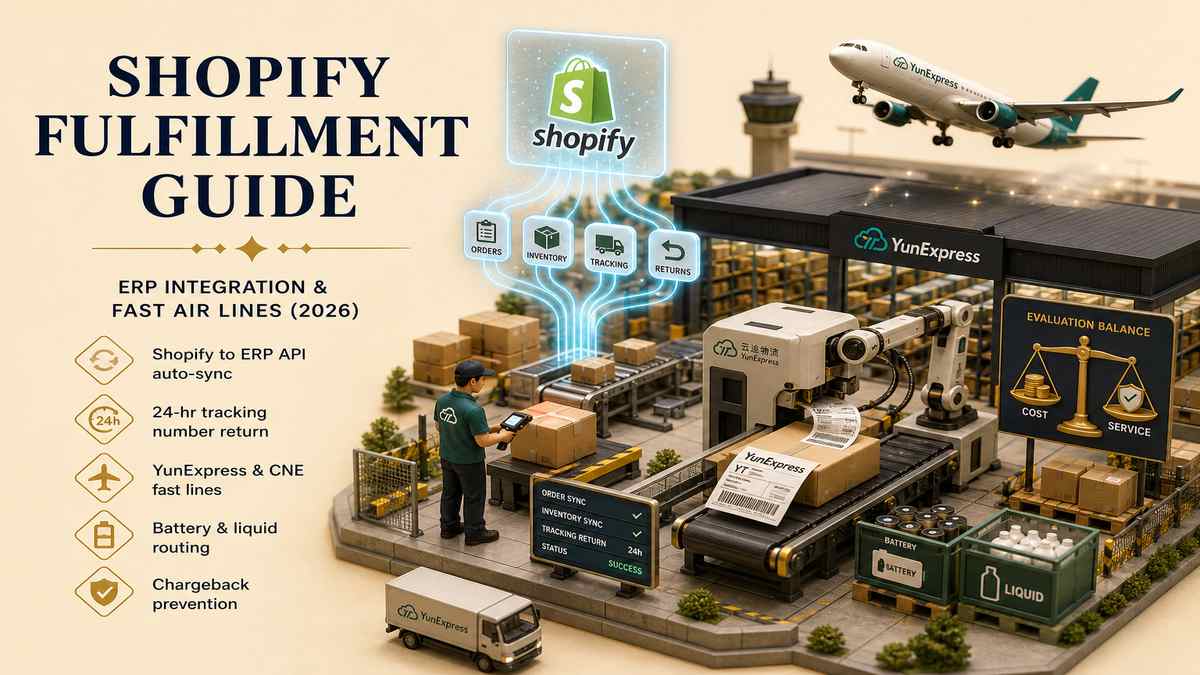
Direct Answer: In 2026, building an Automated Shopify Order Fulfillment System directly from China is the engine that powers 8-figure Direct-to-Consumer (DTC) brands. Manually uploading CSV spreadsheets or relying on slow AliExpress suppliers is obsolete. A professional China fulfillment setup operates on a smooth 4-stage data loop: (1) Real-Time API Syncing (Shopify Webhooks push customer orders to Chinese Enterprise Resource Planning / ERP systems in under 5 seconds); (2) Automated Warehouse Wave Picking & 100% Quality Inspection; (3) Smart Courier Routing (automatically routing general cargo to YunExpress/CNE 6–9 day lines and battery items to dedicated Hong Kong air lines); and (4) Automated 24-Hour Tracking Number Return (pushing live tracking codes back to Shopify to mark orders fulfilled and trigger branded delivery notifications). Setting up automated ERP fulfillment reduces store chargebacks below 0.2% and protects merchant accounts from payment processor holds.
To understand how third-party fulfillment centers manage picking and warehouse handling fees, review our complete breakdown of China 3PL warehousing and order fulfillment rates across Shenzhen and Yiwu.
When customer orders flow automatically from your Shopify checkout directly to a dedicated packing station in China, your team can focus 100% of its energy on creative advertising and customer acquisition.
To ensure incoming factory products are stripped of all Chinese domestic invoices before international dispatch, explore our guide on blind dropshipping from China and custom packaging kitting for private label unboxing.
In this technical 2026 Shopify fulfillment guide, we map out the end-to-end ERP data flow architecture, decode smart courier routing rules, expose 3 critical logistics and payment dispute risks, and share a 5-step SOP to integrate automated China fulfillment with your Shopify store.
Shopify to China ERP Automated Fulfillment Data Flow Architecture
To understand how automated order fulfillment operates between your online storefront and warehouse pickers in China, review this data architecture:
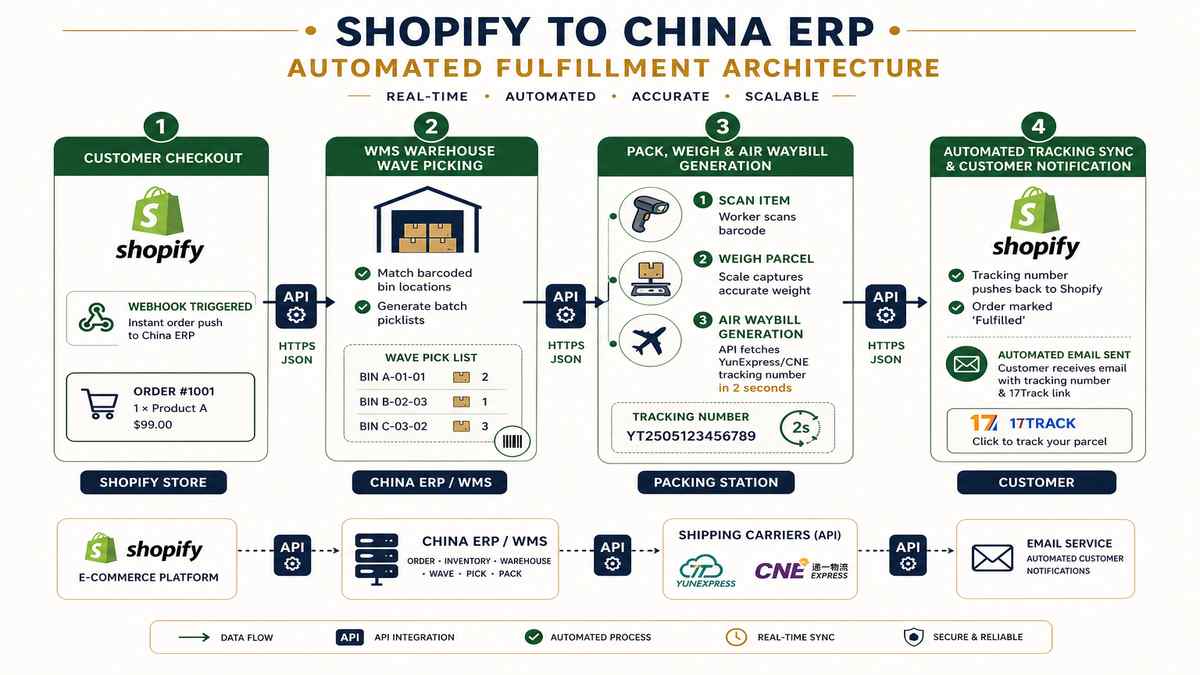
To build custom API webhooks and order fulfillment automation, consult technical documentation from the Shopify Developers Admin API & Webhooks Documentation.
Smart Courier Routing Rules for Shopify Orders from China
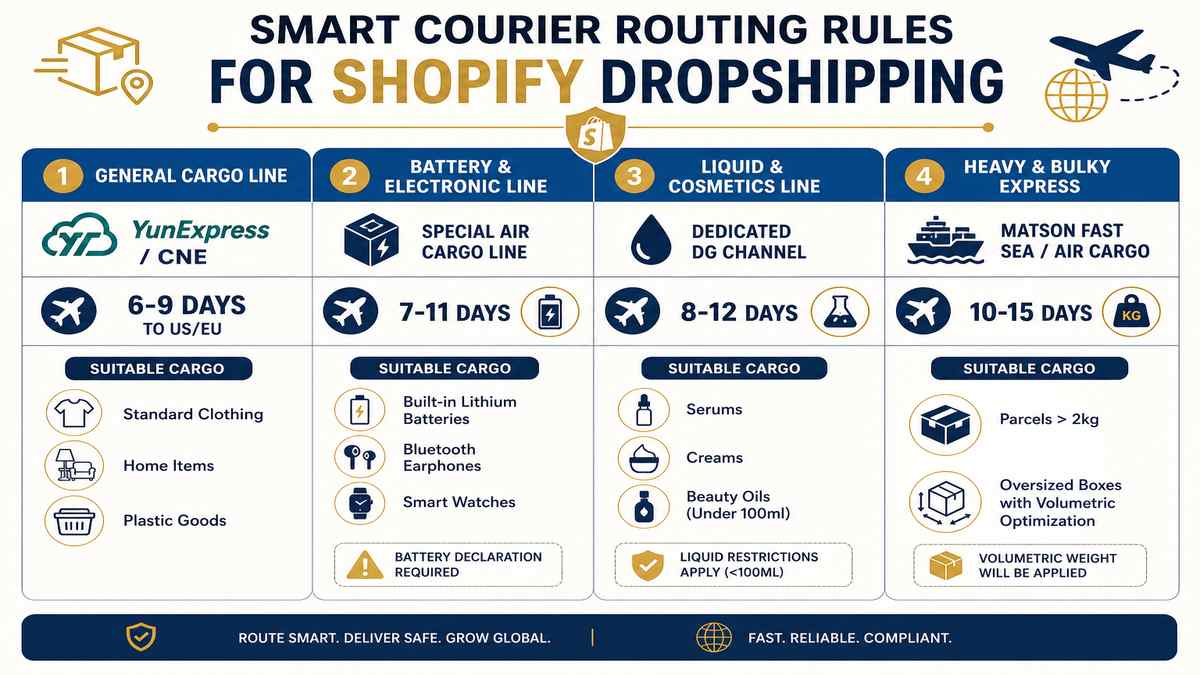
Not all products can ship on standard postal lines. An automated ERP applies intelligent routing rules based on product attributes:
To understand how private sourcing agents coordinate fast courier lines with domestic 1688 factories, review our guide on how to find reliable private sourcing agents for dropshipping in China.
| Product Cargo Category | Physical Item Examples | Recommended Fast Air Line | Average Transit Time | Key Routing & Customs Rule |
|---|---|---|---|---|
| 1. General Non-Sensitive Cargo | Apparel, phone cases, home tools, toys. | YunExpress / CNE General Line | 6 – 9 business days | Lowest cost; direct flight injection to US/EU hubs. |
| 2. Battery & Electronic Goods | Smart watches, Bluetooth earbuds, massage guns. | Special Cargo Air Line (Hong Kong Hub) | 7 – 11 business days | Must transit via Hong Kong with UN38.3 battery reports. |
| 3. Cosmetic Liquids & Creams | Facial serums, beauty lotions, hair oils. | Dedicated Cosmetic DG Line | 8 – 12 business days | Requires MSDS safety sheets; volume limited <100ml. |
| 4. Heavy & Volumetric Goods | Office chairs, large pet beds, luggage. | Air Cargo Consolidation / Fast Sea | 10 – 15 business days | Optimized for dimensional volumetric weight (L×W×H/6000). |
3 Critical Logistics & Chargeback Risks in Shopify China Fulfillment
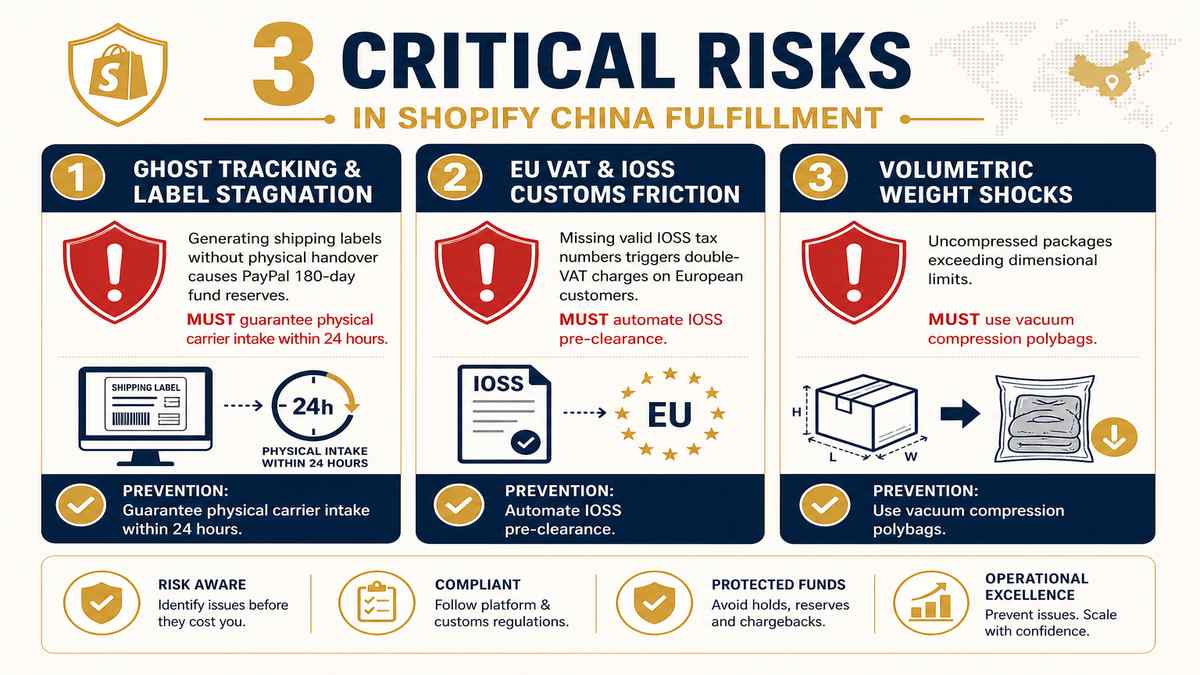
Failing to manage logistics data properly can trigger severe payment gateway penalties. Protect your store against these three major risks:
To ensure product classifications comply with international customs tariff schedules, audit item codes against the World Customs Organization (WCO) Harmonized System Database.
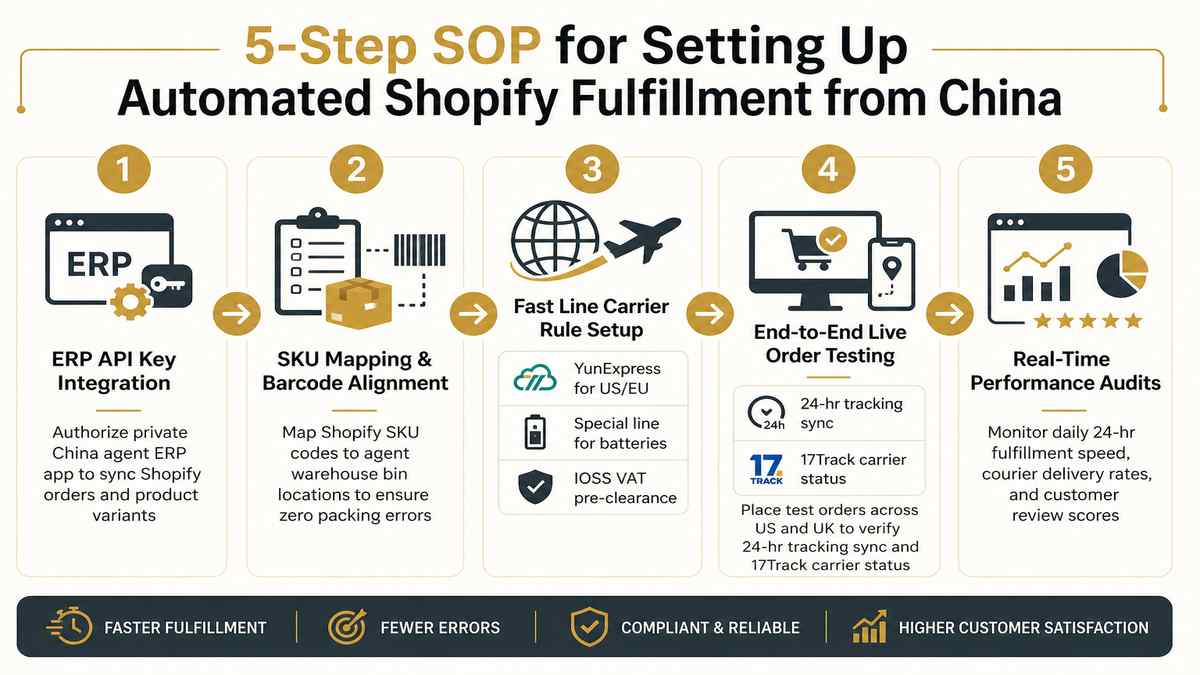
5-Step SOP for Setting Up Automated Shopify Fulfillment from China
Follow this standard operating procedure to connect your Shopify store with an automated China fulfillment center:
To inspect physical packaging prototypes before starting automated daily fulfillment, conduct a formal first article inspection (FAI) sample review.
- Authorize ERP App & API Key Connection: Generate a private API integration key in your Shopify Admin and authorize your China 3PL agent’s ERP platform (Dianxiaomi, Mabang, or custom app) to read orders and write fulfillment updates.
- Execute SKU & Variant Barcode Mapping: Map every Shopify product variant title and SKU code directly to matching warehouse inventory bin numbers to eliminate picking errors.
- Configure Automated Smart Carrier Rules: Set up courier routing rules based on destination country and cargo type (e.g., YunExpress for US general cargo, special DG lines for electronics, and automated IOSS tax numbers for EU orders).
- Execute Live End-to-End Test Orders: Place 5 live test orders shipped to personal addresses in the US and Europe, checking that tracking numbers sync to Shopify within 24 hours and carrier tracking links update properly on 17Track.
- Audit Warehouse Quality Systems & Calibrated Standards: Ensure warehouse operations follow calibrated quality procedures certified under ISO 9001 Quality Management Standards.
To protect your inventory and fulfillment speed legally, lock 24-hour dispatch deadlines into an enforceable bilingual manufacturing sales contract under PRC law.
To evaluate candidate China warehouse facilities and inventory storage racks, perform an on-site audit using our China factory audit checklist review.
Top 3 China Cross-Border ERP Systems for Shopify Store Integration
To choose the right software bridge between your Shopify store and your China warehouse, review this comparative breakdown of the top 3 e-commerce ERP systems used by Chinese fulfillment centers:
| China ERP Platform | Primary Target Merchant Scale | Shopify API Sync Stability | Supported Cross-Border Couriers | Key Warehouse Feature Strengths |
|---|---|---|---|---|
| 1. Dianxiaomi (店小秘) | Startups to Mid-Market (10–500 orders/day) | Ultra-Fast (Real-time webhook sync) | 1,200+ global couriers (YunExpress, CNE, 4PX, Yanwen) | Intuitive UI, automated SKU mapping, zero-cost starter tier. |
| 2. Mabang ERP (马帮) | High-Growth Brands (100–3,000 orders/day) | High (Enterprise API architecture) | Comprehensive direct air express and postal lines | Advanced multi-warehouse routing, intelligent inventory buffer forecasting. |
| 3. Tongtool (通途) | Enterprise & Multi-Channel (500+ orders/day) | Very High (High-concurrency support) | Full global air freight and sea cargo integration | Automated financial reconciliation, advanced batch wave-picking algorithms. |
Configuring Shopify Shipping Profiles & Realistic Delivery Expectations
To prevent customer anxiety and maintain high conversion rates, configure your store shipping zones to reflect accurate transit speeds:
Illustrative Scenario: How a Wellness Brand Fulfill 120 Daily Orders with Zero Errors
To see how automated Shopify fulfillment from China scales e-commerce brands efficiently, review this consumer wellness case study:
A fitness recovery brand in Chicago, Illinois launched a portable high-frequency deep tissue massage gun with 4 interchangeable heads (\$89 retail price, scaling to 120 daily orders).
- The Manual Fulfillment Breakdown: The founder manually downloaded Shopify CSV files every evening and emailed them to an AliExpress supplier. The vendor took 3 days to provide tracking numbers, shipped units via slow postal lines (averaging 21 days), and misrouted 8% of battery-powered units, triggering a 6.5% customer refund rate and an impending PayPal 180-day account freeze.
- The Sourcing Pioneer Automated Fulfillment Overhaul: Sourcing Pioneer implemented a fully automated China fulfillment pipeline in Shenzhen: (1) Connected our WMS to the brand’s Shopify store via private ERP API for real-time order ingestion, (2) Sourced massage guns directly from the primary 1688 manufacturer for \$16.20 per unit, (3) Conducted 100% motor spin and battery charging QC tests on every unit, (4) Packed goods into custom matte black zipper EVA travel cases with branded thank-you cards (\$1.30 kitting fee), and (5) Routed orders automatically via YunExpress Battery Special Air Line (7.4-day average US doorstep delivery).
- Flawless 24-Hour Automated Tracking Sync: Every order checkout automatically triggered warehouse wave picking, with live tracking numbers pushed back to Shopify within 18 hours of store buy.
- The Commercial Outcome: Customer refund disputes plunged from 6.5% down to 0.2%, PayPal lifted all reserve fund holds, and the brand scaled ad spend smoothly to over \$320,000 in monthly revenue with zero fulfillment bottlenecks.
Frequently Asked Questions (FAQ)
How does Shopify order fulfillment from China work automatically?
When a customer places an order on your Shopify store, a Webhook automatically pushes order data to your China 3PL agent’s ERP system. The warehouse picks, inspects, and packs the product, generating a YunExpress or CNE waybill. The ERP instantly sends the tracking number back to Shopify via API, automatically marking the order ‘Fulfilled’ and notifying the buyer.
What ERP software is used to connect Shopify stores with China fulfillment warehouses?
The leading e-commerce ERP systems used by China 3PLs include Dianxiaomi (店小秘), Mabang (马帮), Tongtool (通途), and custom private Shopify apps built using Shopify GraphQL Admin APIs.
How do you fulfill Shopify orders containing lithium batteries or liquids from China?
Products containing built-in batteries (Bluetooth earbuds, smart watches) or cosmetic liquids (creams, serums) must be routed through dedicated ‘Dangerous Goods’ (DG) air courier lines operating via Hong Kong cargo hubs, taking 7 to 11 days with full customs rules.
Why do ghost tracking numbers cause PayPal and Stripe payment holds on Shopify?
If an agent generates a shipping label and marks the Shopify order fulfilled, but the parcel sits in a warehouse for 5 days without physical carrier scans, payment gateways detect a delivery delay. This triggers rolling reserve funds (10% to 20% hold) and payment dispute penalties.
How does EU IOSS tax automation work for Shopify orders fulfilled from China?
By configuring your Shopify store’s EU Import One-Stop Shop (IOSS) tax identification number inside your agent’s ERP software, European orders under 150 Euros clear EU customs automatically with pre-paid VAT, preventing customers from being charged surprise duties upon doorstep delivery.
Automate Your Shopify Store with Direct China 3PL Fulfillment & 6-Day Fast Lines
Our China engineering team connects your Shopify store via private ERP API, performs 100% piece-by-piece QC, and fulfills orders via YunExpress with automated 24-hour tracking return.
Get Free Shopify China Fulfillment Consultation
Questions & Comments
We read every one and reply within 24 hoursConnecting your Shopify store to China ERP software, setting up automated smart courier routing rules for battery products, or preventing carrier tracking delays? Post your fulfillment questions below — our on-the-ground e-commerce logistics specialists will guide your integration.