
FCL vs. LCL Shipping: When to Switch from Shared Container to Full Container (2026 Guide)
 ·
Updated September 29, 2026
·
16 min read
·
Updated September 29, 2026
·
16 min read
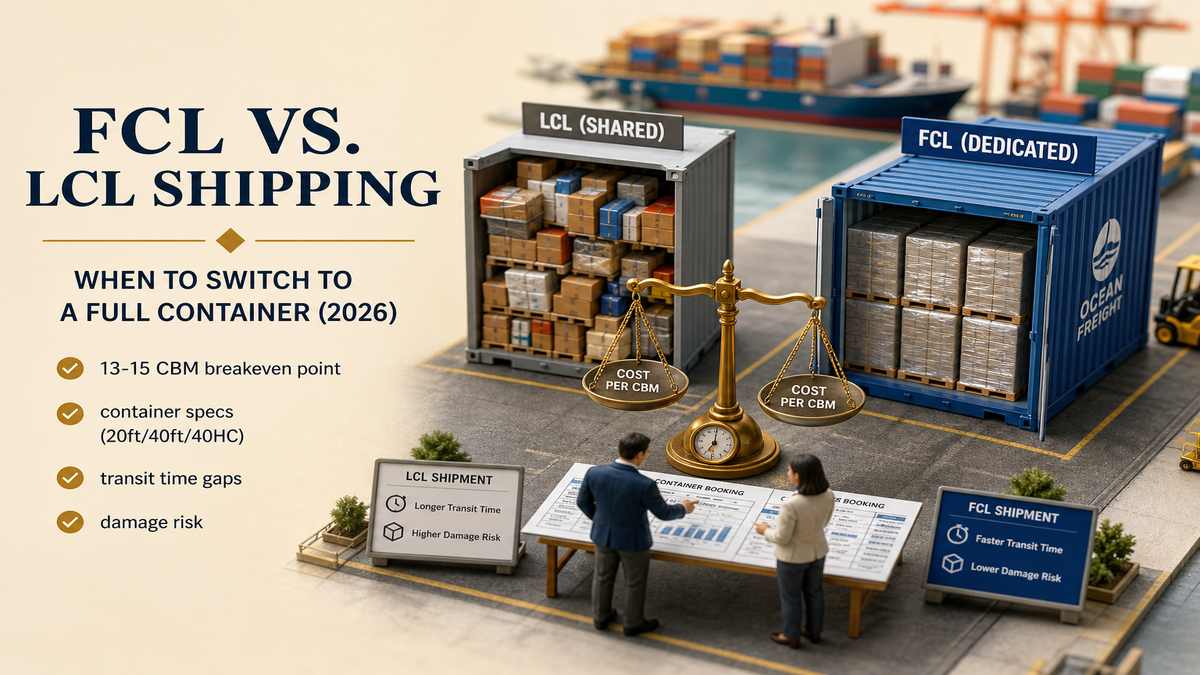
Direct Answer: FCL (Full Container Load) means renting an entire 20ft or 40ft shipping container exclusively for your cargo, while LCL (Less than Container Load) means sharing container space with goods from other random importers. As a general supply chain rule, the financial breakeven point occurs at 13 to 15 CBM. Once your shipment volume reaches 13 CBM (approx. 5 to 7 pallets), booking a dedicated 20ft FCL container is cheaper in total landed costs because it eliminates destination port deconsolidation fees (\$400+ per shipment) and arrives 5 to 8 days faster with zero risk of damage or collateral customs holds from stranger cargo.
When businesses start importing from China, LCL shipping is the standard default for small trial orders. You only pay for the exact cubic meters (CBM) your cartons occupy on the vessel. But as your order quantities grow, continuing to ship LCL becomes a silent profit killer.
LCL freight forwarders quote artificially low ocean freight rates upfront (sometimes even “\$10/CBM”), only to bill you \$600 to \$1,200 in predatory destination port handling charges (CFS, CISF, deconsolidation surcharges) when the ship docks. In this guide, we compare FCL vs. LCL operational dynamics, calculate the exact 13-15 CBM breakeven formula, review real container capacities (20ft, 40ft, 40ft HC), and share a 5-step decision framework to choose the optimal mode for your inventory.
FCL vs. LCL: Operational & Security Comparison Matrix
Under global maritime standards established by the International Federation of Freight Forwarders Associations (FIATA), the differences between full and shared container logistics span security, documentation, speed, and cost structure:
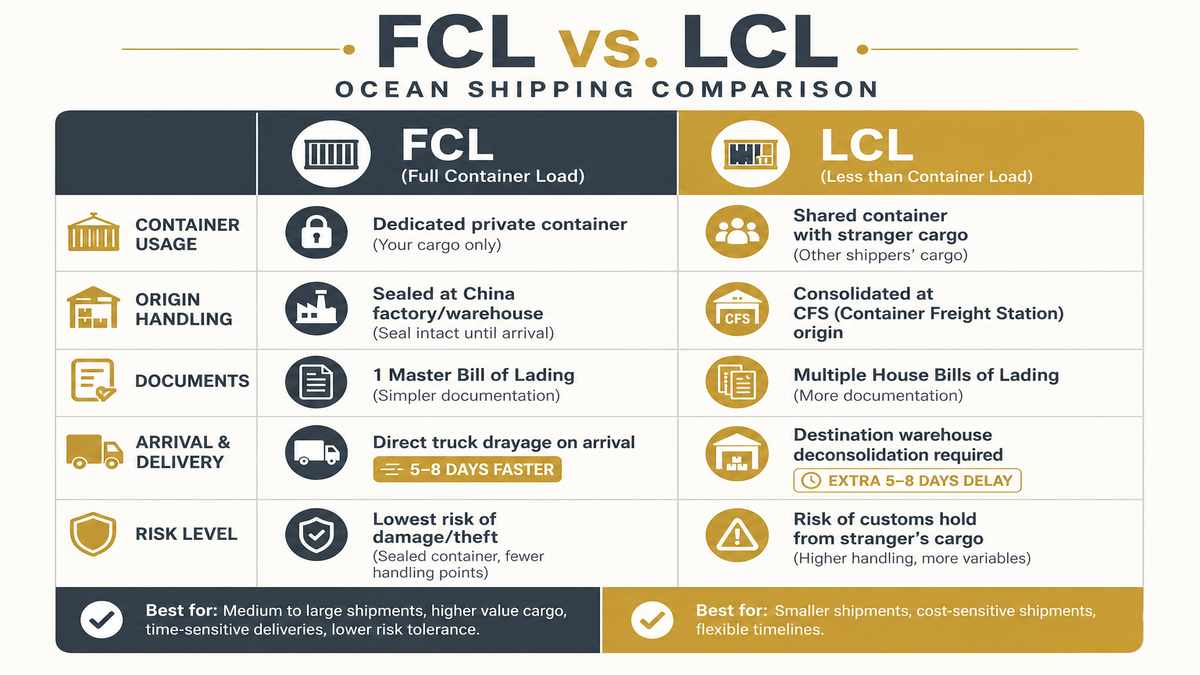
| Logistical Factor | FCL (Full Container Load) | LCL (Less than Container Load) |
|---|---|---|
| Cargo Space Ownership | 100% Exclusive (Dedicated container for your business) | Shared Public Space (Mixed with cargo from 10-30 other companies) |
| Loading & Sealing | Loaded and sealed with high-security bolt seal at factory/warehouse | Handled multiple times at origin and destination CFS warehouses |
| End-to-End Transit Speed | Fastest (Direct drayage pickup from marine terminal) | 5 to 8 Days Slower (Requires container trucking to CFS and unpacking) |
| Damage & Theft Risk | Extremely Low (Zero-touch transit from factory door to your dock) | Moderate to High (Forklift shifts, stacked under heavy stranger boxes) |
| Collateral Customs Hold Risk | Zero (Only your paperwork is reviewed) | High (If one stranger’s cargo in the shared box has contraband, all cargo is locked) |
| Pricing Model | Flat fee per container (e.g. \$2,100 per 20ft box) | Variable rate per CBM or Revenue Ton (\$80-\$160/CBM total landed) |
The 13-15 CBM Breakeven Point: When FCL Becomes Cheaper Than LCL
Many buyers ask: “Why would I book a 20ft container (which holds 28 CBM) if I only have 14 CBM of goods?”
The answer lies in the total landed fee structure. LCL shipping carries high fixed and variable destination fees charged on every single cubic meter. The chart below illustrates the cost crossover point between Ningbo/Shanghai and Los Angeles:
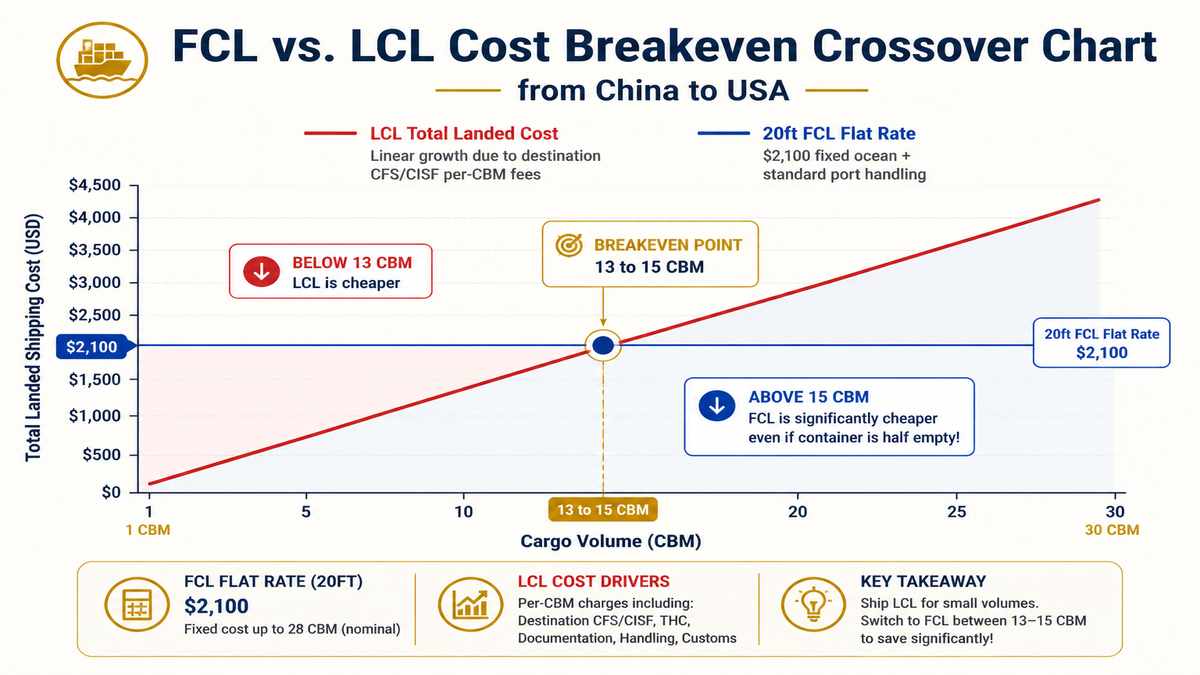
| Cargo Volume (CBM) | Estimated LCL Total Landed Cost | 20ft FCL Flat Rate Total Landed Cost | Recommended Cost-Optimal Choice |
|---|---|---|---|
| 2 CBM (Small Sample Batch) | \$480 | \$2,450 | LCL (Much Cheaper) |
| 6 CBM (2-3 Pallets) | \$980 | \$2,450 | LCL (Cheaper) |
| 10 CBM (4-5 Pallets) | \$1,650 | \$2,450 | LCL (Slightly Cheaper) |
| 14 CBM (The Breakeven Zone) | \$2,380 | \$2,450 | Switch to FCL (Faster, zero damage, 14 CBM extra free space!) |
| 18 CBM (8-9 Pallets) | \$3,100 | \$2,450 | FCL (Saves \$650 + 6 days faster) |
| 24 CBM (Full 20ft Load) | \$4,150 | \$2,450 | FCL (Saves \$1,700 / 41% Cheaper!) |
Even if a 20ft container is half empty at 14 CBM, switching to FCL gives you 14 CBM of “free” extra volume capacity to top off with fast-moving stock, while eliminating LCL deconsolidation fees and potential port demurrage and detention charges.
Container Dimensions & Real Usable Capacities: 20ft, 40ft & 40HC
When booking FCL ocean freight governed by the World Shipping Council (WSC) container standards, you must understand the difference between theoretical volume and real usable volume:
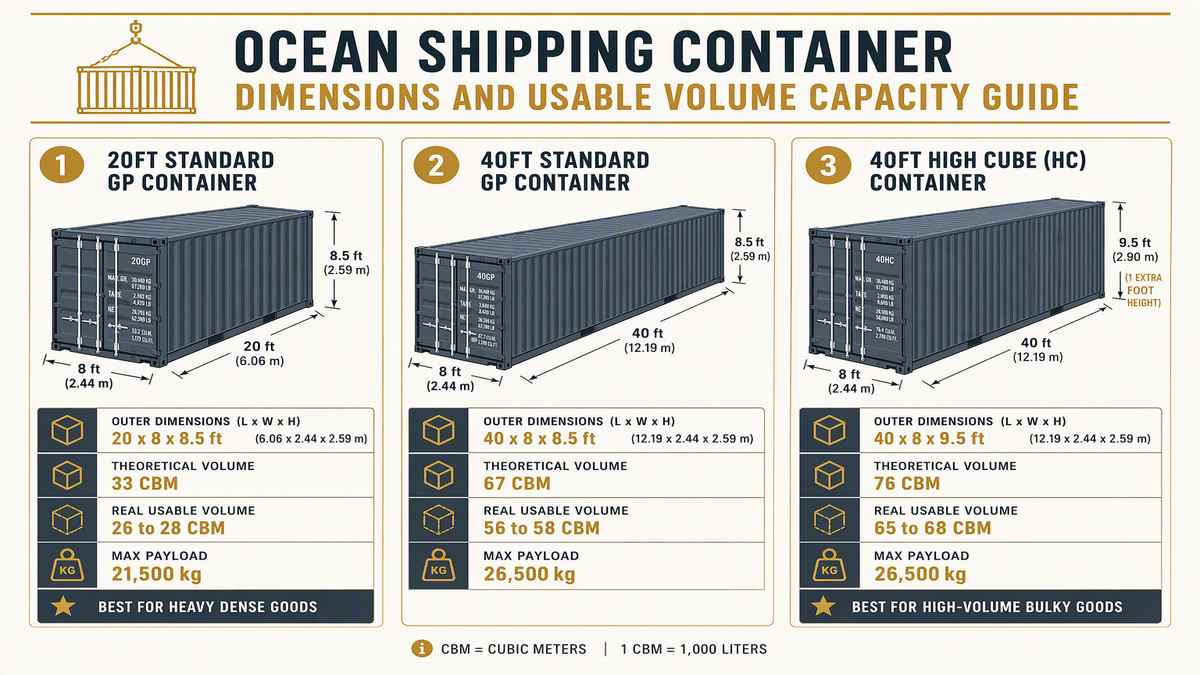
Theoretical Volume: 33.2 CBM | Real Usable Volume: 26 to 28 CBM.
Max Cargo Weight: ~21,500 kg (Subject to highway weight limits).
Best For: Heavy, dense goods like metal hardware, ceramic tiles, machinery, and liquids.
Theoretical Volume: 67.7 CBM | Real Usable Volume: 56 to 58 CBM.
Max Cargo Weight: ~26,500 kg.
Best For: Balanced general consumer goods, footwear, and consumer electronics.
Theoretical Volume: 76.3 CBM | Real Usable Volume: 65 to 68 CBM.
Max Cargo Weight: ~26,500 kg.
Best For: Bulky lightweight goods like furniture, plush toys, apparel, and plastic housewares.
To calculate exact box packing limits, review our mathematical guide on how to calculate volumetric weight and CBM.
5-Step Decision Framework: How to Choose FCL vs. LCL
Use this 5-step decision tree to select the right ocean shipping method for every buy order:
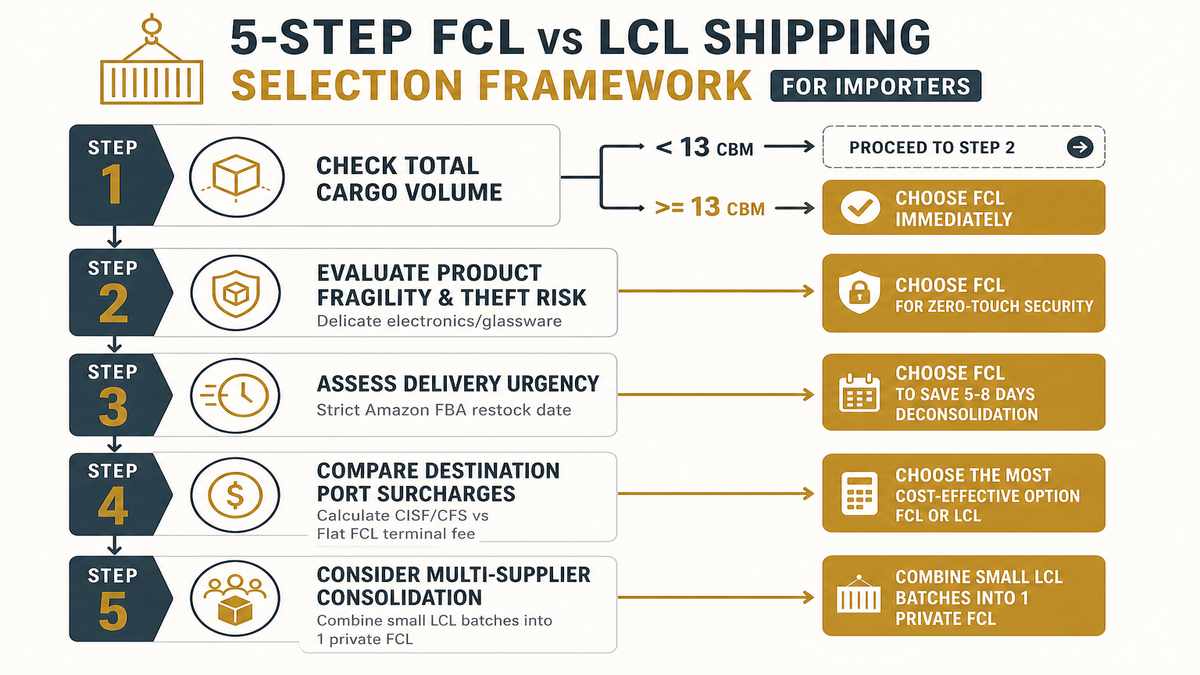
- Check Your Total Shipment CBM: If your order is under 12 CBM, proceed with LCL; if your shipment is 13 CBM or greater, book a 20ft FCL container immediately.
- Evaluate Product Fragility & Damage Sensitivity: If you ship delicate glass, ceramics, precision electronics, or high-value retail merchandise, choose FCL even at 10 CBM to avoid multi-touch handling at public CFS warehouses per safety standards in the IMO CTU Packing Code.
- Assess Delivery Deadlines & Amazon FBA Restock Schedules: FCL delivers 5 to 8 days faster than LCL because containers skip the deconsolidation queue. When tracking critical sea freight transit times to US and Europe, FCL guarantees reliable delivery windows.
- Audit Destination CFS & CISF Surcharges: Ask your freight forwarder for a binding destination port fee tariff before confirming CIF vs. FOB shipping terms. If destination LCL port fees exceed \$50/CBM, FCL is almost always cheaper.
- Consolidate Multi-Supplier Orders in China: If you buy 3 CBM from Supplier A, 5 CBM from Supplier B, and 6 CBM from Supplier C, combine them at a China warehouse cargo consolidation facility to build your own dedicated 20ft FCL container!
The Dark World of LCL Surcharges: Why “Zero Freight” is a Trap
If a Chinese supplier offers to ship your order via LCL with “Free Ocean Freight” or an unrealistically cheap rate like \$10/CBM under CIF terms, do not accept it!
Freight forwarders who offer negative or zero freight make their profit through aggressive kickbacks, dumping inflated destination surcharges onto the buyer at the arrival port:
- China Import Service Fee (CISF): A notorious surcharge billed exclusively on LCL imports from China, often charging \$60 to \$120 per CBM!
- Container Freight Station (CFS) Handling: Billed at \$40 to \$85 per CBM just to forklift your pallet out of the shared container.
- Destination Terminal Handling (DTHC): Billed separately from ocean freight, adding \$35 to \$60 per CBM.
- Documentation & Deconsolidation Release Fees: Mandatory administrative fees ranging from \$150 to \$300 per arrival notice.
FCL Advantage: With a dedicated FCL container, you pay a single flat ocean freight rate and a standardized terminal handling fee. There are zero CISF surcharges and zero CFS deconsolidation fees.
Highway Road Weight Limits: The 20ft Heavy Container Trap
While ocean shipping lines allow you to load up to 21,500 kg into a 20ft container and 26,500 kg into a 40ft container, inland highway road regulations are much stricter:
If you import dense heavy goods (such as metal fasteners, granite slabs, or ceramic tiles), your 20ft container will hit the legal road weight limit when it is only 60% full by volume.
Real Case Study: Overcoming a €1,850 CIF LCL Surcharge in Hamburg
In September 2025, a commercial kitchen equipment importer in Frankfurt ordered 11 CBM of stainless steel prep tables from a factory in Ningbo. The factory persuaded the buyer to ship via LCL under CIF terms with “super cheap \$15/CBM ocean freight.”
When the vessel docked at the Port of Hamburg, the destination handling agent issued an arrival fee invoice for €1,865.40 (€990 CISF + €480 CFS handling + €240 customs release fee + €155 fuel adjustment)!
On their next quarterly order (15 CBM), the buyer switched their contract to FOB Ningbo 20ft FCL:
- Total 20ft FCL ocean freight from Ningbo to Hamburg was \$1,450 fixed.
- Hamburg standard port terminal handling was €210 flat.
- Financial Outcome: Total landed shipping cost for 15 CBM of goods dropped from €2,350 down to €1,550, saving €800 in hard cash while gaining 36% more product volume and cutting 6 days of port transit time!
Real Case Study: Switching from LCL to FCL Saved \$14,800 Annually
A home accessories brand based in Seattle was importing monthly batches of woven storage baskets and ceramic planters from 3 different factories in Zhejiang (averaging 16 CBM per month).
For two years, they shipped goods via standard forwarder LCL under CIF terms, paying an average of \$2,850 per month in total landed freight (\$650 ocean freight + \$1,400 destination CFS port surcharges + \$800 customs and trucking fees).
Our sourcing and logistics team audited their annual supply chain:
- We stopped all separate LCL bookings and established a monthly 20ft FCL consolidation schedule at our Ningbo export warehouse.
- All 16 CBM of products were loaded into a dedicated 20ft container, with the extra 12 CBM used to ship seasonal fast-moving SKUs.
- New Monthly FCL Landed Cost: \$1,620 total (\$1,100 ocean freight + \$220 standard port fee + \$300 customs & drayage).
- Outcome: Monthly shipping costs dropped from \$2,850 down to \$1,620—saving \$1,230 per month (\$14,760 in annual hard-dollar savings!) while eliminating damaged ceramic shipments completely.
Frequently Asked Questions (FAQ)
What is the difference between FCL and LCL shipping?
FCL (Full Container Load) means an entire ocean container is rented exclusively by one buyer, sealed at the origin factory/warehouse, and delivered directly to the destination. LCL (Less than Container Load) means smaller shipments from multiple different buyers share space in the same container, requiring consolidation and deconsolidation at port container freight stations (CFS).
What is the CBM breakeven point between LCL and a 20ft FCL container?
The financial breakeven point typically occurs between 13 and 15 CBM. Once your cargo volume reaches 13 CBM, booking a dedicated 20ft FCL container (which holds up to 28 CBM) is cheaper in total landed costs because it eliminates expensive destination CFS, CISF, and deconsolidation handling fees charged on LCL per cubic meter.
How much faster is FCL compared to LCL?
FCL is typically 5 to 8 days faster than LCL. Upon vessel arrival at the destination port, FCL containers are picked up immediately by truckers, whereas LCL containers must be transported to a bonded warehouse, unpacked, sorted, and customs-cleared individually before release.
How many CBM can actually fit inside a 20ft vs 40ft container?
A standard 20ft GP container has a theoretical volume of 33 CBM and holds 26 to 28 CBM of real cargo. A 40ft GP container has a theoretical volume of 67 CBM and holds 56 to 58 CBM. A 40ft High Cube (HC) container holds 65 to 68 CBM of real cargo.
What is the biggest risk of shipping LCL from China?
The biggest risk in LCL shipping is collateral customs hold. If another company’s cargo in the shared container contains undeclared items, counterfeit goods, or paperwork errors, customs authorities will hold the entire container for inspection, delaying your cargo for 7 to 14 days.
Calculate your FCL breakeven & stop overpaying on LCL
Our bilingual logistics specialists in Ningbo, Shenzhen, and Yiwu audit your volume CBM, compare live FCL vs. LCL contract rates, and consolidate multi-factory orders to save you 30% to 45% on ocean shipping.
Get free FCL vs LCL audit & freight quote
Questions & Comments
We read every one and reply within 24 hoursUnsure whether your upcoming China order volume qualifies for a 20ft FCL container or if LCL is more economical? Share your total CBM, gross weight, departure port, and destination city below — our freight team will calculate your breakeven analysis.