
Chinese Supplier vs Foreign Supplier: The 2026 Sourcing & China Plus One Guide
 ·
Updated September 24, 2026
·
Updated September 24, 2026
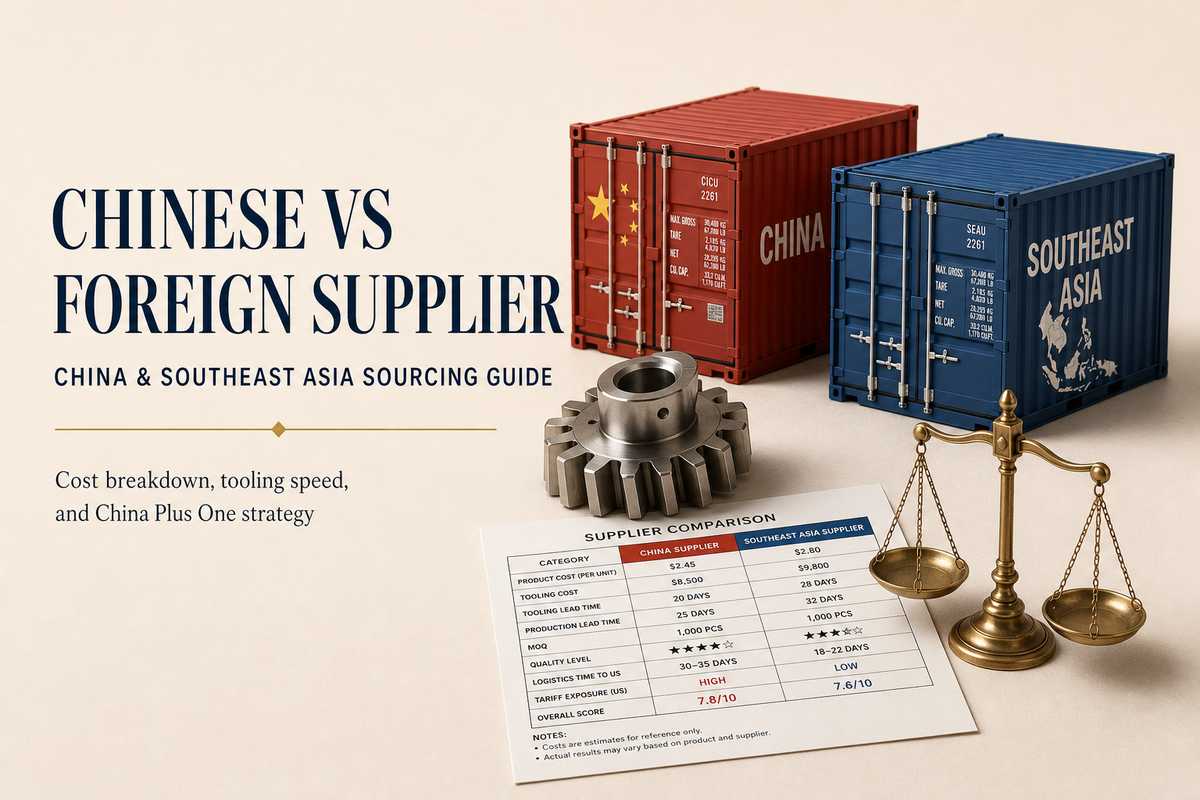
Direct Answer: Choosing between a Chinese supplier and a foreign supplier in Southeast Asia, India, or Mexico depends on your product complexity, order volume, and tariff sensitivity. For products requiring custom injection tooling, electronics, multi-part hardware, fast prototyping, or mature sub-tier supply chains, Chinese suppliers remain unmatched in speed, scale, and total landed cost. Conversely, for basic cut-and-sew garments, simple footwear, low-tech wood items, or companies executing a formal China Plus One risk diversification strategy to avoid specific import duties, regional hubs in Vietnam, Cambodia, and Mexico offer strong advantages.
For more than three decades, China served as the default factory of the world. However, shifting geopolitical trade rules, rising wages in coastal industrial zones, and the rise of manufacturing hubs across Southeast Asia (Vietnam, Thailand, Malaysia, Indonesia) and North America (Mexico nearshoring) have made global sourcing decisions more nuanced than ever.
Many overseas importers and brand owners ask whether they should move production out of China completely or stick with established Chinese partners. The answer is rarely all-or-nothing. Whether you are evaluating custom manufacturing and tooling facilities, sourcing from high-volume commodity hubs like Yiwu Market, or meeting direct suppliers at the Canton Fair, understanding the operational differences between Chinese and foreign factories will protect your margins and supply chain continuity.
In this comprehensive guide, we compare Chinese suppliers against emerging foreign alternatives across six critical operational dimensions: total landed cost, tooling speed, component supply chain depth, minimum order quantities (MOQ), quality control, and tariff rules.
Direct Comparison: China vs. Southeast Asia, India & Mexico at a Glance
To help you evaluate manufacturing regions objectively, here is a high-level operational breakdown across the major global sourcing destinations in 2026:
| Evaluation Factor | China (Mainland) | Vietnam & Southeast Asia | India | Mexico (Nearshoring) |
|---|---|---|---|---|
| Primary Strengths | Full-scale supply chain, fast tooling, advanced automation, high volume. | Lower labor costs, favorable tariff treaties, strong garment and footwear base. | Low labor costs, English fluency, large domestic market, textiles & metal casting. | Short shipping transit to US (2-4 days), USMCA zero-tariff benefits. |
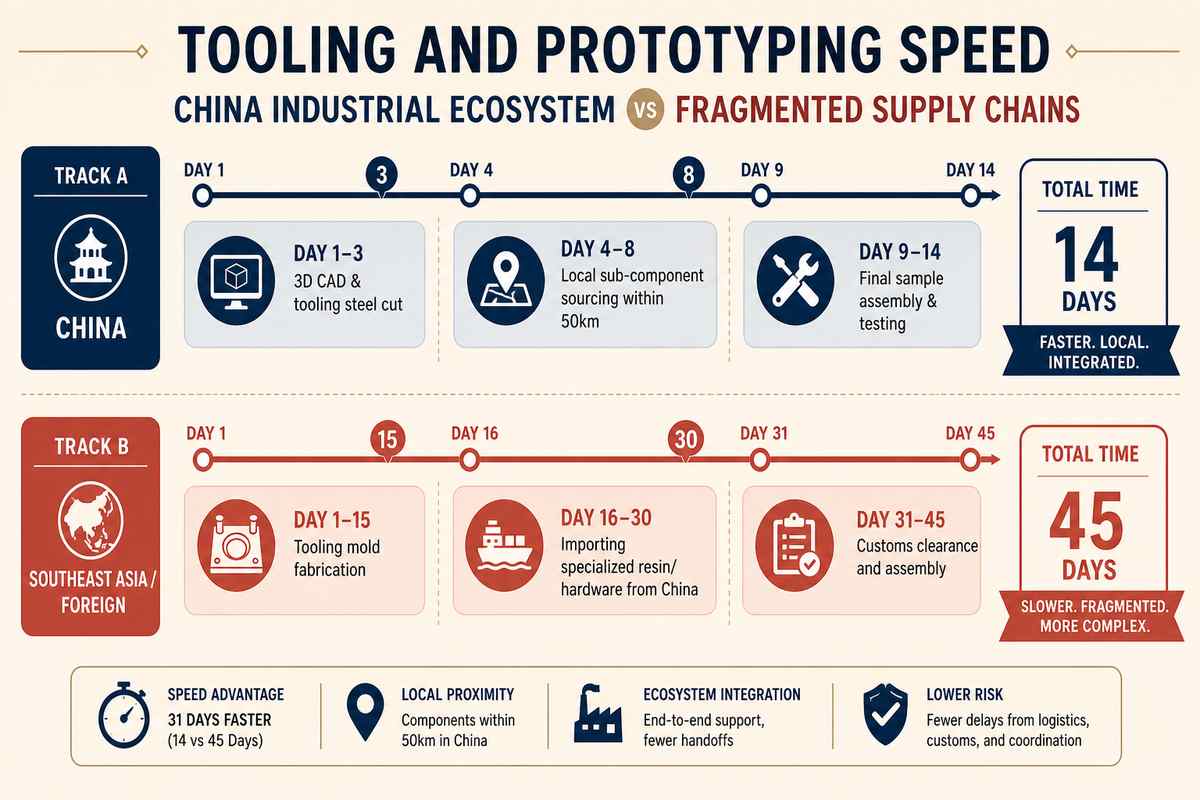
| Tooling & Prototyping | Very fast (7 to 14 days for steel molds and working functional samples). | Moderate (3 to 6 weeks; molds and parts often imported from China). | Moderate to slow (4 to 8 weeks depending on industrial category). | Moderate (2 to 5 weeks; higher upfront tooling prices). |
| Component Availability | 90%+ raw materials and sub-components sourced locally within 50km. | 30% to 50% local; heavily reliant on Chinese raw materials and fabrics. | 50% to 70% local; strong in base metals, cotton, and chemicals. | 40% to 60% local; imports specialty sub-assemblies from Asia/US. |
| Worker Productivity | Very high (mature skilled workforce, modern semi-automated machinery). | Moderate to high (growing quickly in textiles and consumer assembly). | Moderate (high variance between small workshops and large tier-1 plants). | High (skilled technical workforce in automotive, aerospace, and electronics). |
| Average Lead Time | 20 to 35 days for standard mass production orders. | 35 to 60 days (often delayed by raw material import schedules). | 40 to 65 days (impacted by internal transport and customs clearance). | 15 to 30 days (fast land freight into North American markets). |
| Port & Logistics Network | World-class deepwater ports (automated container terminals, zero congestion). | Improving, but key ports (Ho Chi Minh, Haiphong) face seasonal backlogs. | Port modernization underway, but customs paperwork can cause delays. | Excellent overland rail/truck border crossings into North America. |
1. Real Manufacturing Cost: Beyond Hourly Labor Rates
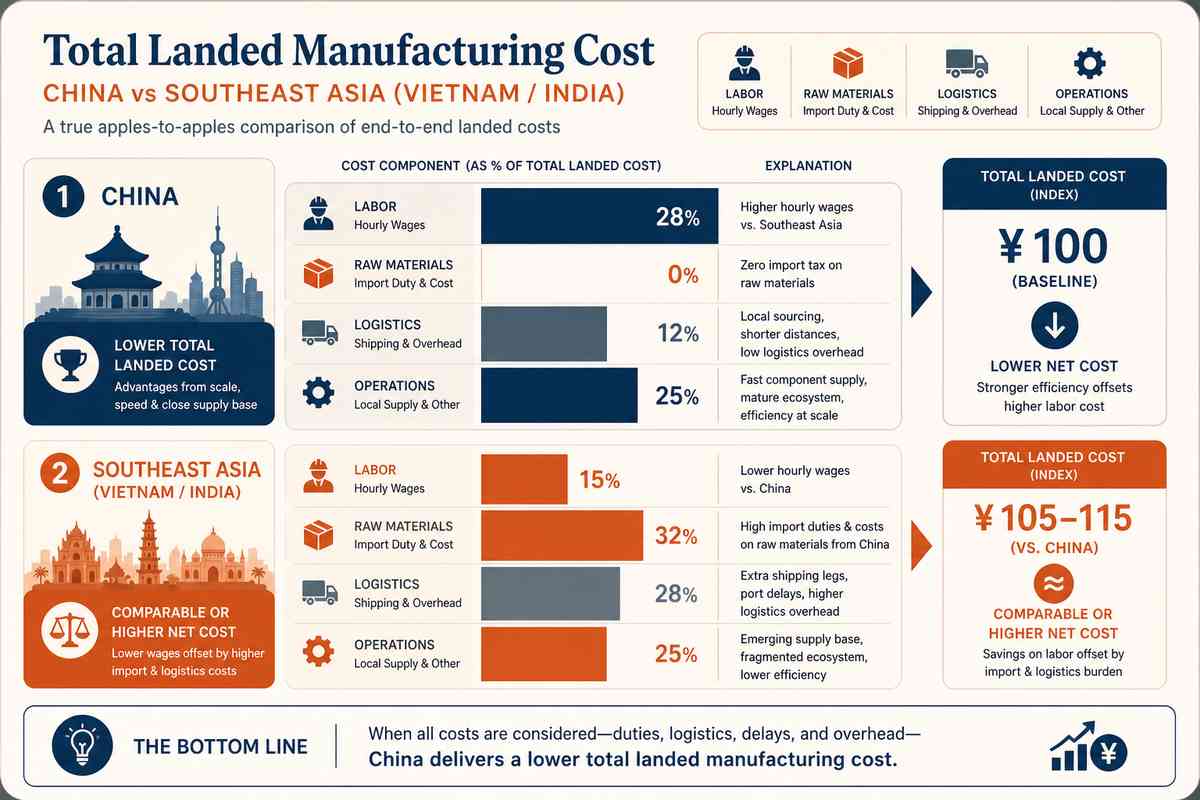
The single biggest mistake new importers make is comparing factories based purely on hourly worker wages. On paper, direct factory labor in Vietnam ($2.00 to $2.80 per hour) or India ($1.50 to $2.20 per hour) appears vastly cheaper than coastal Chinese factory labor ($4.50 to $6.50 per hour).
However, labor represents only 15% to 25% of the total cost for most manufactured consumer goods. The remaining 75% to 85% is made up of raw materials, specialized hardware, packaging, factory power, yield loss, and freight logistics.
When you account for the complete bill of materials (BOM), Chinese factories often deliver lower total unit costs due to four fundamental advantages:
- Raw Material Localization: In China, steel, engineered plastics, custom silicone, zippers, printed cartons, and surface plating are bought within the same county. Foreign suppliers must import these materials, paying international freight and import duties.
- Production Yield and Defect Rates: Mature Chinese tooling operators achieve 98% to 99% first-pass production yields. Factories with newer workforces in emerging hubs frequently experience 5% to 8% scrap rates on complex assemblies, increasing overall unit costs.
- Economies of Scale: Chinese suppliers buy base resins and metals in massive thousand-ton lots, securing volume discounts unavailable to smaller regional factories in Southeast Asia.
- Inland Transport Efficiency: Transporting a container from an inland industrial park to a major Chinese port takes less than 24 hours on modern toll highways. In developing alternatives, road bottlenecks and container shortages add hidden transport surcharges.
Real World Landed Cost Calculation
A plastic consumer electronic product costs $4.20 FOB Shenzhen. The same product quoted in northern Vietnam is $3.90 FOB Haiphong. However, because the Vietnamese factory must import the custom PCBA and polycarbonate resin from Guangdong, add import customs clearance fees, and pay higher ocean carrier surcharges, the final landed cost at a US warehouse is $5.15 from Vietnam versus $4.85 from China.
2. Tooling, Prototyping, and Industrial Ecosystem Speed
In modern e-commerce and retail, product launch speed is a vital competitive edge. If your competitor launches a trending product in 30 days while your supply chain takes 90 days, you lose market momentum.
This is where China’s dense industrial clusters offer a decisive advantage. In regions like Shenzhen, Dongguan, Ningbo, and Yongkang, entire supply chains operate within a 30-minute driving radius:
For brands launching original private-label designs (OEM) or developing complex new products from scratch, building your initial tooling and product prototypes in China remains the industry standard.
3. Minimum Order Quantities (MOQ) and Customization Flexibility
Minimum order quantities (MOQ) vary significantly between manufacturing countries based on factory size and local production setup:
High Scale vs. Agile Small Batches
While massive tier-1 Chinese factories demand 3,000 to 10,000 units, China’s vast network of specialized small-to-mid-size factories and buying agents can deliver custom private label goods with MOQs of 500 to 1,000 units by sharing component runs.
High MOQ for Big Retail Programs
Many export-oriented factories in Vietnam, Cambodia, and Bangladesh are large mega-plants set up by multinational brands (like Nike or Samsung). They often reject orders below 5,000 or 10,000 units because small runs disrupt their continuous lines.
Flexible for Handcrafted & Nearshore
Indian manufacturers are very open to smaller pilot runs (200 to 500 units) in home textiles, brassware, and leather goods. Mexican nearshore plants offer small batch assembly but charge higher unit labor premiums.
4. Quality Consistency and Advanced Manufacturing Capabilities
Old stereotypes about poor Chinese manufacturing quality no longer reflect reality. Today, China operates some of the world’s most sophisticated automated manufacturing lines, producing advanced smartphones, electric vehicles, medical devices, and precision optical equipment.
Comparing quality between Chinese and foreign suppliers comes down to process control maturity:
- Quality Management Systems: Most export-oriented Chinese factories maintain mature ISO 9001, IATF 16949, or BSCI certifications with documented incoming, in-process, and pre-shipment quality inspection protocols.
- Automation and Testing Equipment: Chinese factories invest heavily in automated optical inspection (AOI), robotic welding, automated screw-fastening, and drop/cycle test labs to ensure high consistency across 50,000-unit runs.
- Workforce Experience: In coastal China, factory floor managers and line technicians often have 10 to 20 years of specialized manufacturing experience, enabling them to troubleshoot tooling defects quickly. In newer industrial markets, high employee turnover can cause quality fluctuations during peak production seasons.
Independent Quality Audits Are Mandatory Everywhere
Whether you work with a supplier in China, Vietnam, India, or Mexico, never release final payments without conducting an independent pre-shipment quality inspection using standard AQL 2.5 defect thresholds. Quality issues occur in every country when buyers fail to provide clear technical specifications.
5. Tariffs, Trade Barriers, and Geopolitical Risk Management
The primary driver pushing international buyers to explore foreign suppliers is trade tariffs and geopolitical risk. Under U.S. Section 301 tariffs, many product categories imported from China face additional duties ranging from 7.5% to 25% on top of standard most-favored-nation (MFN) rates.
However, shifting production to escape tariffs requires following international trade rules closely:
According to U.S. Customs and Border Protection rules of origin guidelines, simply assembling completely knocked-down (CKD) Chinese parts in Vietnam or packaging goods in Mexico does not change the country of origin. The product must undergo a substantial transformation that results in a new name, character, or use.
Trade treaties like USMCA (for Mexico) or EVFTA (for Vietnam to the EU) require that a specific percentage (often 40% to 60%) of the product’s total production value be added locally within that treaty member country to qualify for duty-free entry.
Routing Chinese-made goods through a third country to falsely relabel them as “Made in Vietnam” or “Made in Malaysia” constitutes illegal transshipment. Customs authorities conduct deep factory audits, and violations lead to severe fines, cargo seizure, and retroactive duty clawbacks.
Before moving production purely for tariff reasons, check actual duty rates using the World Trade Organization tariff statistics and consult with a licensed customs broker to check whether your manufacturing plan meets legal origin criteria.
6. How to Build a Real “China Plus One” Supply Chain in 2026
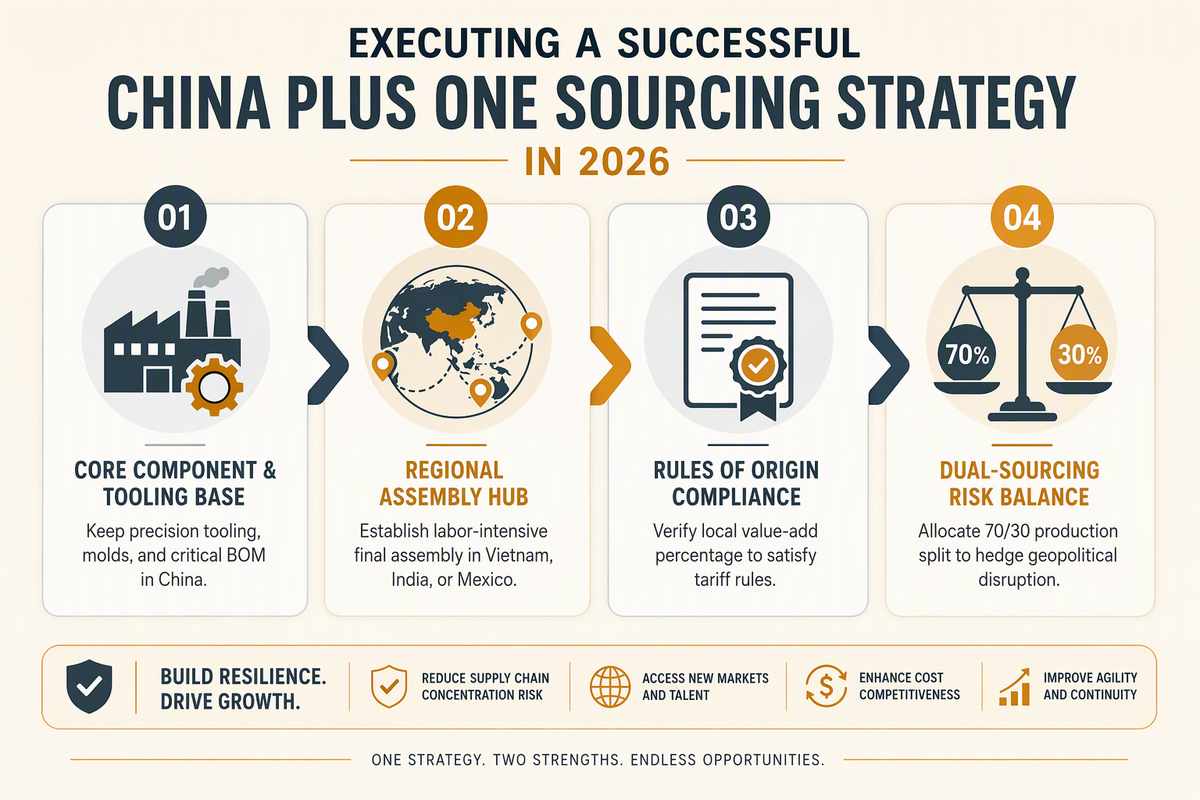
Rather than cutting ties with China entirely, leading global brands and smart importers put in place a balanced China Plus One strategy. This hybrid model leverages China’s unmatched tooling and component ecosystem while building regional assembly capacity to mitigate geopolitical risk.
Here is the proven 4-step framework to execute a China Plus One strategy successfully:
Step 1: Keep Core Tooling and High-Tech Components in China
Fabricate your high-precision injection molds, stamping dies, PCBAs, and specialized custom materials with experienced Chinese partners. China’s tooling masters and component suppliers offer the lowest failure rates and fastest engineering turnaround.
Step 2: Establish Labor-Intensive Assembly in a Secondary Country
Set up final assembly, manual sewing, packaging, and box-build operations in a secondary manufacturing hub (such as Vietnam for electronics, Cambodia for bags, or Mexico for North American distribution) where labor wage savings are highest.
Step 3: Audit Rules of Origin and Local Value Addition
Work with your supply chain partners to ensure that the assembly operations in your secondary hub meet legal substantial transformation standards and local value-added thresholds, securing genuine preferential tariff treatment.
Step 4: Maintain a 70/30 Dual-Sourcing Allocation
Allocate 70% of your baseline production volume to your primary Chinese supplier to maintain volume tier pricing, while running 30% through your secondary facility. If trade disputes or port disruptions occur in either region, you can quickly ramp up production volume at the alternate plant without re-engineering tools.
Decision Matrix: Which Manufacturing Country Fits Your Product?
Use this practical decision matrix to match your product category with the most effective manufacturing region:
| Product Category | Recommended Primary Source | Secondary / Alternate Source | Strategic Rationale |
|---|---|---|---|
| Consumer Electronics & PCBA | China (Shenzhen / Dongguan) | Vietnam or Malaysia | China holds complete component ecosystem; Southeast Asia serves as final assembly hub. |
| Custom Plastic Injection & Tooling | China (Ningbo / Zhejiang) | Mexico (for nearshore fast delivery) | Unmatched mold fabrication speed, steel availability, and low tooling costs in China. |
| Apparel & Cut-and-Sew Garments | Vietnam / Bangladesh / Cambodia | China (Shaoxing / Guangzhou) | Southeast Asia offers lower labor costs; China remains best for technical and synthetic fabrics. |
| Home Textiles & Bedding | China (Nantong / Yiwu) | India or Pakistan | China leads in fleece, microfibers, and printed fabrics; India excels in organic cotton and handlooms. |
| Heavy Metal Hardware & Castings | China (Hebei / Jiangsu) | India (Rajkot / Coimbatore) | China leads in precision CNC and automated stamping; India provides competitive sand casting. |
Frequently Asked Questions: Chinese vs Foreign Suppliers
Is manufacturing in Vietnam cheaper than in China in 2026?
Direct factory worker wages in Vietnam are roughly 40% lower than in coastal China. However, because Vietnamese factories must import many specialized raw materials, packaging, and tooling parts from China, the total landed cost for complex goods is often equal to or higher than direct Chinese production.
What is the China Plus One sourcing strategy?
China Plus One is a supply chain risk management approach where a business maintains primary volume production, tooling, and component manufacturing in China while setting up a secondary factory in another country (such as Vietnam, India, or Mexico) to diversify geopolitical and tariff risks.
Which products are best sourced outside of China?
Basic cut-and-sew apparel, low-tech footwear, simple wooden furniture, and handicraft home decor are often well-suited for Southeast Asian factories in Vietnam, Cambodia, and Indonesia due to favorable labor rates and tariff exemptions.
Why is prototyping and tooling faster in China than in foreign countries?
China features tight industrial clusters where raw materials, CNC machining, injection molds, surface treatments, and electronic parts are located within a 50-kilometer radius. In contrast, factories in other developing markets must import specialty tooling steel and components, adding 2 to 4 weeks to prototype lead times.
How do Rules of Origin affect shifting manufacturing from China to Vietnam?
Under international trade regulations, simple assembly or packaging in a third country does not change a product’s country of origin. To qualify for tariff exemptions, goods must undergo a substantial transformation and meet specific local value-added percentage thresholds defined by customs authorities.
Final Verdict: Choosing the Right Manufacturing Partner
The decision between a Chinese supplier and a foreign supplier is not about finding one perfect country—it is about aligning your product complexity, budget, and risk profile with the right manufacturing ecosystem. For most businesses, China remains the indispensable engine for rapid tooling, complex parts, and high-volume production, while foreign suppliers provide valuable redundancy and tariff relief.
If you need expert guidance evaluating factory capabilities, auditing supplier legitimacy, or setting up a resilient sourcing strategy across China and Southeast Asia, our team at Sourcing Pioneer can help you build a secure, cost-effective supply chain through our multi-country supplier evaluation and risk management.
Questions & Comments
We read every one and reply within 24 hoursAre you deciding between keeping production in China or diversifying into Vietnam, India, or Mexico? Share your product category and volume below for tailored sourcing advice.