
Paying Chinese Suppliers: Which Method Fits, and How to Split It
There is no safest way to pay a Chinese supplier. There is only a payment method that fits the size of the order, how well you know the factory, and how much you can afford to lose if it goes wrong. Most buyers get this backwards: they look for the one method that protects them always, and end up using an expensive tool for a $200 sample or a wide-open one for a $40,000 container.
This page covers every method actually in use between foreign buyers and Chinese suppliers, what each one protects against, and where each one leaves you exposed. Then it covers the part that matters more than the method itself: how the payment is split across the order.
The two fears in every deal
Every payment arrangement is an answer to two questions that pull in opposite directions.
You are afraid of paying and getting nothing, or getting rubbish. The supplier is afraid of making your goods and not getting paid. Both fears are reasonable. A factory that starts a 5,000-unit run on your word alone is risking real money on raw materials and labour.
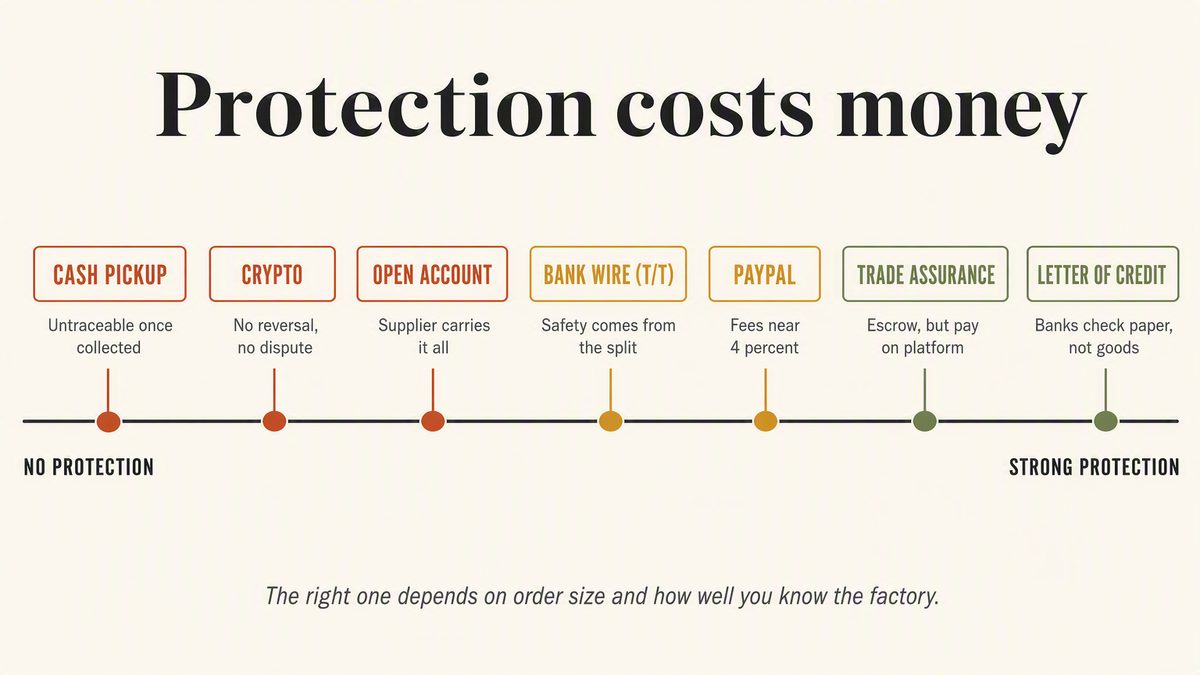
Every method below sits somewhere on the line between those two fears. The ones that protect you most cost more, take longer, or get refused by suppliers. The ones suppliers love leave you carrying everything.
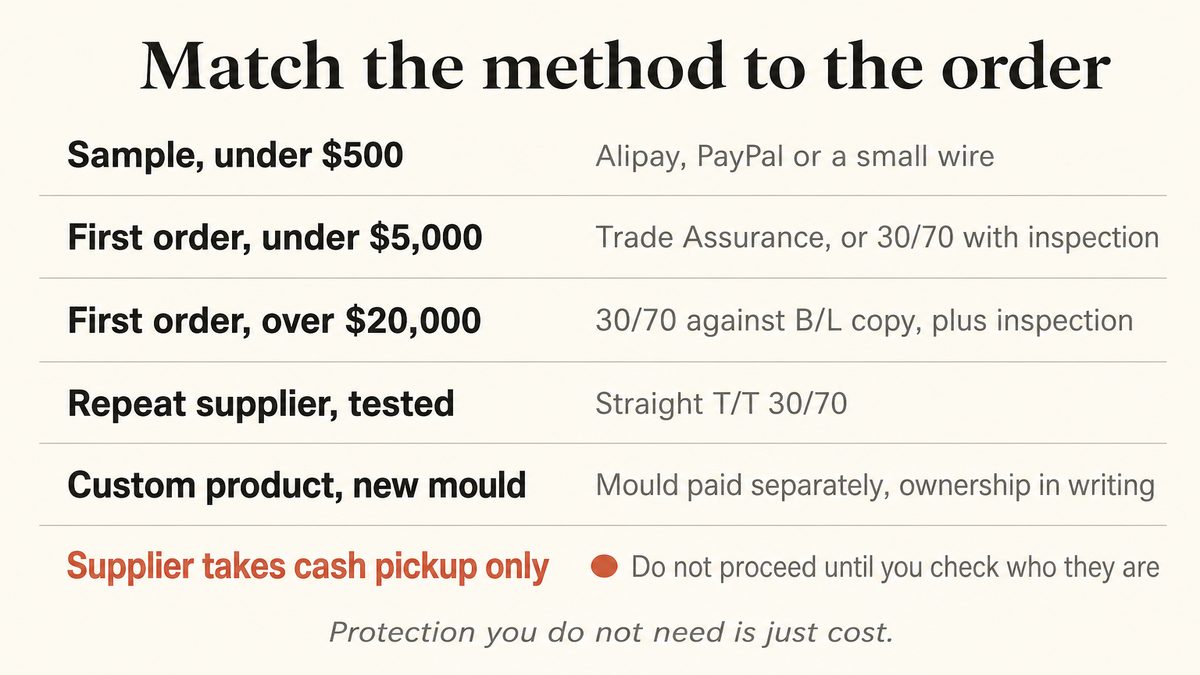
Match the protection to what you can afford to lose, not to how nervous you feel. Escrow on a $300 sample wastes fees. A bare wire on a first $30,000 order is not brave, it is uninsured.
Bank transfer (T/T)
The telegraphic transfer, or T/T, is a straight bank-to-bank wire and it remains the backbone of this trade. Almost every established supplier expects it, it scales to any amount, and the cost is a flat bank fee rather than a percentage.
What it protects. Nothing, by itself. A wire is a payment, not a mechanism. Its protection comes entirely from how you split it, which is covered further down.
Where it exposes you. Once sent, it is effectively gone. Recall is possible in theory and rare in practice. There is no dispute button, no chargeback, no platform to appeal to.
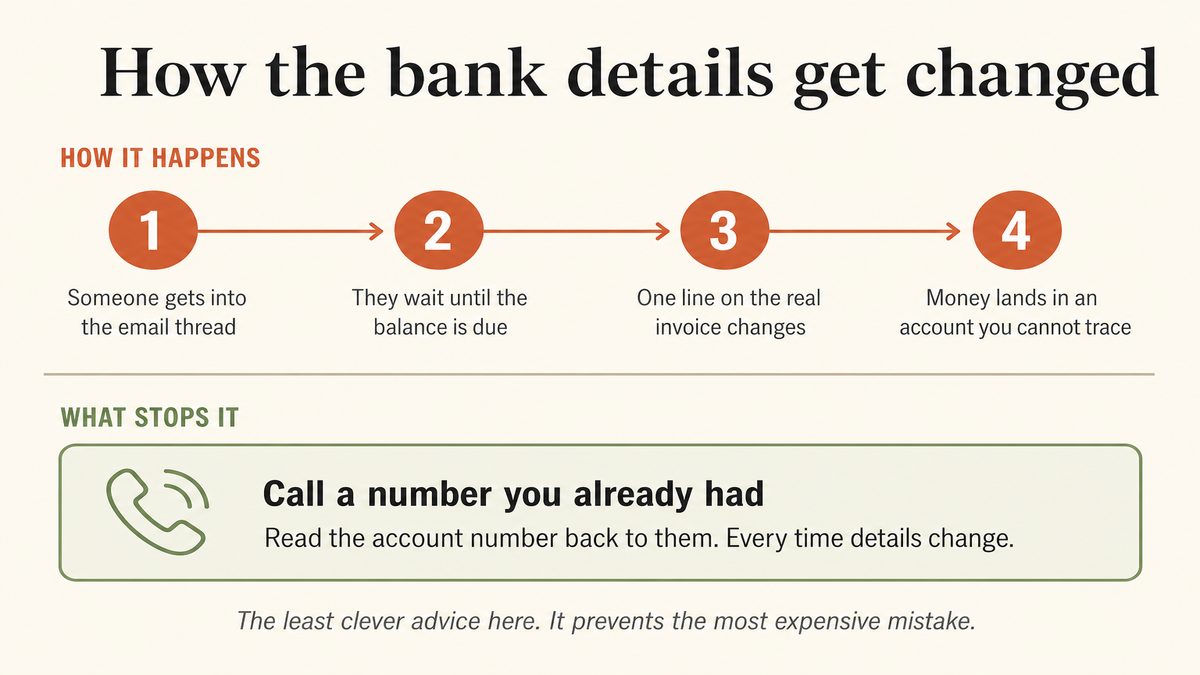
The specific risk everyone underestimates. Payment redirection fraud. Someone gets into the email thread — often the supplier’s own mailbox, not yours — and sends you updated bank details shortly before the balance is due. The invoice looks right because it is the real invoice with one line changed. The money lands in an account you cannot trace.
The defence is simple and almost nobody does it: call the supplier on a number you already had, and read the account number back to them. Not the number in the email signature. A number from an earlier document, or the one you have called before. Do this every time the details change, and do it before every first payment.
Alibaba Trade Assurance
Trade Assurance is escrow with an order record attached. You pay Alibaba, the money sits there, and it is released once you confirm receipt. If something goes wrong you open a dispute and the platform adjudicates.
What it protects. Non-delivery, and a clear-cut difference from what the order specified. If the order says 5,000 blue units and 3,000 red ones arrive, you have a strong case.
Where it exposes you. Anything requiring judgement. “The stitching is poor” is not a claim the platform can easily settle. Protection is also capped at the order value recorded on the platform, which matters if you agreed extras over chat.
The same escrow structure sits behind platform payments generally, and the gap between paying inside a platform and sending to a supplier’s wallet directly is covered in the guide to paying through escrow.
The mistake that voids it. Paying outside the platform. A supplier who asks you to place the order on Alibaba and then wire the money directly to their bank account — because it is faster, or the platform fee is high — has just removed the entire protection. The order record exists; the money never entered the system. Some suppliers do this innocently. It does not matter. The cover is gone either way.
Trade Assurance is at its best on first orders with a supplier you have not tested. Once you have run three clean orders, its cost usually outweighs the protection it still provides.
Letter of credit
A letter of credit moves the promise from you to your bank. Your bank tells the supplier’s bank that payment will be made once a specific set of documents is presented — typically the bill of lading, invoice and packing list.
What it protects. Both sides, thoroughly, on large orders. The supplier knows a bank stands behind the payment. You know nothing is released until documents proving shipment exist.
Where it exposes you. It is a documentary instrument, not a quality one. Banks check paperwork, not goods. If the documents are in order, payment goes through even if the cartons are full of the wrong product. It is also expensive and slow to arrange, and small suppliers often cannot handle the paperwork.
Realistic cut-off. Below roughly $50,000 the cost and delay usually outweigh the benefit. Above it, on a first order with a supplier you cannot visit, it starts to make sense.
Alipay, WeChat Pay and PayPal
These three get grouped together because buyers use them for the same job: small, fast payments.
Alipay is normal in China and many suppliers accept it. It is quick and fine for samples. On larger amounts, fees and the exchange rate work against you, and cross-border consumer payment rails are not designed for trade volumes.
WeChat Pay is the same story with tighter limits. It is convenient because the supplier is already chatting with you there, which is exactly why people use it for deposits they should be sending another way.
PayPal carries buyer protection, which sounds ideal until you read the exclusions. Fees run around 4% and suppliers usually add that to your price. Many will ask you to send as “friends and family” to avoid the fee — that removes buyer protection completely. If someone asks for this, you are being asked to pay a business as though it were a personal gift, with no recourse.
All three are reasonable for samples and small first orders. None is a serious channel for production quantities.
Western Union, MoneyGram and crypto
These solve one problem: getting money to someone who cannot easily receive it another way.
Western Union and MoneyGram are cash-pickup services. They are fast and they reach places banks do not. They also offer essentially no buyer protection, and once collected the money is untraceable. That combination is exactly why they appear so often in scam reports.
If a supplier’s only accepted method is cash pickup, treat that as information about the supplier. An established factory has a company bank account. One that cannot receive a normal wire is telling you something about its registration status.
There are still situations where cash pickup is the sensible choice, and a clear line between those and the ones that will cost you money — set out in the guide to cash transfers and suppliers.
USDT and other stablecoins settle in minutes with low fees, which is genuinely useful where banking is slow. The risks are different rather than smaller: send to a wrong address and there is no reversal, no intermediary, no dispute. If you use it, send a small test transaction first and confirm receipt before the rest. Also check your own country’s rules on paying business invoices in crypto, because your accountant will ask.
Open account
Open account means the supplier ships first and you pay later — 30, 60 or 90 days after shipment. All the risk sits with the supplier.
You will not get this on a first order and you should not expect it. It arrives after years of clean history, and it arrives because the supplier wants to keep you. If a new supplier offers open account terms unprompted on a large order, be curious rather than pleased. Either they are desperate for the order, or the arrangement is not what you think it is.
The split matters more than the method
This is the part most guides skip, and it is where your actual protection comes from.
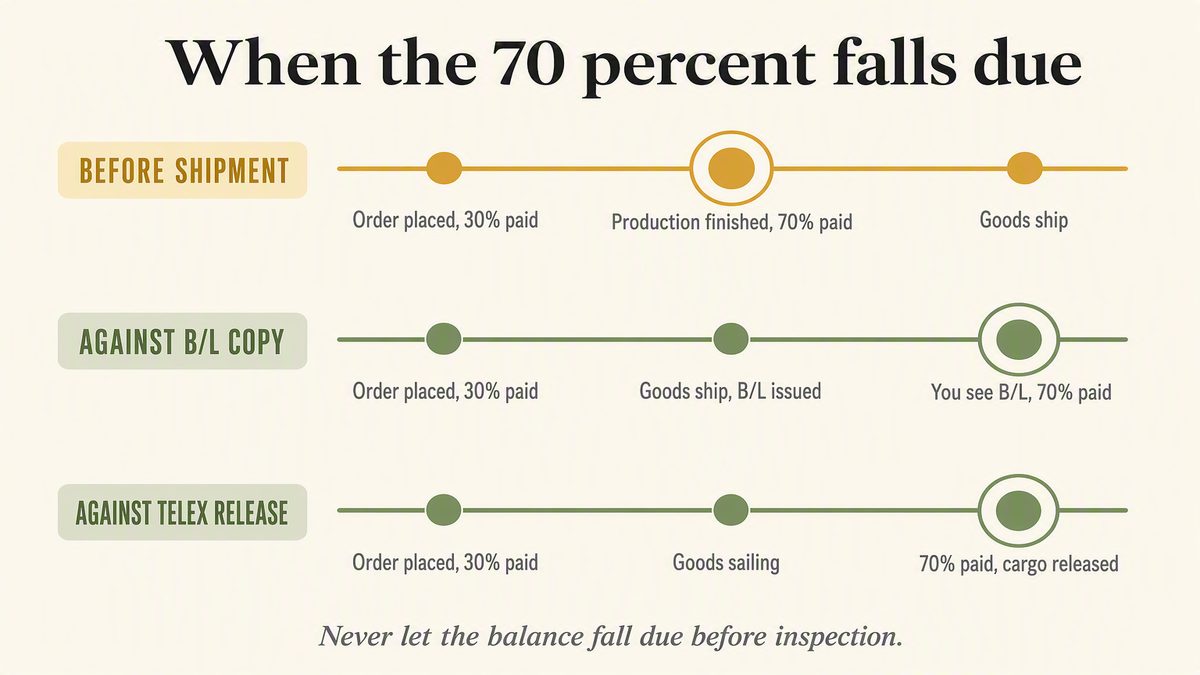
The standard arrangement is 30% deposit, 70% before shipment. It is standard because it balances both fears: the factory has working capital to start, and you still hold most of the money while your goods are being made.
But that final 70% has several possible trigger points, and they are not equally safe.
The difference between these three is worth more than the difference between any two payment methods on this page. Which one you can negotiate depends on order size and history, and the mechanics of each are covered in the guide to deposit terms and bill of lading release.
One rule applies whichever you use: never let the final payment fall due before inspection. If you pay the balance and then inspect, you are not inspecting, you are just finding out.
Why 30% is the number
The deposit exists to cover the supplier’s raw material outlay so they are not funding your order alone. That is its whole job.
When a supplier asks for 50% or more, ask why. Sometimes the answer is legitimate — expensive raw materials, a custom mould, or a genuinely small order that is barely worth running. Sometimes it means their cash flow is poor, which is worth knowing before you commit.
When a supplier asks for 100% upfront, the answer is no. There is no version of this trade where a foreign buyer needs to fund an entire order in advance to a factory they have not tested. If that is genuinely the only term available, the order is too risky at any price.
A tooling or mould charge is a separate matter and is normally paid in full upfront. That is fine, provided the contract states who owns the mould afterwards. Get that in writing before you pay, because retrieving a mould from an unwilling factory is close to impossible.
Matching method to situation
Checks worth doing before the first payment
The safest payment method cannot protect you from paying the wrong company. Two checks, both free, prevent more losses than any payment mechanism.
Several of the requests that arrive around payment time follow a recognisable script — the frozen account, the better price for paying outside the platform, the balance needed before shipping. What each one usually means is covered in the guide to what suppliers say and what it actually means.
Confirm the bank account name matches the company name. If the invoice says Ningbo XYZ Trading Co. Ltd and the account is in a person’s name, or in a Hong Kong company you have never heard of, stop and ask. There are legitimate explanations — some factories bill through an export agent — but you want that explained before you send money, not after.
Check the company actually exists and has for a while. Chinese company records are public and show founding date, registered capital, business scope and legal representative. A supplier claiming ten years of experience through a company registered eighteen months ago needs to explain the gap. How to run that check is covered in the guide to supplier background research.
Both take about ten minutes. Neither costs anything. Together they filter out most of what actually goes wrong.
Keeping the paperwork straight
Boring, and it saves people repeatedly.
Keep the order sheet, the invoice, the payment confirmation and the shipping documents together, filed under the same order number. Make sure the company name is identical across all of them — not similar, identical. Mismatched names between invoice and bill of lading cause customs delays, and mismatched names between invoice and bank account cause disputes nobody can settle.
Save the SWIFT confirmation for every wire. If you ever need to trace a payment, that reference is what the banks work from, and asking for it six months later is much harder than saving it on the day.
Common questions
What is the safest way to pay a Chinese supplier?
There is no single safest method, only one that fits the order. For a first order under a few thousand dollars, escrow through Trade Assurance gives you a dispute path. For larger first orders, a 30/70 split with the balance paid against a copy of the bill of lading, after inspection, protects you better than any payment tool alone. For a tested supplier, a plain bank wire is normal and sensible.
Is Alibaba Trade Assurance actually reliable?
For what it covers, yes. It handles non-delivery and clear deviations from the order well. It handles quality arguments poorly, because “not good enough” is hard for a platform to adjudicate. The critical rule is that the money must go through Alibaba. If you place the order on the platform but wire the supplier directly, the protection does not exist, whatever the order page shows.
Should I pay a 50% deposit if the supplier insists?
Ask why first. Expensive raw materials, a custom mould or a very small run are legitimate reasons. Poor cash flow is a reason too, and one you would want to know about. What you should not agree to is 100% upfront to a factory you have never tested, regardless of the discount offered.
What is a telegraphic transfer and how is it different from a bank transfer?
They are the same thing. T/T is simply the trade term for an international bank wire, and you will see it on Chinese proforma invoices constantly. It is not a special product and there is nothing to arrange beyond a normal international transfer from your bank.
My supplier sent new bank details by email. Is that normal?
It happens legitimately, and it is also the single most common fraud in this trade. Someone accesses the email thread and changes one line on a real invoice. Always confirm by voice on a number you already had, not one from the new email, and read the account number back. Do this every time details change, without exception.
Can I pay a Chinese supplier in USDT?
Some accept it, and it settles fast with low fees where banking is slow. The trade-offs are different rather than smaller: a wrong address cannot be reversed and there is no dispute process. Send a small test amount first, keep the transaction IDs, and check your own country’s rules on settling business invoices in crypto before making it routine.
The short version
Pick the method by order size and how well you know the supplier, then spend your attention on the split rather than the tool. Deposit to start production, balance triggered by something that proves the goods exist and are right.
And confirm bank details by voice. It is the least sophisticated advice on this page and it prevents the most expensive mistake.
Questions & Comments
We read every one and reply within 24 hoursUnsure about payment terms you have been offered, or about a supplier asking for something unusual? Describe it below — order value, method and the split. You will get an honest read, including when the terms are perfectly normal.